


The Gut Microbiome in Psoriasis and Crohn's Disease: Is Its Perturbation a Common Denominator for Their Pathogenesis?
- PMID: 35214702
- PMCID: PMC8877283
- DOI: 10.3390/vaccines10020244
The Gut Microbiome in Psoriasis and Crohn's Disease: Is Its Perturbation a Common Denominator for Their Pathogenesis?
Abstract
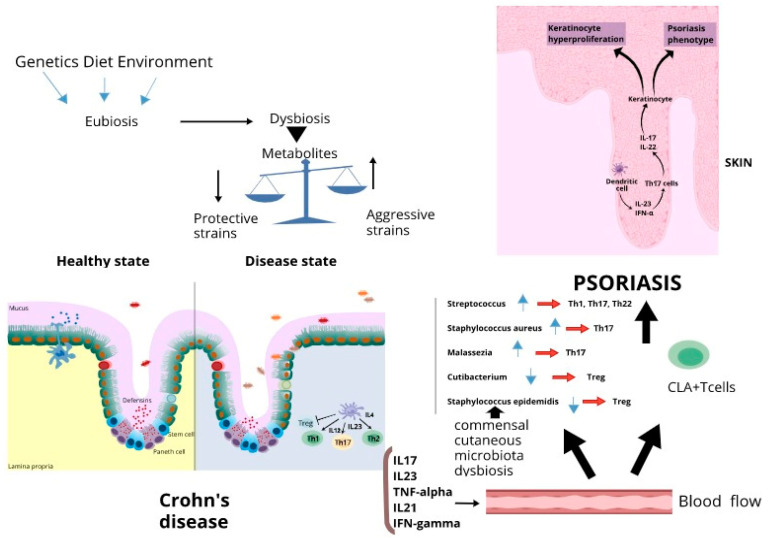
Psoriasis and inflammatory bowel disease (IBD), including ulcerative colitis (UC) and Crohn's disease (CD), are interlinked. In fact, the prevalence of IBD is higher in patients with psoriasis, with a risk of ulcerative colitis of 1.6-times higher than in the general population. Analogously, patients with psoriasis have a greater risk of developing IBD. Furthermore, they share some clinical features and pathogenic mechanisms. Both are chronic inflammatory diseases with a relapsing-remitting condition that persists for the patient's whole life and exhibit increased permeability of the mucosal barrier of skin and gut, allowing an increased interaction of pathogens with inflammatory receptors of the immune cells. A key element in the pathogenesis of these diseases is represented by the microbiota; in particular, the gut microbiota is an important driver of CD pathogenesis, while in psoriasis changes in gut and skin microbiota have been described without a defined pathogenic function. Furthermore, genetic predispositions or environmental factors contribute to disease manifestation, with a central role attributed to the immune responses and, in particular, to a dysregulated role played by T helper 17 cells both in psoriasis and IBD. The purpose of this review was to summarize present information about the links between psoriasis, inflammatory bowel disease, in particular Crohn's disease, and changes in gut and/or skin microbiome.
Keywords: gut; inflammation; microbiota; skin.
Conflict of interest statement
The authors declare no conflict of interest.
Figures
References
-
- Stolwijk C., Essers I., van Tubergen A., Boonen A., Bazelier M.T., De Bruin M.L., de Vries F. The epidemiology of extra-articular manifestations in ankylosing spondylitis: A population-based matched cohort study. Ann. Rheum. Dis. 2015;74:1373–1378. doi: 10.1136/annrheumdis-2014-205253. - DOI - PubMed
-
- Lee F.I., Bellary S.V., Francis C. Increased occurrence of psoriasis in patients with Crohn’s disease and their relatives. Am. J. Gastroenterol. 1990;85:962–963. - PubMed
Publication types
LinkOut - more resources
Full Text Sources
