


A Convenient Route to New (Radio)Fluorinated and (Radio)Iodinated Cyclic Tyrosine Analogs
- PMID: 35215275
- PMCID: PMC8877694
- DOI: 10.3390/ph15020162
A Convenient Route to New (Radio)Fluorinated and (Radio)Iodinated Cyclic Tyrosine Analogs
Abstract
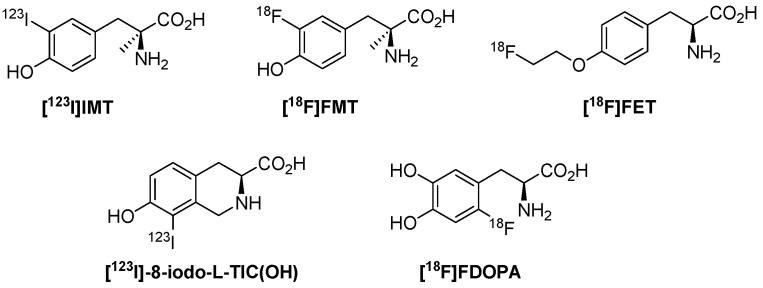
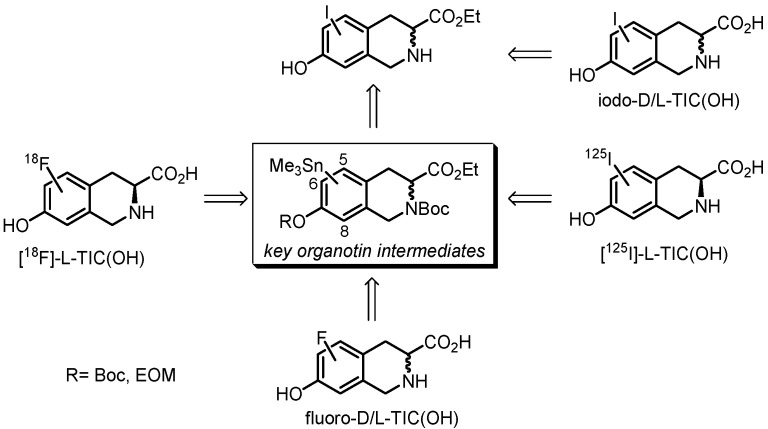
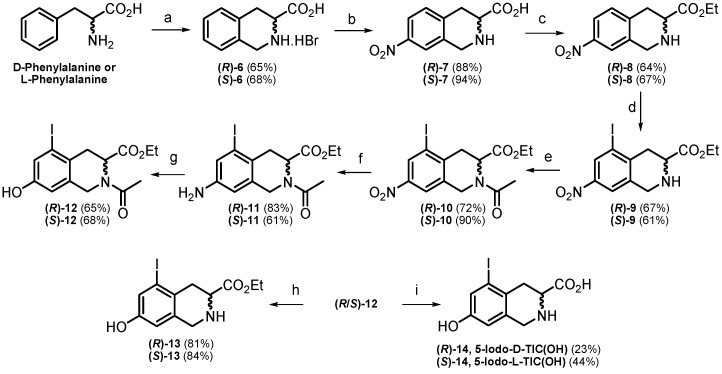
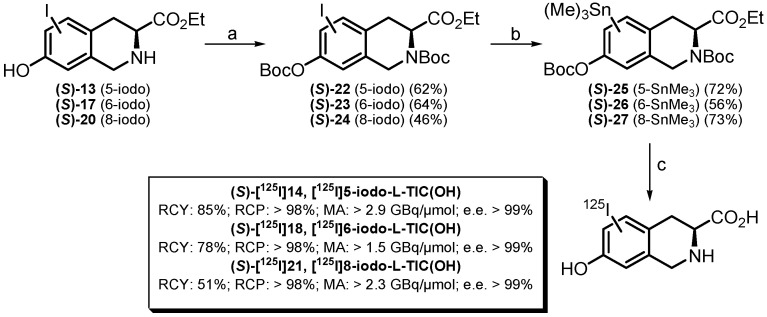
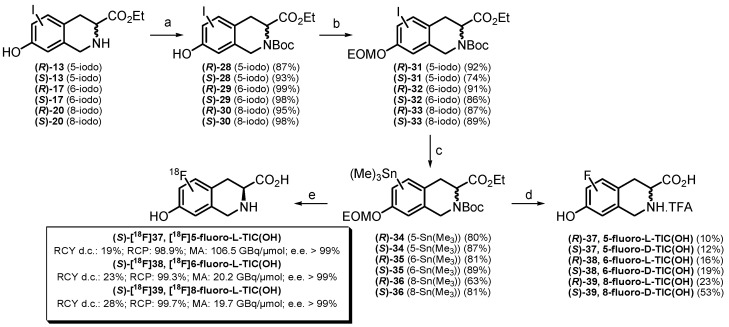
The use of radiolabeled non-natural amino acids can provide high contrast SPECT/PET metabolic imaging of solid tumors. Among them, radiohalogenated tyrosine analogs (i.e., [123I]IMT, [18F]FET, [18F]FDOPA, [123I]8-iodo-L-TIC(OH), etc.) are of particular interest. While radioiodinated derivatives, such as [123I]IMT, are easily available via electrophilic aromatic substitutions, the production of radiofluorinated aryl tyrosine analogs was a long-standing challenge for radiochemists before the development of innovative radiofluorination processes using arylboronate, arylstannane or iodoniums salts as precursors. Surprisingly, despite these methodological advances, no radiofluorinated analogs have been reported for [123I]8-iodo-L-TIC(OH), a very promising radiotracer for SPECT imaging of prostatic tumors. This work describes a convenient synthetic pathway to obtain new radioiodinated and radiofluorinated derivatives of TIC(OH), as well as their non-radiolabeled counterparts. Using organotin compounds as key intermediates, [125I]5-iodo-L-TIC(OH), [125I]6-iodo-L-TIC(OH) and [125I]8-iodo-L-TIC(OH) were efficiently prepared with good radiochemical yield (RCY, 51-78%), high radiochemical purity (RCP, >98%), molar activity (Am, >1.5-2.9 GBq/µmol) and enantiomeric excess (e.e. >99%). The corresponding [18F]fluoro-L-TIC(OH) derivatives were also successfully obtained by radiofluorination of the organotin precursors in the presence of tetrakis(pyridine)copper(II) triflate and nucleophilic [18F]F- with 19-28% RCY d.c., high RCP (>98.9%), Am (20-107 GBq/µmol) and e.e. (>99%).
Keywords: PET/SPECT imaging; TIC(OH); radiofluorination; radioiodination; tyrosine analogs.
Conflict of interest statement
The authors declare no conflict of interest. The funders had no role in the design of the study; in the collection, analyses, or interpretation of data; in the writing of the manuscript, or in the decision to publish the results.
Figures
References
-
- Bannai S., Christensen H.N., Vadgama J.V., Ellory J.C., Englesberg E., Guidotti G.G., Gazzola G.C., Kilberg M.S., Lajtha A., Sacktor B. Amino Acid Transport Systems. Nature. 1984;311:308. - PubMed
-
- Christensen H.N. Distinguishing Amino Acid Transport Systems of a given Cell or Tissue. Meth. Enzymol. 1989;173:576–616. - PubMed
LinkOut - more resources
Full Text Sources
