


Effect of Morning and Evening Exercise on Energy Balance: A Pilot Study
- PMID: 35215466
- PMCID: PMC8877501
- DOI: 10.3390/nu14040816
Effect of Morning and Evening Exercise on Energy Balance: A Pilot Study
Abstract
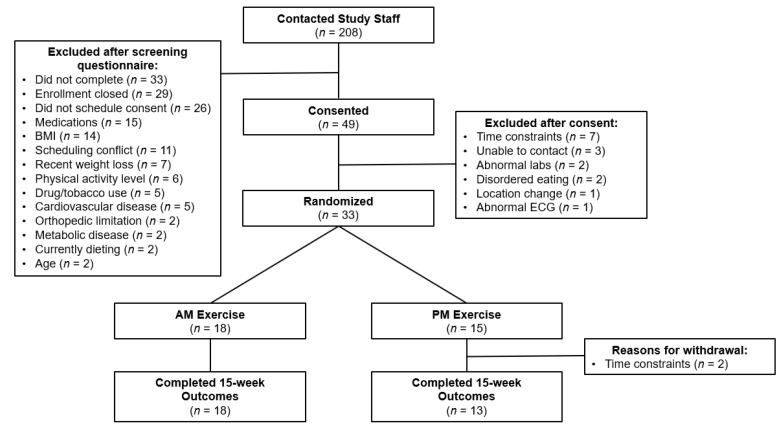
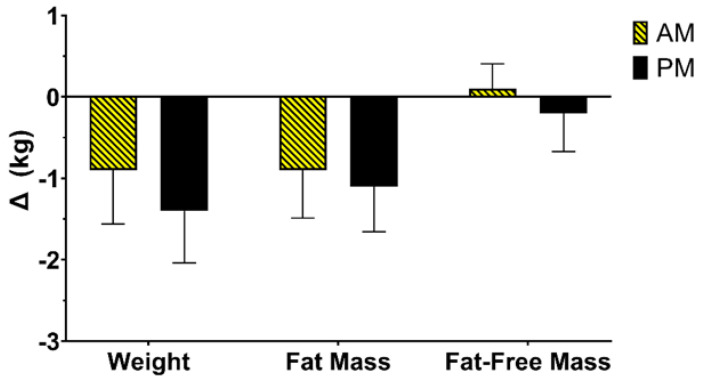
The purpose of this study was to evaluate the feasibility and acceptability of randomizing adults with overweight and obesity (BMI 25-40 kg/m2) to morning (06:00-10:00) or evening (15:00-19:00) aerobic exercise. Participants completed four exercise sessions per week in the morning (AM, n = 18) or evening (PM, n = 15). The exercise program was 15 weeks and progressed from 70 to 80% heart rate maximum and 750-2000 kcal/week. Bodyweight, body composition, total daily energy expenditure (TDEE), energy intake (EI), sleep, sedentary behavior (SB), non-exercise physical activity (NEPA), and maximal aerobic capacity were assessed at baseline and week 15. Study retention was 94% and adherence to the supervised exercise program was ≥90% in both groups. Weight change was -0.9 ± 2.8 kg and -1.4 ± 2.3 kg in AM and PM, respectively. AM and PM increased TDEE (AM: 222 ± 399 kcal/day, PM: 90 ± 150 kcal/day). EI increased in AM (99 ± 198 kcal/day) and decreased in PM (-21 ± 156 kcal/day) across the intervention. It is feasible to randomize adults with overweight and obesity to morning or evening aerobic exercise with high levels of adherence. Future trials are needed to understand how the timing of exercise affects energy balance and body weight regulation.
Keywords: diurnal; exercise timing; obesity; weight loss.
Conflict of interest statement
E.L.M. is supported by resources from the Geriatric Research, Education, and the Clinical Center at the Denver VA Medical Center. The contents do not represent the views of the U.S. Department of Veterans Affairs or the United States Government. All other authors have nothing to disclose. The funders had no role in the design of the study; in the collection, analyses, or interpretation of data; in the writing of the manuscript; or in the decision to publish the results.
Figures
References
-
- Martin C.K., Johnson W.D., Myers C.A., Apolzan J.W., Earnest C.P., Thomas D.M., Rood J.C., Johannsen N.M., Tudor-Locke C., Harris M., et al. Effect of different doses of supervised exercise on food intake, metabolism, and non-exercise physical activity: The E-MECHANIC randomized controlled trial. Am. J. Clin. Nutr. 2019;110:583–592. doi: 10.1093/ajcn/nqz054. - DOI - PMC - PubMed
-
- Donnelly J.E., Honas J.J., Smith B.K., Mayo M.S., Gibson C.A., Sullivan D.K., Lee J., Herrmann S.D., Lambourne K., Washburn R.A. Aerobic exercise alone results in clinically significant weight loss for men and women: Midwest exercise trial 2. Obesity. 2013;21:E219–E228. doi: 10.1002/oby.20145. - DOI - PMC - PubMed
-
- Donnelly J.E., Hill J.O., Jacobsen D.J., Potteiger J., Sullivan D.K., Johnson S.L., Heelan K., Hise M., Fennessey P.V., Sonko B. Effects of a 16-month randomized controlled exercise trial on body weight and composition in young, overweight men and women: The Midwest Exercise Trial. Arch. Intern. Med. 2003;163:1343–1350. doi: 10.1001/archinte.163.11.1343. - DOI - PubMed
-
- Church T.S., Martin C.K., Thompson A.M., Earnest C.P., Mikus C.R., Blair S.N. Changes in weight, waist circumference and compensatory responses with different doses of exercise among sedentary, overweight postmenopausal women. PLoS ONE. 2009;4:e4515. doi: 10.1371/journal.pone.0004515. - DOI - PMC - PubMed
-
- Slentz C.A., Duscha B.D., Johnson J.L., Ketchum K., Aiken L.B., Samsa G.P., Houmard J.A., Bales C.W., Kraus W.E. Effects of the amount of exercise on body weight, body composition, and measures of central obesity: STRRIDE—A randomized controlled study. Arch. Intern. Med. 2004;164:31–39. doi: 10.1001/archinte.164.1.31. - DOI - PubMed
Publication types
MeSH terms
Grants and funding
LinkOut - more resources
Full Text Sources
Medical
