


Prevalence and Clinical Impact of Coinfection in Patients with Coronavirus Disease 2019 in Korea
- PMID: 35216039
- PMCID: PMC8876760
- DOI: 10.3390/v14020446
Prevalence and Clinical Impact of Coinfection in Patients with Coronavirus Disease 2019 in Korea
Abstract
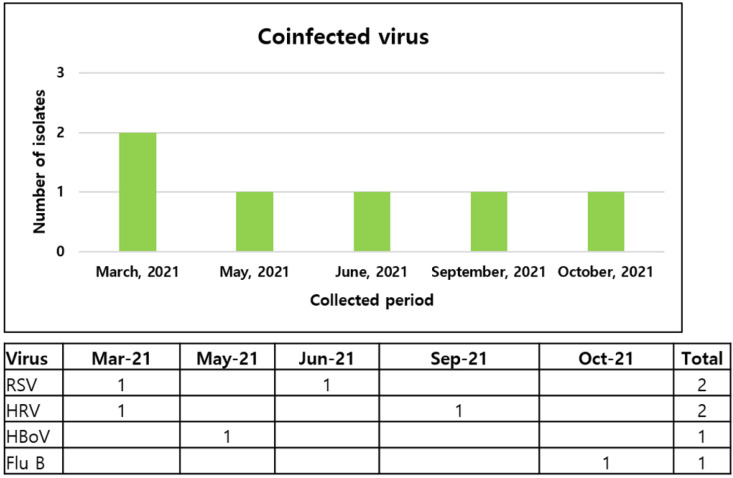
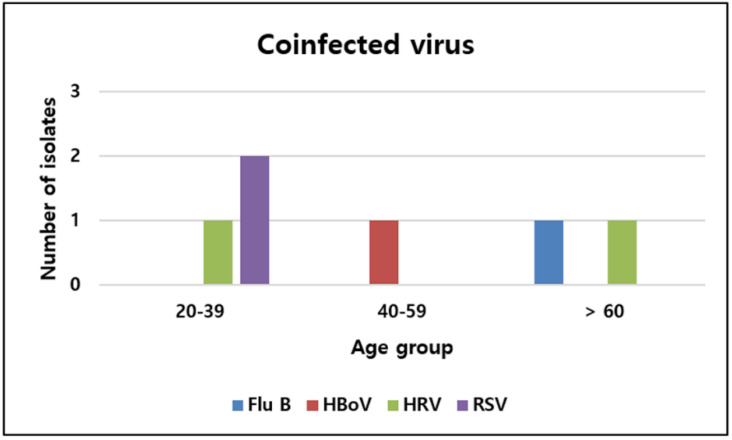
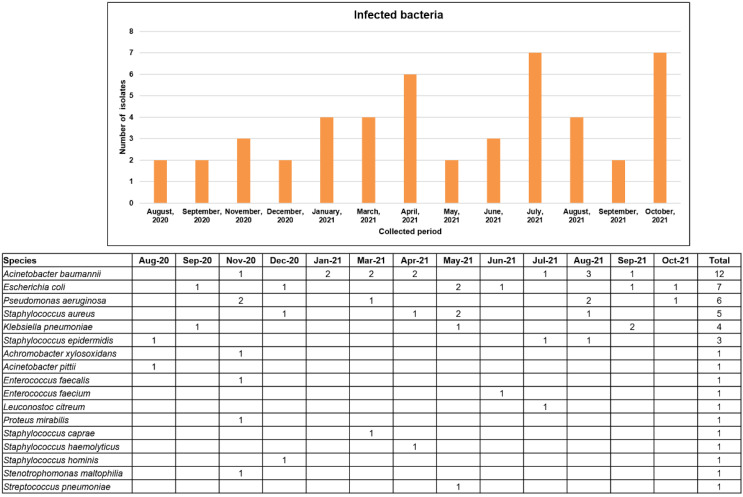
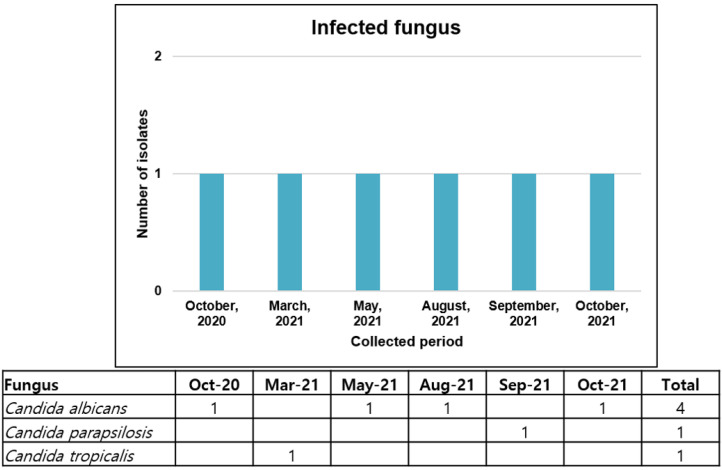
Coinfection rates with other pathogens in coronavirus disease 2019 (COVID-19) varied during the pandemic. We assessed the latest prevalence of coinfection with viruses, bacteria, and fungi in COVID-19 patients for more than one year and its impact on mortality. A total of 436 samples were collected between August 2020 and October 2021. Multiplex real-time PCR, culture, and antimicrobial susceptibility testing were performed to detect pathogens. The coinfection rate of respiratory viruses in COVID-19 patients was 1.4%. Meanwhile, the rates of bacteria and fungi were 52.6% and 10.5% in hospitalized COVID-19 patients, respectively. Respiratory syncytial virus, rhinovirus, Acinetobacter baumannii, Escherichia coli, Pseudomonas aeruginosa, and Candida albicans were the most commonly detected pathogens. Ninety percent of isolated A. baumannii was non-susceptible to carbapenem. Based on a multivariate analysis, coinfection (odds ratio [OR] = 6.095), older age (OR = 1.089), and elevated lactate dehydrogenase (OR = 1.006) were risk factors for mortality as a critical outcome. In particular, coinfection with bacteria (OR = 11.250), resistant pathogens (OR = 11.667), and infection with multiple pathogens (OR = 10.667) were significantly related to death. Screening and monitoring of coinfection in COVID-19 patients, especially for hospitalized patients during the pandemic, are beneficial for better management and survival.
Keywords: COVID-19; SARS-CoV-2; coinfection; mortality; prevalence; resistance.
Conflict of interest statement
The authors declare no conflict of interest. The funders had no role in the design of the study; in the collection, analyses, or interpretation of data; in the writing of the manuscript, or in the decision to publish the results.
Figures

References
-
- World Health Organization WHO Coronnavirus (COVID-19) Dashboard. [(accessed on 9 December 2021)]. Available online: https://covid19.who.int/
-
- Kim J.Y., Choe P.G., Oh Y., Oh K.J., Kim J., Park S.J., Park J.H., Na H.K., Oh M.D. The First Case of 2019 Novel Coronavirus Pneumonia Imported into Korea from Wuhan, China: Implication for Infection Prevention and Control Measures. J. Korean Med. Sci. 2020;35:e61. doi: 10.3346/jkms.2020.35.e61. - DOI - PMC - PubMed
-
- Korea Centers for Disease Control and Prevention. KCDC Coronnavirus (COVID-19) Dashboard. [(accessed on 9 December 2021)]. Available online: http://ncov.mohw.go.kr/
-
- Bordi L., Nicastri E., Scorzolini L., Di Caro A., Capobianchi M.R., Castilletti C., Lalle E., COVID-19 Study Group and Collaborating Centers Differential diagnosis of illness in patients under investigation for the novel coronavirus (SARS-CoV-2), Italy, February 2020. Eur. Surv. 2020;25:2000170. doi: 10.2807/1560-7917.ES.2020.25.8.2000170. - DOI - PMC - PubMed
Publication types
MeSH terms
Grants and funding
LinkOut - more resources
Full Text Sources
Medical
Miscellaneous
