


Strategies to Improve the Efficiency of Somatic Cell Nuclear Transfer
- PMID: 35216087
- PMCID: PMC8879641
- DOI: 10.3390/ijms23041969
Strategies to Improve the Efficiency of Somatic Cell Nuclear Transfer
Abstract
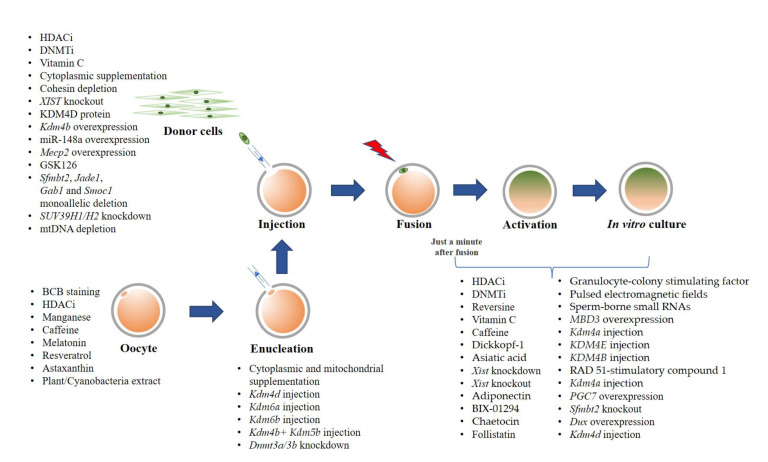
Mammalian oocytes can reprogram differentiated somatic cells into a totipotent state through somatic cell nuclear transfer (SCNT), which is known as cloning. Although many mammalian species have been successfully cloned, the majority of cloned embryos failed to develop to term, resulting in the overall cloning efficiency being still low. There are many factors contributing to the cloning success. Aberrant epigenetic reprogramming is a major cause for the developmental failure of cloned embryos and abnormalities in the cloned offspring. Numerous research groups attempted multiple strategies to technically improve each step of the SCNT procedure and rescue abnormal epigenetic reprogramming by modulating DNA methylation and histone modifications, overexpression or repression of embryonic-related genes, etc. Here, we review the recent approaches for technical SCNT improvement and ameliorating epigenetic modifications in donor cells, oocytes, and cloned embryos in order to enhance cloning efficiency.
Keywords: cloning efficiency; embryo; epigenetic modification; nuclear reprogramming; somatic cell nuclear transfer.
Conflict of interest statement
The authors declare no conflict of interest. The funders had no role in the writing of the manuscript, or in the decision to publish the manuscript.
Figures
Similar articles
-
Chaetocin Improves Pig Cloning Efficiency by Enhancing Epigenetic Reprogramming and Autophagic Activity.Int J Mol Sci. 2020 Jul 8;21(14):4836. doi: 10.3390/ijms21144836. Int J Mol Sci. 2020. PMID: 32650566 Free PMC article.
-
BIX-01294 increases pig cloning efficiency by improving epigenetic reprogramming of somatic cell nuclei.Reproduction. 2016 Jan;151(1):39-49. doi: 10.1530/REP-15-0460. Reproduction. 2016. PMID: 26604326
-
[Advances in epigenetic reprogramming of somatic cells nuclear transfer in mammals].Yi Chuan. 2019 Dec 20;41(12):1099-1109. doi: 10.16288/j.yczz.19-193. Yi Chuan. 2019. PMID: 31857281 Review. Chinese.
-
Catalytic inhibition of H3K9me2 writers disturbs epigenetic marks during bovine nuclear reprogramming.Sci Rep. 2020 Jul 13;10(1):11493. doi: 10.1038/s41598-020-67733-9. Sci Rep. 2020. PMID: 32661262 Free PMC article.
-
Lessons Learned from Somatic Cell Nuclear Transfer.Int J Mol Sci. 2020 Mar 27;21(7):2314. doi: 10.3390/ijms21072314. Int J Mol Sci. 2020. PMID: 32230814 Free PMC article. Review.
Cited by
-
The Complexities of Interspecies Somatic Cell Nuclear Transfer: From Biological and Molecular Insights to Future Perspectives.Int J Mol Sci. 2025 Apr 2;26(7):3310. doi: 10.3390/ijms26073310. Int J Mol Sci. 2025. PMID: 40244161 Free PMC article. Review.
-
Profiling the transcriptomic signatures and identifying the patterns of zygotic genome activation - a comparative analysis between early porcine embryos and their counterparts in other three mammalian species.BMC Genomics. 2022 Nov 24;23(1):772. doi: 10.1186/s12864-022-09015-4. BMC Genomics. 2022. PMID: 36434523 Free PMC article.
-
iSCNT embryo culture system for restoration of Cervus nippon hortulorum, presumed to be sika deer in the Korean Peninsula.PLoS One. 2024 Apr 18;19(4):e0300754. doi: 10.1371/journal.pone.0300754. eCollection 2024. PLoS One. 2024. PMID: 38635543 Free PMC article.
-
Neuronal Transplantation for Alzheimer's Disease and Prospects for Generating Exogenic Neurons as a Source of Cells for Implantation.Cell Transplant. 2023 Jan-Dec;32:9636897231164712. doi: 10.1177/09636897231164712. Cell Transplant. 2023. PMID: 37219048 Free PMC article. Review.
-
- Invited Review - Reproductive technologies needed for the generation of precise gene-edited pigs in the pathways from laboratory to farm.Anim Biosci. 2023 Feb;36(2):339-349. doi: 10.5713/ab.22.0389. Epub 2022 Nov 14. Anim Biosci. 2023. PMID: 36397683 Free PMC article.
References
Publication types
MeSH terms
LinkOut - more resources
Full Text Sources
