


Platelet-Released Factors: Their Role in Viral Disease and Applications for Extracellular Vesicle (EV) Therapy
- PMID: 35216433
- PMCID: PMC8876984
- DOI: 10.3390/ijms23042321
Platelet-Released Factors: Their Role in Viral Disease and Applications for Extracellular Vesicle (EV) Therapy
Abstract
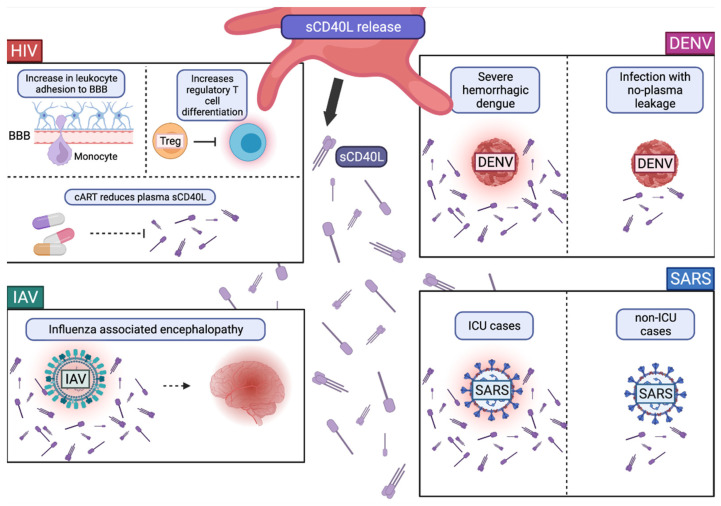
Platelets, which are small anuclear cell fragments, play important roles in thrombosis and hemostasis, but also actively release factors that can both suppress and induce viral infections. Platelet-released factors include sCD40L, microvesicles (MVs), and alpha granules that have the capacity to exert either pro-inflammatory or anti-inflammatory effects depending on the virus. These factors are prime targets for use in extracellular vesicle (EV)-based therapy due to their ability to reduce viral infections and exert anti-inflammatory effects. While there are some studies regarding platelet microvesicle-based (PMV-based) therapy, there is still much to learn about PMVs before such therapy can be used. This review provides the background necessary to understand the roles of platelet-released factors, how these factors might be useful in PMV-based therapy, and a critical discussion of current knowledge of platelets and their role in viral diseases.
Keywords: microparticles; microvesicle; platelets; therapy; vesicles; virus.
Conflict of interest statement
The authors declare no conflict of interest.
Figures



References
-
- Bizzozero G. Sur Un Nouvel Èlèment Morphologique Du Sang Chez Les Mammiferes et Son Importance Dans La Thrombose et Dans La Coagulation. Arch. Ital. Biol. 1882;1:1–5.
Publication types
MeSH terms
Substances
Grants and funding
LinkOut - more resources
Full Text Sources
Medical
