Review
. 2022 Apr;18(4):191-204.
doi: 10.1038/s41584-022-00755-x. Epub 2022 Feb 25.

COVID-19 in people with rheumatic diseases: risks, outcomes, treatment considerations

Affiliations
Review

COVID-19 in people with rheumatic diseases: risks, outcomes, treatment considerations

Rebecca Grainger et al. Nat Rev Rheumatol. 2022 Apr.

Abstract

The COVID-19 pandemic has brought challenges for people with rheumatic disease in addition to those faced by the general population, including concerns about higher risks of infection with severe acute respiratory syndrome coronavirus 2 (SARS-CoV-2) and poor outcomes of COVID-19. The data that are now available suggest that rheumatic disease is associated with a small additional risk of SARS-CoV-2 infection, and that outcomes of COVID-19 are primarily influenced by comorbidities and particular disease states or treatments. Despite considerable advances in our knowledge of which therapeutic agents provide benefits in COVID-19, and of what constitutes effective vaccination strategies, the specific considerations that apply to people with rheumatic disease are yet to be definitively addressed. An overview of the most important COVID-19 studies to date that relate to people with rheumatic disease can contribute to our understanding of the clinical-care requirements of this population.


Conflict of interest statement

R.G. reports receiving speakers bureau honoraria from AbbVie, Cornerstones and Janssen, consulting fees from AstraZeneca and Novartis, and non-financial support from Janssen and Pfizer. A.H.J.K. reports receiving research grant funding from GlaxoSmithKline, consulting fees from Alexion Pharmaceuticals, Aurinia Pharmaceuticals, Exagen Diagnostics and GlaxoSmithKline, and speakers bureau honoraria from Aurinia Pharmaceuticals, Exagen Diagnostics and GlaxoSmithKline. R.C. reports receiving speakers bureau honoraria from AbbVie, Janssen, Roche and Sanofi. J.Y. reports receiving research grant funding from AstraZeneca and Gilead and consulting fees from AstraZeneca, Aurinia, Eli Lilly and Pfizer. P.C.R. reports receiving personal fees from AbbVie, Atom Biosciences, Eli Lilly, Gilead, Janssen, Novartis, Pfizer, Roche and UCB, meeting-attendance support from Bristol Myers Squibb, Pfizer and UCB, and grant funding from Janssen, Novartis, Pfizer and UCB.

Figures

Fig. 1
Fig. 1. SARS-CoV-2 pre-infection and post-infection considerations for people with rheumatic disease.
Actions for people with rheumatic disease to take while living in an area with community transmission of SARS-CoV-2, dependent on whether they are uninfected, or have confirmed asymptomatic or symptomatic (mild, moderate, severe or critical) COVID-19.
Fig. 2
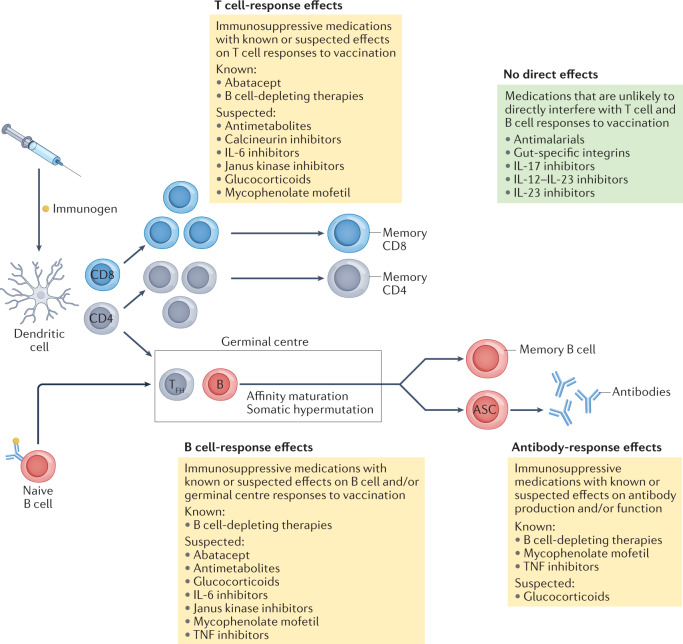
Fig. 2. Vaccine-induced immune responses and potential effects of immunosuppression.
Protective responses generated by vaccination require sequential activation of several immune cells. Following delivery of the immunogen by vaccination, dendritic cells activate CD4+ T cells, which polarize into a variety of helper T cell subsets, including T follicular helper (TFH) cells. Soluble immunogens also activate immunogen-specific naive B cells, which encounter TFH cells. This interaction is a critical step in the induction of T cell-dependent B cell responses to initiate the germinal centre response, which generates a pool of mature B cells harbouring a diverse array of B cell receptors with high affinity for the immunogen. These mature B cells can further differentiate into memory B cells or antibody-secreting cells (ASCs). The diversification of the B cell receptor repertoire (and thus antibody secretion) is critical for broad coverage of the numerous epitopes the immunogen contains, and for neutralization of virus variants. Immunosuppressive medications influence T and B cell function, some more specifically than others. Immunosuppressives with known or suspected effects on T cell and B cell responses to SARS-CoV-2 vaccination are shown. Medications that affect the immune system but are unlikely to directly interfere with T cell and B cell responses to vaccination because of their mechanisms of action are also shown.

References

    1. Krammer F. SARS-CoV-2 vaccines in development. Nature. 2020;586:516–527. - PubMed
    1. Maddur MS, Vani J, Lacroix-Desmazes S, Kaveri S, Bayry J. Autoimmunity as a predisposition for infectious diseases. PLoS Pathog. 2010;6:e1001077. - PMC - PubMed
    1. Sattui SE, et al. Early experience of COVID-19 vaccination in adults with systemic rheumatic diseases: results from the COVID-19 Global Rheumatology Alliance Vaccine Survey. RMD Open. 2021;7:e001814. - PMC - PubMed
    1. Deepak P, et al. Effect of immunosuppression on the immunogenicity of mRNA vaccines to SARS-CoV-2: a prospective cohort study. Ann. Intern. Med. 2021;174:1572–1585. - PMC - PubMed
    1. Voysey M, et al. Safety and efficacy of the ChAdOx1 nCoV-19 vaccine (AZD1222) against SARS-CoV-2: an interim analysis of four randomised controlled trials in Brazil, South Africa, and the UK. Lancet. 2021;397:99–111. - PMC - PubMed