


Pattern of treatment failures in patients with central nervous system non-germinomatous germ cell tumors (CNS-NGGCT): A pooled analysis of clinical trials
- PMID: 35218656
- PMCID: PMC9629424
- DOI: 10.1093/neuonc/noac057
Pattern of treatment failures in patients with central nervous system non-germinomatous germ cell tumors (CNS-NGGCT): A pooled analysis of clinical trials
Abstract
Background: Central Nervous System Non-Germinomatous Germ Cell Tumors (CNS-NGGCT) are rare but curable tumors. Due to their rarity, patients with treatment failures remain a poorly characterized group with unfavorable outcomes. In this study, we sought to characterize patients with treatment failures in a large, prospectively treated cohort.
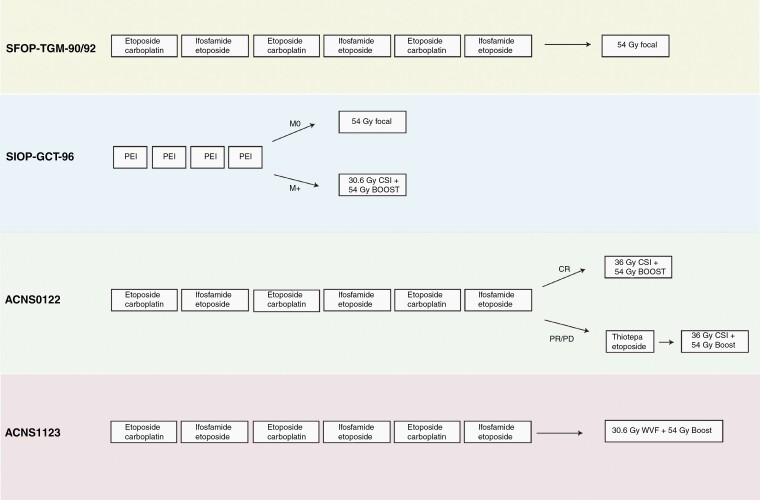
Methods: European and North American clinical trials for patients with CNS-NGGCT (SIOP-GCT-96, SFOP-TGM-TC 90/92, COG-ACNS0122, and COG-ACNS1123) were pooled for analysis. Additionally, patients included and treated in the UK and France national registries under strict protocol guidelines were included as an independent, non-overlapping cohort.
Results: A total of 118 patients experienced a treatment failure. Twenty-four patients had progressive disease during therapy, and additional 11 patients were diagnosed with growing teratoma syndrome (GTS). Patients with GTS are significantly younger and present with local failures and negative tumor markers. Eighty-three individuals experienced disease relapses after treatment ended. Patients' metastatic relapses presented significantly earlier than local relapses and were associated with tumor marker elevation (OR: 4.39; P = .026). In our analysis, focal or whole-ventricular radiation therapy was not associated with an increased risk of metastatic relapses.
Conclusions: Herein, we present the largest pooled dataset of prospectively treated patients with relapsed CNS-NGGCT. Our study identified younger age and negative tumor markers to be characteristic of GTS. Additionally, we elucidated that metastatic relapses occur earlier than local relapses are associated with elevated tumor markers and are not associated with the field of radiation therapy. These findings are of utmost importance for the planning of future clinical trials and the implementation of surveillance strategies in these patients.
Keywords: CNS; NGGCT; intracranial germ cell tumors; relapse.
© The Author(s) 2022. Published by Oxford University Press on behalf of the Society for Neuro-Oncology. All rights reserved. For permissions, please e-mail: journals.permissions@oup.com.
Figures


Comment in
-
CNS non-germinomatous germ cell tumor (NGGCT): Lessons from the recent past.Neuro Oncol. 2022 Nov 2;24(11):1962-1963. doi: 10.1093/neuonc/noac119. Neuro Oncol. 2022. PMID: 35512703 Free PMC article. No abstract available.
References
-
- Robertson PL, DaRosso RC, Allen JC. Improved prognosis of intracranial non-germinoma germ cell tumors with multimodality therapy. J Neurooncol. 1997;32(1):71–80. - PubMed
-
- Ogawa K, Toita T, Nakamura K, et al. Treatment and prognosis of patients with intracranial nongerminomatous malignant germ cell tumors: a multiinstitutional retrospective analysis of 41 patients. Cancer. 2003;98(2):369–376. - PubMed
MeSH terms
Substances
LinkOut - more resources
Full Text Sources
Medical
