


A Comparison of Seegene Technologies Novaplex SARS-CoV-2 Variants I, II, and IV Assays with Spike Gene Sequencing for Detection of Known Severe Acute Respiratory Syndrome Coronavirus 2 Variants
- PMID: 35218945
- PMCID: PMC8865930
- DOI: 10.1016/j.jmoldx.2022.02.001
A Comparison of Seegene Technologies Novaplex SARS-CoV-2 Variants I, II, and IV Assays with Spike Gene Sequencing for Detection of Known Severe Acute Respiratory Syndrome Coronavirus 2 Variants
Abstract
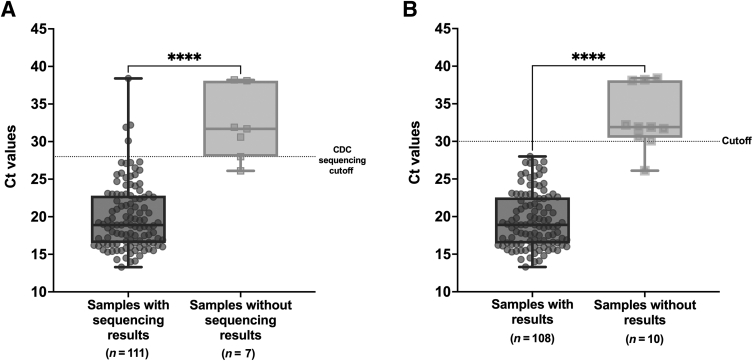
Tracking new and emerging severe acute respiratory syndrome coronavirus 2 (SARS-CoV-2) variants has become increasingly important for public health responses, primarily because of variant-dependent transmission, disease severity, and treatment decisions. This evaluation compared Seegene Technologies Novaplex SARS-CoV-2 Variants I, II, and IV (I,II&IV) assays to detect known SARS-CoV-2 variants using traditional spike gene Sanger sequencing results as the gold standard reference. Both RNA extraction and extraction-free protocols were assessed. A total of 156 samples were included in this study. There was 100% (109/109) overall agreement (95% CI, 96.7%-100%) between the spike gene sequencing and the I,II&IV results using extracted RNA for the variants included in the Novaplex assay menus. The RNA extraction-free method was 91.7% (143/156) as sensitive (95% CI, 86.2%-95.5%) as the traditional RNA extraction method. Using the extraction-free method on samples with higher cycle threshold values (>30) resulted in some mutations not being detected, presumably due to lower nucleic acid concentrations in the original samples. In conclusion, the I,II&IV assays provide an accurate, rapid, and less labor-intensive method for detecting SARS-CoV-2 and identifying known variants of interest and concern. The RNA extraction-free method for samples with cycle threshold of <30 could be cost-effective for surveillance purposes. However, spike gene sequencing retains the advantage of detecting more and new variants.
Copyright © 2022 Association for Molecular Pathology and American Society for Investigative Pathology. Published by Elsevier Inc. All rights reserved.
Figures
References
-
- Campbell F., Archer B., Laurenson-Schafer H., Jinnai Y., Konings F., Batra N., Pavlin B., Vandemaele K., Van Kerkhove M.D., Jombart T., Morgan O., le Polain de Waroux O. Increased transmissibility and global spread of SARS-CoV-2 variants of concern as at June 2021. Eurosurveillance. 2021;26:2100509. - PMC - PubMed
-
- Davies N., Abbott S., Barnard R., Jarvis C., Kucharski A., Munday J., Pearson C., Russell T., Tully D., Washburne A., Wenseleers T., Gimma A., Waites W., Wong K., van Zandvoort K., Silverman J., Diaz-Ordaz K., Keogh R., Eggo R., Funk S., Jit M., Atkins K., Edmunds W. Estimated transmissibility and impact of SARS-CoV-2 lineage B.1.1.7 in England. Science. 2021;372:eabg3055. - PMC - PubMed
Publication types
MeSH terms
Substances
Supplementary concepts
Grants and funding
LinkOut - more resources
Full Text Sources
Medical
Miscellaneous
