


Biomechanical measures of clinician-defined unsteadiness during a forward stepdown task in individuals post-arthroscopy for femoroacetabular impingement syndrome
- PMID: 35219043
- PMCID: PMC9520757
- DOI: 10.1016/j.clinbiomech.2022.105586
Biomechanical measures of clinician-defined unsteadiness during a forward stepdown task in individuals post-arthroscopy for femoroacetabular impingement syndrome
Abstract
Background: Patients with femoroacetabular impingement syndrome can present with aberrant movement patterns including unsteady balance. Balance training is included in rehabilitation after hip arthroscopy and may improve quality of movement; however, specific biomechanical measures associated with clinician-defined balance impairments are unknown. We aimed to understand these associations as they may inform targeted rehabilitative interventions.
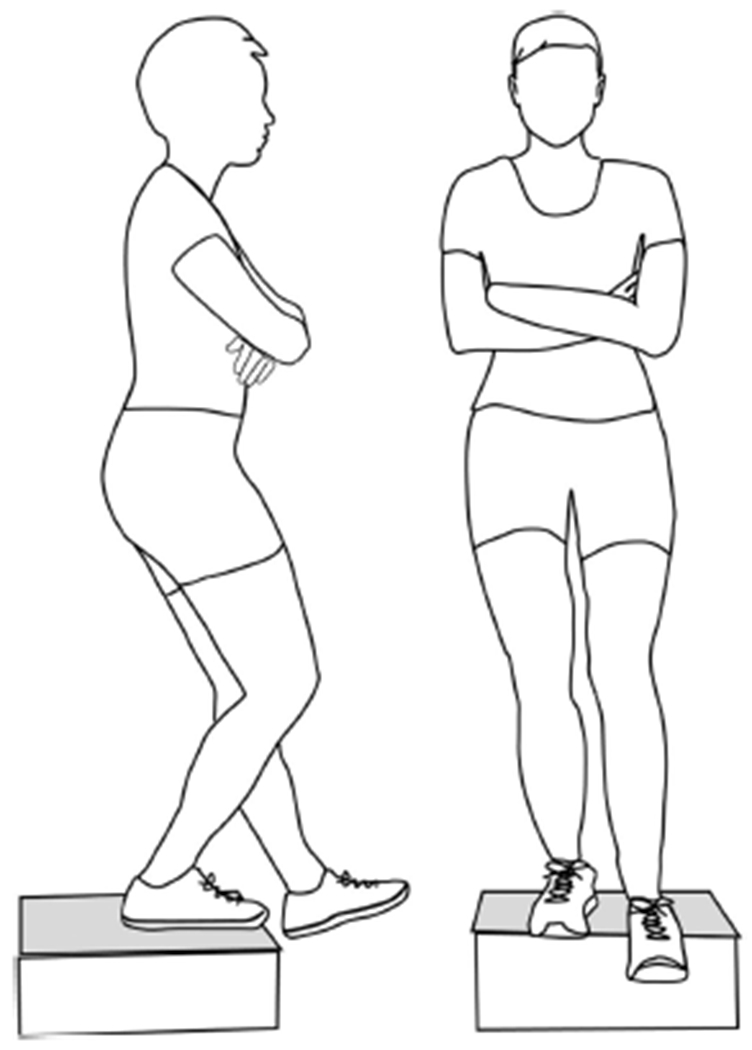
Methods: The forward stepdown is a clinical test used to evaluate movement quality, including balance. 23 individuals at least one-year post-arthroscopy for femoroacetabular impingement syndrome and 15 healthy comparisons performed the forward stepdown, recorded by 3-dimensional motion capture and 2-dimensional video. Three physical therapists graded the 2-dimensional video for steadiness. Two-way analyses of variance were used to evaluate the interaction of group (post-arthroscopy/healthy comparison) by steadiness (steady/unsteady), for center of pressure medial-lateral excursion, center of pressure path length, and lateral trunk, pelvis, and lower extremity joint excursions.
Findings: Six (26.1%) participants post-arthroscopy and five (33.3%) healthy comparisons were categorized as unsteady. The odds of being categorized as unsteady were not greater for participants post-arthroscopy (P = 0.72). There were no significant interactions; however, participants with clinician-defined unsteady balance, regardless of group, had significantly greater frontal plane trunk excursion, greater hip excursion, and greater center of pressure path length than those with steady balance (P ≤ 0.006).
Interpretation: The odds of being categorized as unsteady were not greater for individuals post-arthroscopy for femoroacetabular impingement syndrome. Clinician-defined unsteadiness was associated with greater frontal plane trunk and hip motion which may be rehabilitation targets to improve balance during a dynamic single-leg task.
Keywords: Balance; FAIS; Kinematics.
Copyright © 2022. Published by Elsevier Ltd.
Conflict of interest statement
Declaration of Competing Interest
KNJ, LBT, JP, KG, CL, and JR have no conflicts to report. SD declares her position as an Associate Editor with the Journal of Orthopaedic & Sports Physical Therapy for which she receives an honorarium twice per year. The authors declare that they have no known competing financial interests or personal relationships that could have appeared to influence the work reported in this paper.
Figures


References
-
- Bagwell JJ, Powers CM, 2019. Persons with femoroacetabular impingement syndrome exhibit altered pelvifemoral coordination during weightbearing and non-weightbearing tasks. Clin. Biomech 65, 51–56. - PubMed
-
- Bagwell JJ, Snibbe J, Gerhardt M, Powers CM, 2016. Hip kinematics and kinetics in persons with and without cam femoroacetabular impingement during a deep squat task. Clin. Biomech 31, 87–92. - PubMed
Publication types
MeSH terms
Grants and funding
LinkOut - more resources
Full Text Sources
