


COVID-19 and thrombosis: The role of hemodynamics
- PMID: 35219932
- PMCID: PMC8864963
- DOI: 10.1016/j.thromres.2022.02.016
COVID-19 and thrombosis: The role of hemodynamics
Abstract
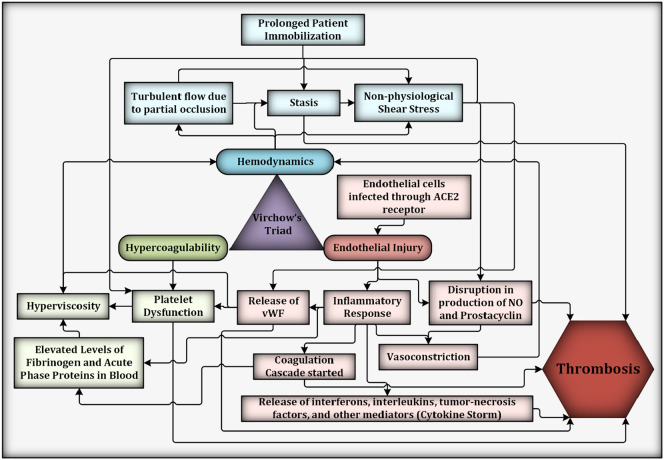
Severe coronavirus disease 2019 (COVID-19) is characterized by an increased risk of thromboembolic events, a leading cause for adverse outcomes in patients afflicted by the more serious manifestation of the disease. These thromboembolic complications expressed as sepsis-induced coagulopathy, disseminated intravascular coagulation, venous and arterial thromboembolism, pulmonary embolism, microthrombosis, and thrombotic microangiopathy have been observed to affect different organs such as the lungs, heart, kidneys, and brain. Endothelial injury and dysfunction have been identified as the critical pathway towards thrombogenesis, and contributions of other mechanisms such as hypercoagulability, cytokine storm, neutrophils have been studied. However, the contribution of hemodynamic pathways towards thrombosis in severe COVID-19 cases has not been investigated. From the classical theory of Virchow's triad to the contemporary studies on the effect of shear enhanced platelet activation, it is well established that hemodynamics plays a role in the initiation and growth of thrombosis. This article reviews recent studies on COVID-19 related thrombotic events and offers hypotheses on how hemodynamics may be responsible for some of the adverse outcomes observed in severe COVID-19 cases. While thrombogenesis through endothelial injury and the effects of hypercoagulability on thrombosis are briefly addressed, the crux of the discussion is focused on hemodynamic factors such as stasis, turbulent flow, and non-physiological shear stress and their effects on thrombosis. In addition, hemodynamics-dependent venous, arterial, and microvascular thrombosis in COVID-19 cases is discussed. We also propose further investigation of diagnostic and therapeutic options that address the hemodynamics aspects of COVID-19 thrombus formation to assess their potential in patient care.
Keywords: COVID-19; Endothelial injury; Hemodynamics; Hypercoagulability; Shear stress; Thrombosis.
Copyright © 2022 Elsevier Ltd. All rights reserved.
Conflict of interest statement
The authors declare that they have no known competing financial interests or personal relationships that could have appeared to influence the work reported in this paper.
Figures

References
-
- Atri D., Siddiqi H.K., Lang J., Nauffal V., Morrow D.A., Bohula E.A. COVID-19 for the cardiologist: a current review of the virology, clinical epidemiology, cardiac and other clinical manifestations and potential therapeutic strategies. JACC Basic Transl. Sci. 2020;5(5):518–536. doi: 10.1016/j.jacbts.2020.04.002. - DOI - PMC - PubMed
Publication types
MeSH terms
LinkOut - more resources
Full Text Sources
Medical
