


An Individual Cognitive Stimulation Therapy App for People with Dementia and Carers: Results from a Feasibility Randomized Controlled Trial (RCT)
- PMID: 35221680
- PMCID: PMC8866989
- DOI: 10.2147/CIA.S323994
An Individual Cognitive Stimulation Therapy App for People with Dementia and Carers: Results from a Feasibility Randomized Controlled Trial (RCT)
Abstract
Background: There is a lack of digital resources that support the cognition and quality of life (QoL) of people with dementia. The individual cognitive stimulation therapy application (iCST app) aims to provide cognitive stimulation and social interaction to people with dementia and carers through interactive touch-screen technology. This study set out to determine the feasibility of conducting a full-scale, randomized controlled trial (RCT) with the iCST app.
Methods: This was a single blind, feasibility RCT including people with mild to moderate dementia and their carers. Multiple trial components were assessed including recruitment and retention rates, intervention fidelity and usability, and acceptability of the outcome assessments which included measures of cognition and QoL. A sample of the intervention group was invited to a semi-structured post-trial interview to examine the experience of using the iCST app.
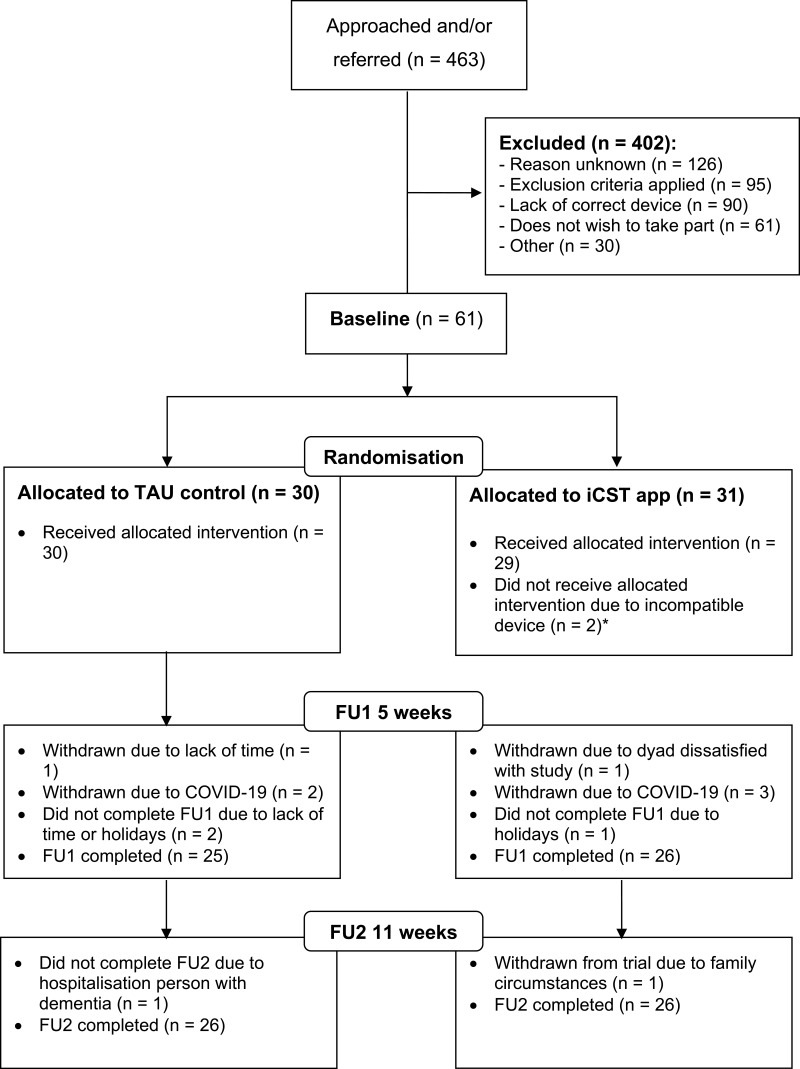
Results: Sixty-one dyads were randomised to the iCST app (n = 31) or treatment-as-usual (TAU) control group (n = 30) for 11 weeks. In the iCST app group, 77% used the intervention for 20 minutes or more each week. Carers using the iCST app rated their QoL better at follow-up 2 compared to the TAU control group (EQ-5D, MD = 7.69, 95% CI = 2.32-13.06, p = 0.006). No significant differences were found on the other outcome measures.
Conclusion: The iCST app was deemed usable and enjoyable. Most participants completed the activities more quickly than anticipated and did not have enough activities to continue using the app frequently. Expansion of the iCST app is needed to maintain engagement for longer. Findings indicate that computerised cognitive stimulation can be beneficial, and a large-scale RCT is feasible with modifications to trial components. The results are relevant to researchers, software developers, policy-makers, people with dementia and carers who are looking to be involved in such interventions.
Trial registration: ClinicalTrials.gov, NCT03282877. Registered on 19 July 2017.
Keywords: application; cognitive stimulation; feasibility trial; touch-screen.
© 2021 Rai et al.
Conflict of interest statement
MO was involved in the development and publishing of the paper-based CST manuals for dementia. Royalties from the sales of these manuals go to the support of the international CST centre at University College London run by Dr Aimee Spector. Dr HKR reports grants from Marie Curie Innovative Training Network, during the conduct of the study and royalties from the sales of the iCST app (Thinkability) go to Eumedianet and the University of Nottingham and provide support for ongoing maintenance of the app including future updates. The authors report no other conflicts of interest in this work.
Figures
References
-
- Prince M, Wimo A, Guerchet M, Ali GC, Wu YT, Prina M World Alzheimer Report 2015. The Global Impact of Dementia. An Analysis of Prevalence, Incidence, Cost and Trends; 2015. Available from: https://www.alz.co.uk/research/WorldAlzheimerReport2015.pdf. Accessed November 3, 2021.
Publication types
MeSH terms
Associated data
LinkOut - more resources
Full Text Sources
Medical
