


The Impact of Job Stress and State Anger on Turnover Intention Among Nurses During COVID-19: The Mediating Role of Emotional Exhaustion
- PMID: 35222162
- PMCID: PMC8863937
- DOI: 10.3389/fpsyg.2021.810378
The Impact of Job Stress and State Anger on Turnover Intention Among Nurses During COVID-19: The Mediating Role of Emotional Exhaustion
Abstract
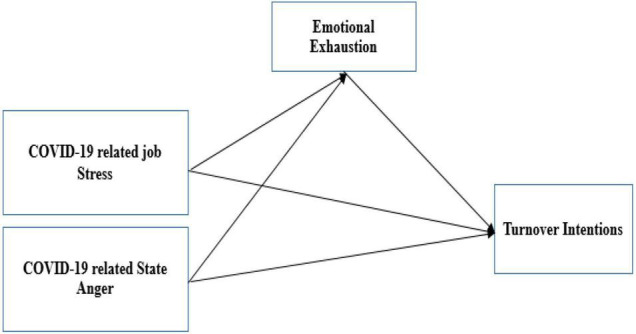
Based on the social exchange theory, the aim of this study is to identify the association between job stress state anger, emotional exhaustion and job turnover intention. This study postulates that job related stress and state anger among nurses during COVID-19 subsequently leads to their job turnover intentions. In addition, the study also aims to see the mediating role of emotional exhaustion between COVID-19-related job stress, state anger, and turnover intentions. The sample of this study is gathered from 335 registered nurses working in Pakistani hospitals dealing with COVID-19-related patients. The interrelationships between variables are checked by using structural equation modeling through AMOS. Key findings confirm that COVID-19-related job stress and state anger had a significant effect on nurses' turnover intentions. Furthermore, emotional exhaustion mediated the relationship between COVID-19-related job stress, state anger, and turnover intentions. There is a lack of research which has assessed the impact of Novel COVID-19-related job stress and state anger on nurses' turnover intentions in hospitals, providing empirical evidence from a developing country-Pakistan. This study offers managerial implications for hospital management and health policymakers. Moreover, nursing managers need to pay attention to nurses' turnover intentions who are facing the issue at the front line as patients receive their initial treatment from nurses in the COVID-19 outbreak.
Keywords: COVID-19; Pakistan; emotional exhaustion; job stress; nurses; social exchange theory; state anger; turnover intentions.
Copyright © 2022 Shah, Haider, Jindong, Mumtaz and Rafiq.
Conflict of interest statement
The authors declare that the research was conducted in the absence of any commercial or financial relationships that could be construed as a potential conflict of interest.
References
-
- Andela M., Truchot D., Van der Doef M. (2016). Job stressors and burnout in hospitals: the mediating role of emotional dissonance. Int. J. Stress Manage. 23 298–317.
-
- Anderson J. C., Gerbing D. W. (1988). Structural equation modeling in practice: a review and recommended two-step approach. Psychol. Bull. 103 411–423.
-
- Anees R. T., Heidler P., Cavaliere L. P. L., Nordin N. A. (2021). Brain Drain in Higher Education. The impact of job stress and workload on turnover intention and the mediating role of job satisfaction at universities. Eur. J. Bus. Manage. Res. 6 1–8. 10.24018/ejbmr.2021.6.3.849 - DOI
LinkOut - more resources
Full Text Sources
