


Glioblastoma, IDH-Wild Type With FGFR3-TACC3 Fusion: When Morphology May Reliably Predict the Molecular Profile of a Tumor. A Case Report and Literature Review
- PMID: 35222252
- PMCID: PMC8863931
- DOI: 10.3389/fneur.2022.823015
Glioblastoma, IDH-Wild Type With FGFR3-TACC3 Fusion: When Morphology May Reliably Predict the Molecular Profile of a Tumor. A Case Report and Literature Review
Abstract
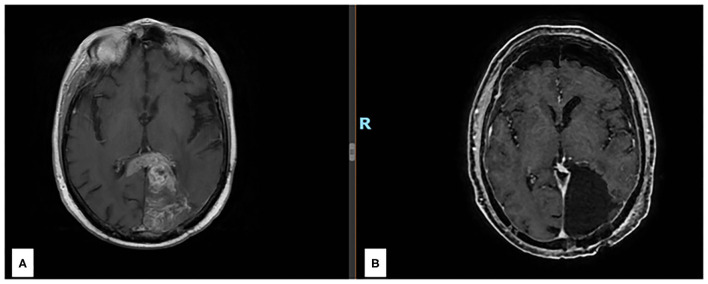
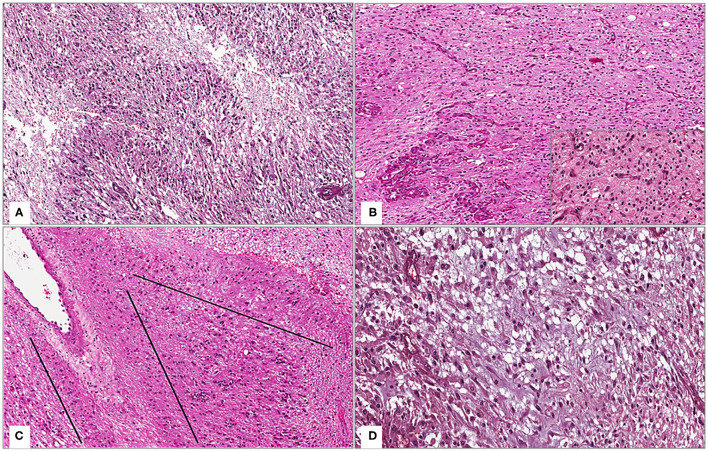
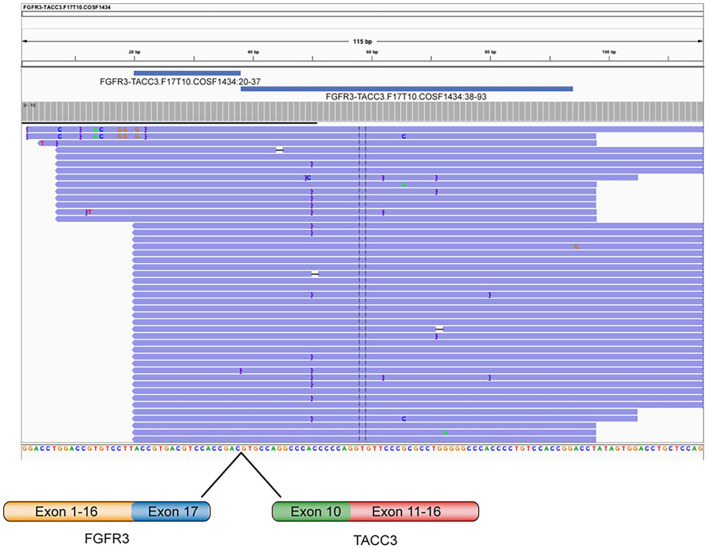
It has been reported that in-frame FGFR3-TACC3 fusions confer to glioblastomas, IDH-wild type (GBMs, IDHwt) some unusual morphologic features, including monomorphous rounded cells with ovoid nuclei, nuclear palisading, endocrinoid network of "chicken-wire" vessels, microcalcifications and desmoplastic stroma, whose observation may predict the molecular profile of the tumor. We herein present a case of recurrent GBMs, IDHwt, exhibiting some of the above-mentioned morphological features and a molecularly-proven FGFR3-TACC3 fusion. A 56-year-old man presented to our hospital for a recurrent GBM, IDHwt, surgically treated at another center. Histologically, the tumor, in addition to the conventional GBM morphology, exhibited the following peculiar morphologic features: (1) monomorphous neoplastic cells with rounded nuclei and scant pale cytoplasm; (2) thin capillary-like vessels with "chicken-wire" pattern; (3) nuclear palisading; (4) formation of vague perivascular pseudorosettes; (5) spindled tumor cells embedded in a loose, myxoid background. Based on this unusual morphology, molecular analyses were performed and an FGFR3 exon17-TACC3 exon 10 fusion was found. The present case contributes to widening the morphologic spectrum of FGFR3-TACC3-fused GBM, IDHwt and emphasizes that pathologists, in the presence of a GBM, IDHwt with unconventional morphology, should promptly search for this fusion gene.
Keywords: FGFR3-TACC3 fusion; IDH-wildtype; diagnosis; glioblastoma; high-grade glioma; molecular biology; unusual morphological features.
Copyright © 2022 Broggi, Piombino, Altieri, Romano, Certo, Barbagallo, Vigneri, Condorelli, Colarossi, Colarossi, Magro and Tirrò.
Conflict of interest statement
The authors declare that the research was conducted in the absence of any commercial or financial relationships that could be construed as a potential conflict of interest.
Figures
References
-
- Barbagallo D, Caponnetto A, Barbagallo C, Battaglia R, Mirabella F, Brex D, et al. The GAUGAA motif is responsible for the binding between circSMARCA5 and SRSF1 and related downstream effects on glioblastoma multiforme cell migration and angiogenic potential. Int J Mol Sci. (2021) 22:1678. 10.3390/ijms22041678 - DOI - PMC - PubMed
Publication types
LinkOut - more resources
Full Text Sources
