. 2022 Feb 11:12:786094.
doi: 10.3389/fmicb.2021.786094. eCollection 2021.

Freshwater Microbial Eukaryotic Core Communities, Open-Water and Under-Ice Specialists in Southern Victoria Island Lakes (Ekaluktutiak, NU, Canada)

Affiliations

Freshwater Microbial Eukaryotic Core Communities, Open-Water and Under-Ice Specialists in Southern Victoria Island Lakes (Ekaluktutiak, NU, Canada)

Marianne Potvin et al. Front Microbiol. .

Abstract

Across much of the Arctic, lakes and ponds dominate the landscape. Starting in late September, the lakes are covered in ice, with ice persisting well into June or early July. In summer, the lakes are highly productive, supporting waterfowl and fish populations. However, little is known about the diversity and ecology of microscopic life in the lakes that influence biogeochemical cycles and contribute to ecosystem services. Even less is known about the prevalence of species that are characteristic of the seasons or whether some species persist year-round under both ice cover and summer open-water conditions. To begin to address these knowledge gaps, we sampled 10 morphometrically diverse lakes in the region of Ekaluktutiak (Cambridge Bay), on southern Victoria Island (NU, Canada). We focused on Greiner Lake, the lakes connected to it, isolated ponds, and two nearby larger lakes outside the Greiner watershed. The largest lakes sampled were Tahiryuaq (Ferguson Lake) and the nearby Spawning Lake, which support commercial sea-run Arctic char (Salvelinus alpinus) fisheries. Samples for nucleic acids were collected from the lakes along with limnological metadata. Microbial eukaryotes were identified with high-throughput amplicon sequencing targeting the V4 region of the 18S rRNA gene. Ciliates, dinoflagellates, chrysophytes, and cryptophytes dominated the lake assemblages. A Bray-Curtis dissimilarity matrix separated communities into under-ice and open-water clusters, with additional separation by superficial lake area. In all, 133 operational taxonomic units (OTUs) occurred either in all under-ice or all open-water samples and were considered "core" microbial species or ecotypes. These were further characterized as seasonal indicators. Ten of the OTUs were characteristic of all lakes and all seasons sampled. Eight of these were cryptophytes, suggesting diverse functional capacity within the lineage. The core open-water indicators were mostly chrysophytes, with a few ciliates and uncharacterized Cercozoa, suggesting that summer communities are mixotrophic with contributions by heterotrophic taxa. The core under-ice indicators included a dozen ciliates along with chrysophytes, cryptomonads, and dinoflagellates, indicating a more heterotrophic community augmented by mixotrophic taxa in winter.

Keywords: Arctic; chrysophytes; ciliates; cryptophytes; season.


Conflict of interest statement

The authors declare that the research was conducted in the absence of any commercial or financial relationships that could be construed as a potential conflict of interest.

Figures
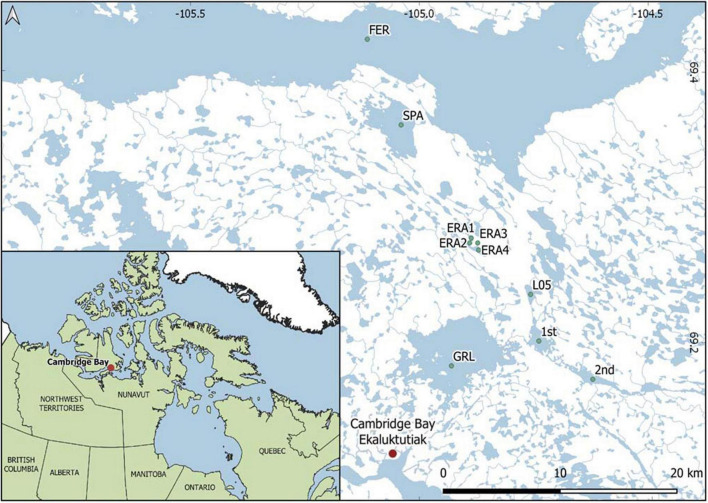
FIGURE 1
FIGURE 1
Map of the study area showing the lakes sampled. Lakes with names are Tahiryuaq, previously known as Ferguson (FER), Spawning (SPA), Greiner (GRL), and Inuhuktok (L05). Map was created using Q-GIS 3.14 based on Landsat 8 Operational Land Imager (OLI) imagery and in situ GPS data.
FIGURE 2
FIGURE 2
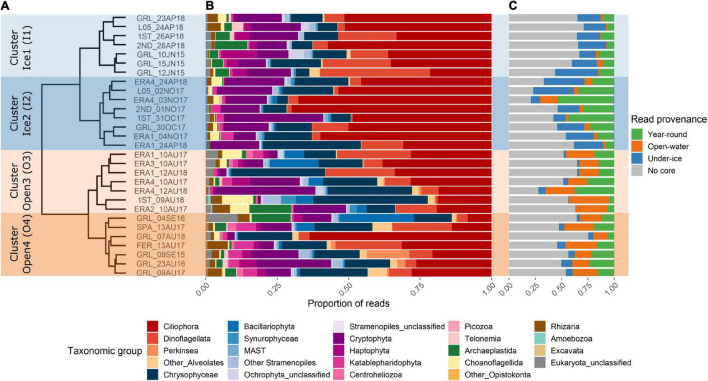
Overall eukaryote diversity in Ekaluktutiak (Cambridge Bay region) revealed with high-throughput sequencing. (A) Dendrogram of Bray–Curtis dissimilarity from the Hellinger-transformed operational taxonomic unit (OTU) table containing all protist OTUs. The samples clustered primarily as under ice (Ice1 and Ice2) and open water (Open3 and Open4). (B) Relative abundance of reads classified by higher-level taxonomy. (C) Relative abundance of reads from the samples within the OTU categories following the initial core definitions. OTUs present in all samples are shown in green, OTUs with 100% prevalence in under-ice samples are in blue, OTUs with 100% prevalence in open-water samples are in orange, and the prevalence of reads from OTUs that were not defined as core is in gray.
FIGURE 3
FIGURE 3
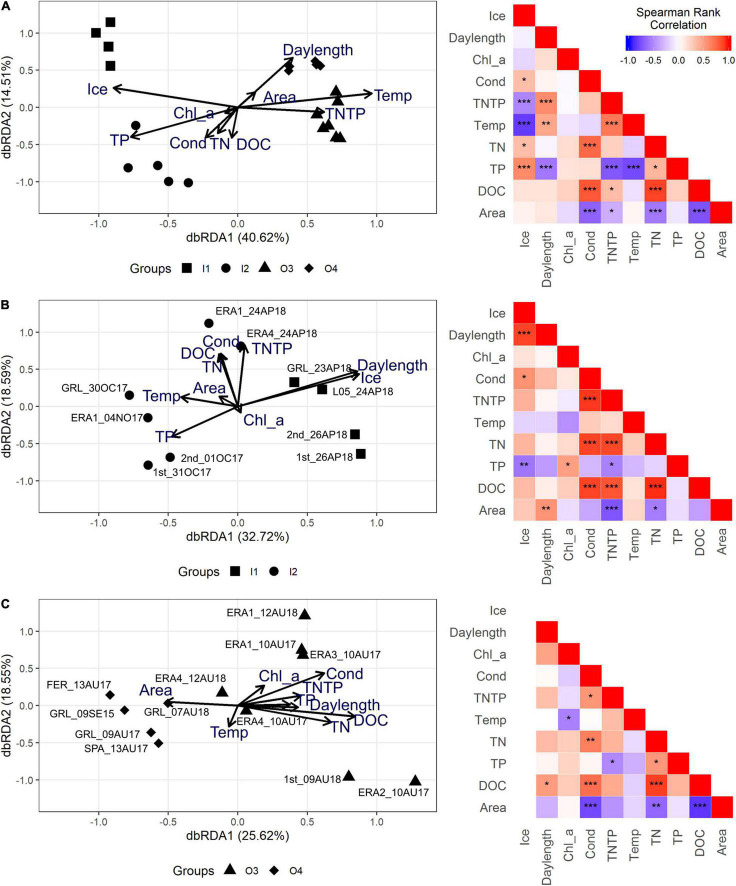
Bray–Curtis distance of the Hellinger-transformed operational taxonomic unit (OTU) table analyzed with different environmental variables. On the right are the associated Spearman’s rank correlation matrices of the environmental variables of corresponding samples. (A–C) Distance-based redundancy analysis (db-RDA) and Spearman’s rank correlation on the complete dataset (A), the open-water sample subset (B), and the under-ice sample subset (C). The date of sampling corresponds to the last part of the sample name. Spearman’s rank correlation: ***p < 0.01, **p < 0.05, and *p < 0.1.
FIGURE 4
FIGURE 4
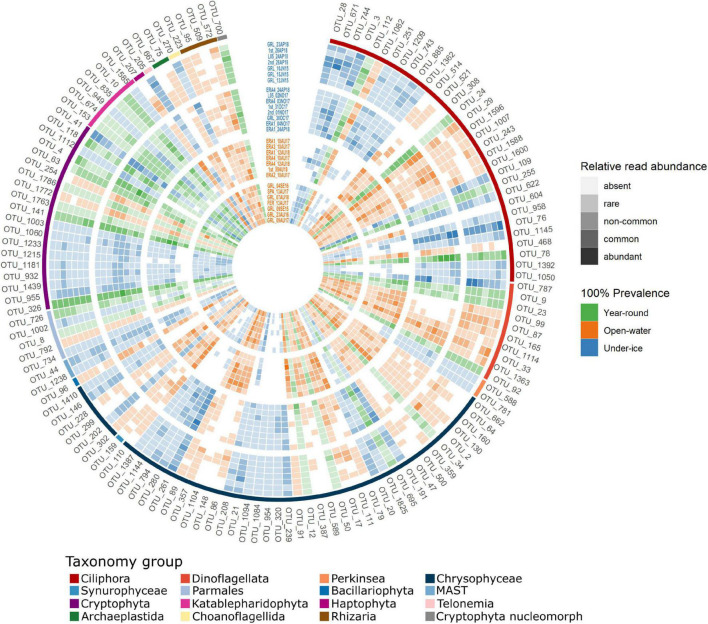
Heatmap of operational taxonomic units (OTUs) with 100% prevalence showing the relative read abundances of the core OTUs within all samples. Samples are arranged following the order of clustering in Figure 2, from the exterior to the center. Initial classification of OTUs is by prevalence. Those detected in all samples are shown in shades of green, open-water samples are in shades of orange, and under-ice samples in shades of blue. Intensity of the colors was based on the relative read abundance categories: absent (0), rare (<0.1%), non-common (0.1–1%), common (1–10%), and abundant (>10%). Taxonomy assignment is at the most precise taxonomic rank possible (see text). Outside ring color indicates the major taxonomic group of the OTUs.
FIGURE 5
FIGURE 5
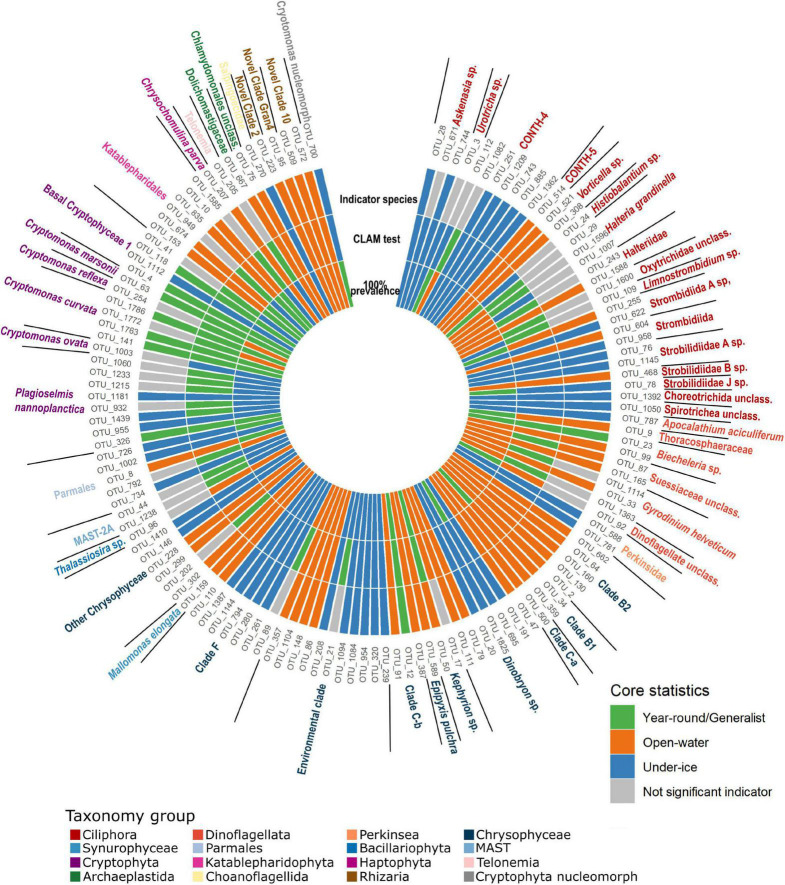
Core species categorizations. Innermost ring indicates initial classification from 100% prevalence data in all under ice, all open water, or both (from Figure 4). Middle ring shows the categorization of operational taxonomic units (OTUs) as under ice or open water or all year using the multinomial species classification method (CLAM test). Outermost ring shows the results of IndVal analysis showing the positive indicator OTUs for under-ice, open-water, or all-year conditions. Generalist OTUs, where the initial and CLAM tests agreed, are also marked in green in the outer ring. For all three rings, positive results are color coded, with year-round generalists in green, open-water OTUs in orange, and under-ice OTUs in blue. Gray in the outermost ring indicates OTUs that were not significant InVal indicators of any of the three conditions and differed between the CLAM and initial classifications.
FIGURE 6
FIGURE 6
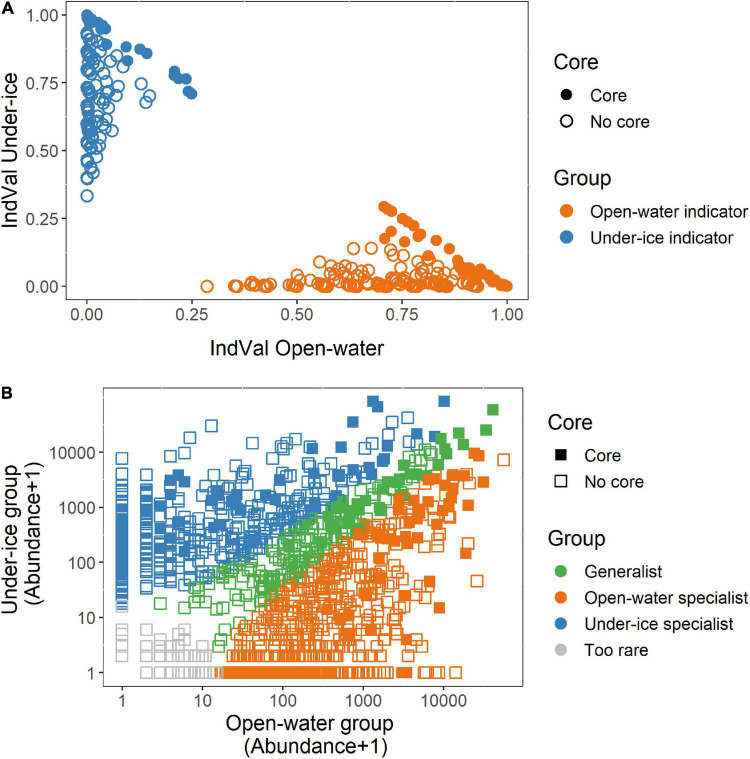
Open-water and under-ice statistical tests and classification. Tests were carried out on the entire dataset. Filled symbols are operational taxonomic units (OTUs) that were identified in the core analysis (Figures 4, 5) and open symbols are those not in the core. (A) Indicator (IndVal) OTUs comparing under ice (blue symbols) and open water (orange symbols). (B) Multinomial species classification method (CLAM) test signifying the open-water (orange), under-ice (blue), or year-round (green) specialists. OTUs that were too rare to classify are shown in light gray.

References

    1. Abnizova A., Young K. L., Lafreniere M. J. (2014). Pond hydrology and dissolved carbon dynamics at Polar Bear Pass wetland, Bathurst Island, Nunavut, Canada. Ecohydrology 7 73–90. 10.1002/eco.1323 - DOI
    1. Ait-Mohamed O., Vanclov A., Joli N., Liang Y., Zhao X., Genovesio A., et al. (2020). PhaeoNet: a holistic RNAseq-based portrait of transcriptional coordination in the model diatom Phaeodactylum tricornutum. Front. Plant Sci. 11:590949. 10.3389/fpls.2020.590949 - DOI - PMC - PubMed
    1. Altenburger A., Blossom H. E., Garcia-Cuetos L., Jakobsen H. H., Carstensen J., Lundholm N., et al. (2020). Dimorphism in cryptophytes-the case of Teleaulax amphioxeia/Plagioselmis prolonga and its ecological implications. Sci. Adv. 6:eabb1611. 10.1126/sciadv.abb1611 - DOI - PMC - PubMed
    1. Andersson A., Falk S., Samuelsson G., Hagstrom A. (1989). Nutritional characteristics of a mixotrophic nanoflagellate, Ochromonas sp. Microb. Ecol. 17 251–262. 10.1007/bf02012838 - DOI - PubMed
    1. Andresen C. G., Lougheed V. L. (2015). Disappearing Arctic tundra ponds: fine-scale analysis of surface hydrology in drained thaw lake basins over a 65 year period (1948-2013). J. Geophys. Res. Biogeosci. 120 466–479. 10.1002/2014jg002778 - DOI