. 2021 Dec 13;13(5):1288-1297.
doi: 10.1039/d1sc06074k. eCollection 2022 Feb 2.

How many more polymorphs of ROY remain undiscovered

Affiliations

How many more polymorphs of ROY remain undiscovered

Gregory J O Beran et al. Chem Sci. .

Abstract

With 12 crystal forms, 5-methyl-2-[(2-nitrophenyl)amino]-3-thiophenecabonitrile (a.k.a. ROY) holds the current record for the largest number of fully characterized organic crystal polymorphs. Four of these polymorph structures have been reported since 2019, raising the question of how many more ROY polymorphs await future discovery. Employing crystal structure prediction and accurate energy rankings derived from conformational energy-corrected density functional theory, this study presents the first crystal energy landscape for ROY that agrees well with experiment. The lattice energies suggest that the seven most stable ROY polymorphs (and nine of the twelve lowest-energy forms) on the Z' = 1 landscape have already been discovered experimentally. Discovering any new polymorphs at ambient pressure will likely require specialized crystallization techniques capable of trapping metastable forms. At pressures above 10 GPa, however, a new crystal form is predicted to become enthalpically more stable than all known polymorphs, suggesting that further high-pressure experiments on ROY may be warranted. This work highlights the value of high-accuracy crystal structure prediction for solid-form screening and demonstrates how pragmatic conformational energy corrections can overcome the limitations of conventional density functionals for conformational polymorphs.


Conflict of interest statement

There are no conflicts to declare.

Figures
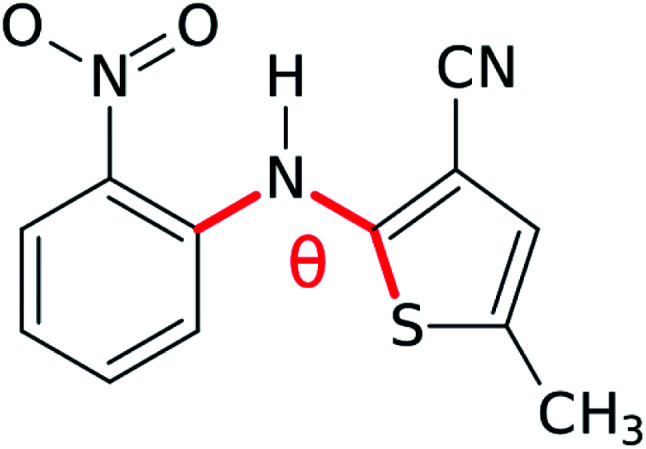
Fig. 1
Fig. 1. The ROY molecule. Its different conformational polymorphs and their associated colors generally involve changes in the S–C–N–C dihedral angle θ.
Fig. 2
Fig. 2. Predicted crystal energy landscapes (a) from CrystalOptimizer with the initial force field, (b) after B86bPBE-XDM geometry relaxation and energy refinement of approximately 300 low-energy structures (red and gray circles), and (c) after single-point SCS-MP2D monomer conformational energy corrections to the B86bPBE-XDM landscape. Experimentally observed structures are indicated in red, while the potential high-pressure candidate structure #15 is indicated in blue. DFT-optimized structures and energies are provided in ESI.
Fig. 3
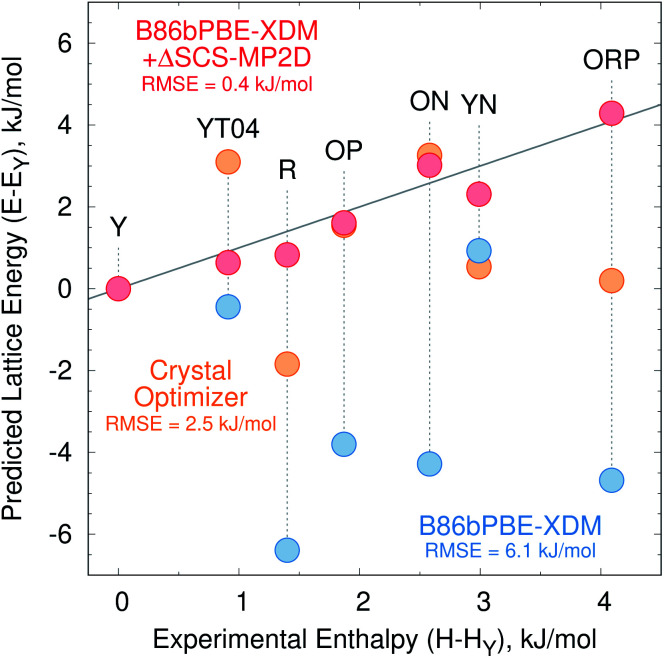
Fig. 3. Relative lattice energies for seven ROY polymorphs predicted with the CrystalOptimizer potential (orange), B86bPBE-XDM (blue) and B86bPBE-XDM + the SCS-MP2D monomer-correction (red) compared against the experimentally measured relative enthalpies (kJ mol−1). Points lying along the solid gray line would represent perfect agreement between the relative theoretical lattice energies and experimental enthalpies.
Fig. 4
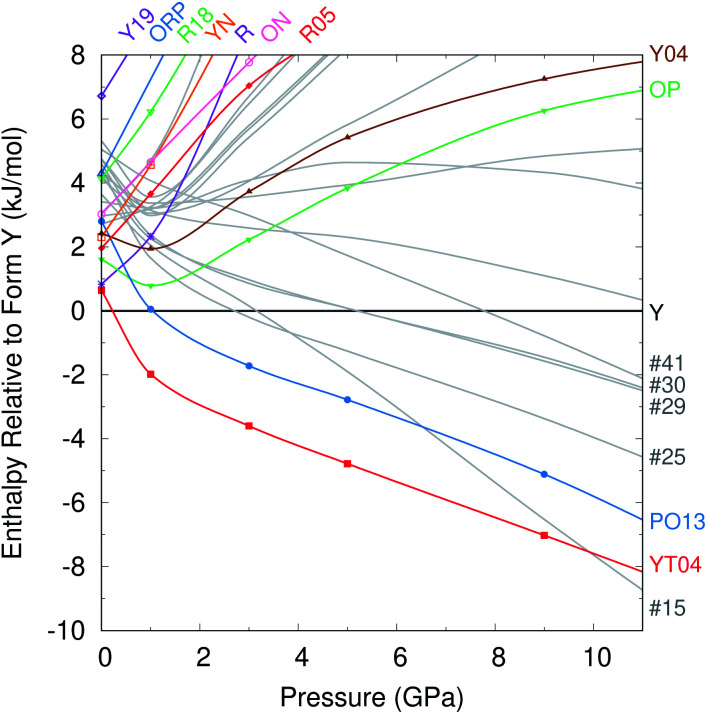
Fig. 4. Enthalpies of the different crystal structures relative to form Y as a function of pressure, in kJ mol−1.
Fig. 5
Fig. 5. Comparison of form Y (yellow) and structure #15 (blue) at ambient pressure. Cell axes are indicated for form Y. For the middle and right perspectives in particular, note how the structures share a common packing motif in the central layers but the adjacent layers above and below in the b direction differ by mirror image inversion about the a axis.
Fig. 6
Fig. 6. ROY crystal structure energy landscape as a function of the intramolecular conformation, as defined by the key SCNC dihedral angle. The gas-phase SCS-MP2D conformational energy scan over this dihedral angle is superimposed on the landscape in blue, while the yellow shaded region indicates the approximate dihedral angle range that leads to yellow polymorphs instead of red/orange ones.

References

    1. Cruz-Cabeza A. J. Reutzel-Edens S. M. Bernstein J. Chem. Soc. Rev. 2015;44:8619–8635. doi: 10.1039/C5CS00227C. - DOI - PubMed
    1. Bhardwaj R. M. McMahon J. A. Nyman J. Price L. S. Konar S. Oswald I. D. H. Pulham C. R. Price S. L. Reutzel-Edens S. M. J. Am. Chem. Soc. 2019;141:13887–13897. doi: 10.1021/jacs.9b06634. - DOI - PubMed
    1. López-Mejías V. Kampf J. W. Matzger A. J. J. Am. Chem. Soc. 2012;134:9872–9875. doi: 10.1021/ja302601f. - DOI - PMC - PubMed
    1. Zeidan T. A. Trotta J. T. Tilak P. A. Oliveira M. A. Chiarella R. A. Foxman B. M. Almarsson Ö. Hickey M. B. CrystEngComm. 2016;18:1486–1488. doi: 10.1039/C5CE02467F. - DOI
    1. Sacchi P. Reutzel-Edens S. M. Cruz-Cabeza A. J. CrystEngComm. 2021;23:3636–3647. doi: 10.1039/D1CE00343G. - DOI