Review
. 2022 Mar;12(3):70.
doi: 10.1007/s13205-022-03121-6. Epub 2022 Feb 13.

Nano to rescue: repository of nanocarriers for targeted drug delivery to curb breast cancer

Affiliations
Review

Nano to rescue: repository of nanocarriers for targeted drug delivery to curb breast cancer

Poonam Banthia et al. 3 Biotech. 2022 Mar.

Abstract

Breast cancer is a heterogeneous disease with different intrinsic subtypes. The conventional treatment of surgical resection, chemotherapy, immunotherapy and radiotherapy has not shown significant improvement in the survival rate of breast cancer patients. The therapeutics used cause bystander toxicities deteriorating healthy tissues. The breakthroughs of nanotechnology have been a promising feat in selective targeting of tumor site thus increasing the therapeutic gain. By the application of nanoenabled carriers, nanomedicines ensure targeted delivery, stability, enhanced cellular uptake, biocompatibility and higher apoptotic efficacy. The present review focuses on breakthrough of nanoscale intervention in targeted drug delivery as novel class of therapeutics. Nanoenabled carriers like polymeric and metallic nanoparticles, dendrimers, quantum dots, liposomes, solid lipid nanoparticles, carbon nanotubes, drug-antibody conjugates and exosomes revolutionized the targeted therapeutic delivery approach. These nanoassemblies have shown additional effect of improving the solubility of drugs such as paclitaxel, reducing the dose and toxicity. The present review provides an insight on the different drug conjugates employed/investigated to curb breast cancer using nanocarrier mediated targeted drug delivery. However, identification of appropriate biomarkers to target, clearer insight of the biological processes, batch uniformity, reproducibility, nanomaterial toxicity and stabilities are the hurdles faced by nanodrugs. The potential of nano-therapeutics delivery necessitates the agglomerated efforts of research community to bridge the route of nanodrugs for scale-up, commercialization and clinical applications.

Keywords: Breast cancer; Drug delivery; Nanocarriers; Nanomaterials; Nanomedicine.


Conflict of interest statement

Conflict of interestThere are no actual or potential conflicts of interest.

Figures
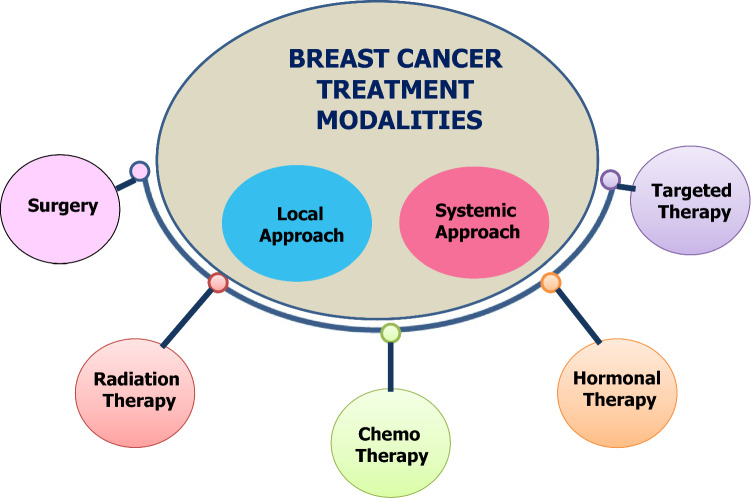
Fig. 1
Fig. 1
Application of nanocarriers in Breast Cancer: the prevalent approaches for breast cancer management and treatment has two principal components viz. Local and systemic. The local therapy includes cancer cell killing by surgery or radiation therapy, whereas, systemic approach includes chemotherapy, hormonal therapy and preferred targeted therapy
Fig. 2
Fig. 2
Passive and active targeting: schematic representation highlights the nanoparticle mediated targeted drug delivery methods. In passive targeting nacarriers take the benefit of leaky vasculatures and deliver the drug while in active targeting, specific ligand-receptor binding affinity is utilized in identifying the receptors present on the cancer cells for selectivity by nanocarriers
Fig. 3
Fig. 3
Nanosolutions to breast cancer: nanocarriers are able to perform targeted delivery of drugs, enhanced cytotoxicity, bioavailability. It reduces systemic toxicity and severe side effects. The scheme showcases the different reforms of nanocarriers for targeted drug delivery. Polymer based, phospholipid based, carbon nanotubes, Liposome and Quantum dots are the few platforms being readily investigated for efficient and controlled drug release at the site of tumor
Fig. 4
Fig. 4
Nanoenabled targeting of breast cancer: various nanocarriers have been developed and investigated to selectively carry the potent drug to the breast cancer cells. The selective targeting helps in enhanced cancer cell killing and reduced toxicity to normal healthy cells leading to increased therapeutic index. The effective doses required for cancer cell killing is lower in targeted approach due to enhanced bioavailability compared to conventional non targeted breast cancer therapy

References

    1. Afzal M, Ameeduzzafar, Alharbi KS, Alruwaili NK, Al-Abassi FA, Al-Malki AAL, Anwar F. Nanomedicine in treatment of breast cancer—a challenge to conventional therapy. Sem Cancer Biol. 2021;69:279–292. doi: 10.1016/j.semcancer.2019.12.016. - DOI - PubMed
    1. Ahmadi-Kashani M, Dehghani H, Zarrabi A. A biocompatible nanoplatform formed by MgAl-layered double hydroxide modified Mn(3)O(4)/N-graphene quantum dot conjugated-polyaniline for pH-triggered release of doxorubicin. Mater Sci Eng. 2020;114:111055. doi: 10.1016/j.msec.2020.111055. - DOI - PubMed
    1. Akram M, Hussain R. Nanohydrogels: history, development, and applications in drug delivery. Nanocellulose Nanohydrogel Matrices. 2017 doi: 10.1002/9783527803835.ch11. - DOI
    1. Alawdi SH, Eidi H, Safar MM, Abdel-Wahhab MA. Loading amlodipine on diamond nanoparticles: a novel drug delivery system. Nanotechnol Sci Appl. 2019;12:47–53. doi: 10.2147/NSA.S232517. - DOI - PMC - PubMed
    1. Aleanizy FS, Alqahtani FY, Seto S, Al Khalil N, Aleshaiwi L, Alghamdi M, Alsarra I. Trastuzumab targeted neratinib loaded poly-amidoamine dendrimer nanocapsules for breast cancer therapy. Int J Nanomed. 2020;15:5433–5443. doi: 10.2147/IJN.S256898. - DOI - PMC - PubMed

LinkOut - more resources
