


Tissue Models for Neisseria gonorrhoeae Research-From 2D to 3D
- PMID: 35223556
- PMCID: PMC8873371
- DOI: 10.3389/fcimb.2022.840122
Tissue Models for Neisseria gonorrhoeae Research-From 2D to 3D
Abstract
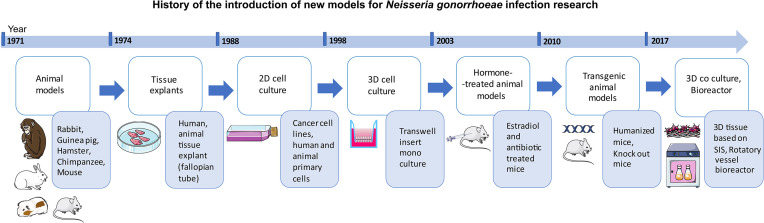
Neisseria gonorrhoeae is a human-specific pathogen that causes gonorrhea, the second most common sexually transmitted infection worldwide. Disease progression, drug discovery, and basic host-pathogen interactions are studied using different approaches, which rely on models ranging from 2D cell culture to complex 3D tissues and animals. In this review, we discuss the models used in N. gonorrhoeae research. We address both in vivo (animal) and in vitro cell culture models, discussing the pros and cons of each and outlining the recent advancements in the field of three-dimensional tissue models. From simple 2D monoculture to complex advanced 3D tissue models, we provide an overview of the relevant methodology and its application. Finally, we discuss future directions in the exciting field of 3D tissue models and how they can be applied for studying the interaction of N. gonorrhoeae with host cells under conditions closely resembling those found at the native sites of infection.
Keywords: Neisseria gonorrhoeae; biomimetic tissue models; ex vivo; in vitro; in vivo.
Copyright © 2022 Heydarian, Rühl, Rawal and Kozjak-Pavlovic.
Conflict of interest statement
The authors declare that the research was conducted in the absence of any commercial or financial relationships that could be construed as a potential conflict of interest.
Figures
References
Publication types
MeSH terms
LinkOut - more resources
Full Text Sources
Medical
Miscellaneous
