Review
. 2022 Feb 15;6(2):e12666.
doi: 10.1002/rth2.12666. eCollection 2022 Feb.

COVID-19 and venous thromboembolism: A narrative review

Affiliations
Review

COVID-19 and venous thromboembolism: A narrative review

Dana E Angelini et al. Res Pract Thromb Haemost. .

Abstract

COVID-19 (severe acute respiratory syndrome coronavirus 2 [SARS-CoV-2]) is associated with coagulopathy through numerous mechanisms. The reported incidence of venous thromboembolism (VTE) in hospitalized patients with COVID-19 has varied widely, and several meta-analyses have been performed to assess the overall prevalence of VTE. The novelty of this coronavirus strain along with its unique mechanisms for microvascular and macrovascular thrombosis has led to uncertainty as to how to diagnose, prevent, and treat thrombosis in patients affected by this virus. This review discusses the epidemiology and pathophysiology of thrombosis in the setting of SARS-CoV-2 infection along with an updated review on the preventative and treatment strategies for VTE associated with SARS-CoV-2 infection.

Keywords: COVID‐19; incidence; review; therapeutics; venous thromboembolism.


Figures

FIGURE 1
FIGURE 1
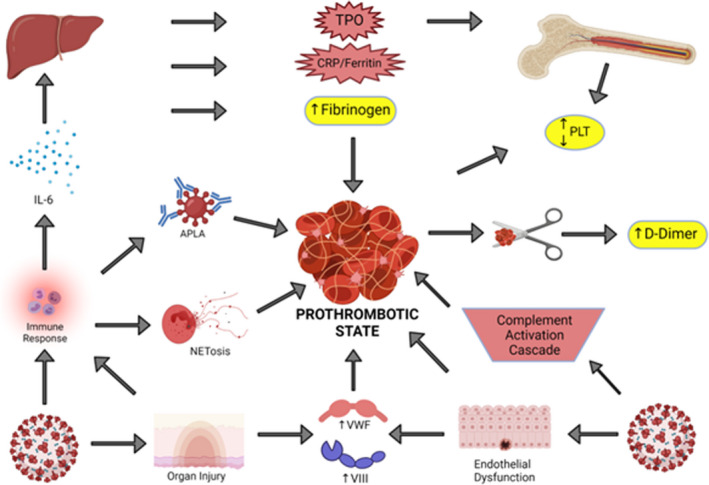
Prothrombotic state of COVID‐19 infection. The pathogenesis of the hypercoagulable state of COVID‐19 infection is depicted above. Bottom left: COVID‐19 infection can lead to a robust immune response with resultant secretion of cytokines (such as interleukin‐6 [IL‐6]), antiphospholipid antibodies (APLA), and neutrophil extracellular traps (NETosis). Bottom right: COVID‐19 infection also leads to complement activation in addition to endothelial dysfunction and organ injury which increases procoagulant molecules such as von Willebrand factor and factor VIII. Top left: Liver injury can occur due to endotheliopathy, which leads to an overall increase in inflammatory markers such as fibrinogen, CRP (C Reactive Protein) and thrombopoietin (TPO). Top right: Acute infection can have a variable effect on the platelet (PLT) count and the D‐dimer is elevated in the setting of fibrinolysis of micro‐ or macrovascular thrombosis
FIGURE 2
FIGURE 2
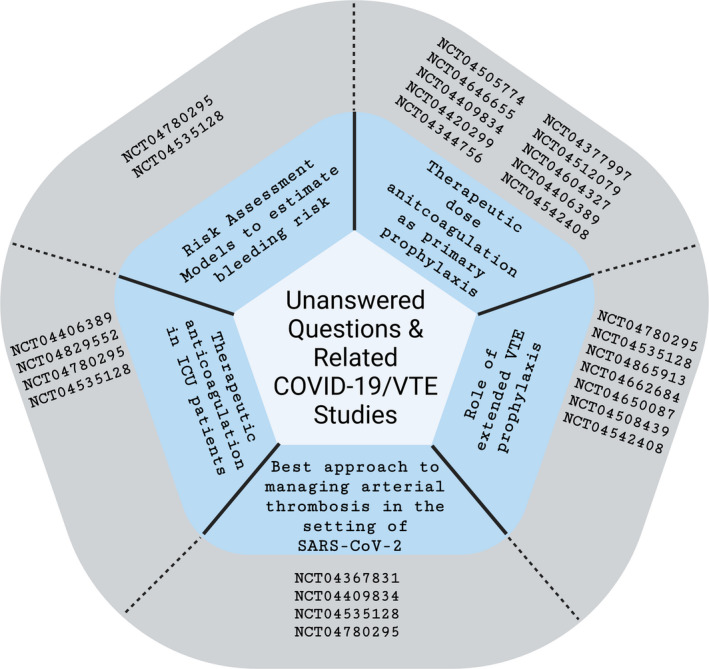
Emerging data to answer clinical queries surrounding COVID‐19 infection and risk of venous thrombosis. NCT04780295: COVID‐19 Registry on Thrombosis Complications (CORE‐THROMB). NCT04535128: COVID‐19 Registry to Assess Frequency, Risk Factors, Management, and Outcomes of Arterial and Venous Thromboembolic Complications (CORONA‐VTE‐NET). NCT04505774: Accelerating COVID‐19 Therapeutic Interventions and Vaccines 4 ACUTE (ACTIV‐4A). NCT04646655: Enoxaparin at Prophylactic or Therapeutic Doses in COVID‐19 (EMOS‐COVID). NCT04409834: Prevention of Ateriovenous Thrombotic Events in Critically Ill COVID‐19 Patients Trial (COVID‐PACT). NCT04344756: Trial Evaluation Efficacy and Safety of Anticoagulation in Patients with COVID‐19 Infection, Nested in the Corimmuno‐19 Cohort (CORIMMUNO‐COAG). NCT04377997: Safety and Efficacy of Therapeutic Anticoagulation on Clinical Outcomes in Hospitalized Patients with COVID‐19. NCT04512079: FREEDOM COVID‐19 Anticoagulation Strategy (FREEDOM COVID). NCT04406389: Anticoagulation in Critically Ill Patients with COVID‐19 (The IMPACT Trial). NCT04865913: Venous Thrombosis Virtual Surveillance in COVID (VVIRTUOSO). NCT04662684: Medically Ill Hospitalized Patients for COVID‐19 Thrombosis Extended Prophylaxis with Rivaroxaban Therapy: The MICHELLE Trial. NCT04650087: COVID‐19 Thrombosis Prevention Trials: Post‐hospital Thromboprophylaxis. NCT04508439: Effect of the Use of Anticoagulant Therapy During Hospitalization and Discharge in Patients With COVID‐19 Infection. NCT04542408: Hamburg Edoxaban for Anticoagulation in COVID‐19 Study (HERO‐19). NCT04367831: Intermediate or Prophylactic‐Dose Anticoagulation for Venous or Arterial Thromboembolism in Severe COVID‐19: A Cluster Based Randomized Selection Trial (IMPROVE‐COVID). NCT04409834: Prevention of Arteriovenous Thrombotic Events in Critically‐Ill COVID‐19 Patients Trial (COVID‐PACT). NCT04829552: Prophylactic vs Therapeutic Dose Anticoagulation in COVID‐19 Infection at the Time of Admission to Critical Care Units. Please note this list is not meant to be exhaustive, but rather illustrate the vast number of studies occurring in each of the areas of interest. ICU, intensive care unit; SARS‐CoV‐2, severe acute respiratory syndrome coronavirus 2; VTE, venous thromboembolism

References

    1. Cui S, Chen S, Li X, Liu S, Wang F. Prevalence of venous thromboembolism in patients with severe novel coronavirus pneumonia. J Thromb Haemost. 2020;18(6):1421‐1424. - PMC - PubMed
    1. Minet C, Potton L, Bonadona A, et al. Venous thromboembolism in the ICU: main characteristics, diagnosis and thromboprophylaxis. Critical Care (London, England). 2015;19(1):287. - PMC - PubMed
    1. Poissy J, Goutay J, Caplan M, et al. Pulmonary embolism in patients with COVID‐19: awareness of an increased prevalence. Circulation. 2020;142(2):184‐186. - PubMed
    1. Asakura H, Ogawa H. COVID‐19‐associated coagulopathy and disseminated intravascular coagulation. Int J Hematol. 2021;113(1):45‐57. - PMC - PubMed
    1. Levi M, Thachil J, Iba T, Levy JH. Coagulation abnormalities and thrombosis in patients with COVID‐19. Lancet Haematol. 2020;7(6):e438‐e440. - PMC - PubMed