


Occupational therapy service provision in adult intensive care units in Australia: A survey of workload practices, interventions and barriers
- PMID: 35224739
- PMCID: PMC9306833
- DOI: 10.1111/1440-1630.12794
Occupational therapy service provision in adult intensive care units in Australia: A survey of workload practices, interventions and barriers
Abstract
Introduction: Occupational therapy practice within intensive care units (ICUs) is limited with respect to published research evidence and guidelines regarding scope of practice. An understanding of the current level of service provision, feasibility of services in ICUs and training and development needs of occupational therapists is required to enable consistent best practice and promote the occupational therapy profile. This study aimed to explore occupational therapy practice within ICUs in Australia including the barriers and enablers to practice perceived by occupational therapists.
Methods: In this cross-sectional study, a national customised online survey was completed by registered occupational therapists who provide services in intensive care settings in Australia. Recruitment was from July to September 2019 through Occupational Therapy Australia and other professional networks and interest groups.
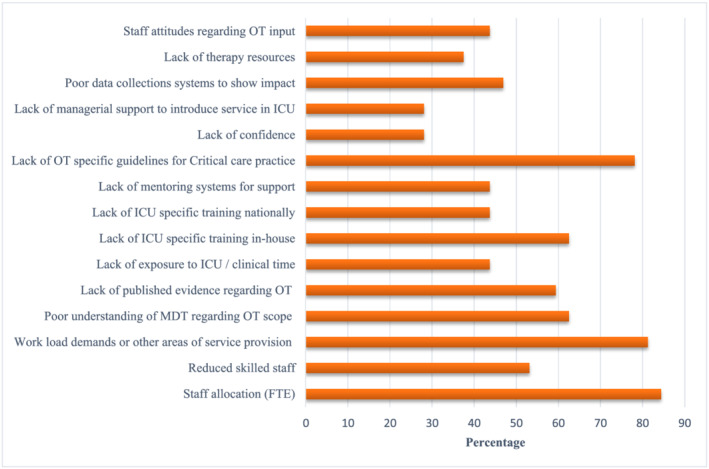
Results: The survey was completed by 43 respondents. The majority were experienced therapists from Queensland with greater than 10-years post-qualification and working in a tertiary hospital setting. The most common length of time spent working in the ICU was 0-2 h per week. Formal and informal self-care measures, cognitive screens and physical outcome measures were commonly used. Bed-based grooming retraining, pressure care management, functional upper limb retraining and passive ranging were the most frequent interventions provided on a daily basis. Perceived barriers to occupational therapy service provision in ICU included lack of funding for staffing, competing workload demands, lack of occupational therapy role delineation and scope of practice and lack of published evidence and training.
Conclusion: Occupational therapy services in intensive care settings in Australia are limited. Published practice guidelines, further research, applications for service funding and ongoing education of the ICU multidisciplinary team regarding the scope of occupational therapy practice are recommended to promote the development of occupational therapy services in ICU.
Keywords: cognition; critical care; delirium; intensive care unit; occupational therapy; rehabilitation.
© 2022 The Authors. Australian Occupational Therapy Journal published by John Wiley & Sons Australia, Ltd on behalf of Occupational Therapy Australia.
Conflict of interest statement
The authors declared no potential conflicts of interest pertaining to the authorship, research and/or publication of this study.
Figures
References
-
- Algeo, N. , & Aitken, L. M. (2019). The evolving role of occupational therapists in adult critical care in England: A mixed methods design using role theory. Irish Journal of Occupational Therapy, 47(2), 74–94. 10.1108/IJOT-04-2019-0005 - DOI
-
- Alvarez, E. A. , Garrido, M. A. , Tobar, E. A. , Prieto, S. A. , Vergara, S. O. , Briceno, C. D. , & Gonzalez, F. J. (2017). Occupational therapy for delirium management in elderly patients without mechanical ventilation in an intensive care unit: A pilot randomized clinical trial. Journal of Critical Care, 37, 85–90. 10.1016/j.jcrc.2016.09.002 - DOI - PubMed
-
- ANZICS Centre for Outcome and Resource Evaluation . (2020). 2019 report Melbourne, Australia. https://www.anzics.com.au/annual-reports/
MeSH terms
Grants and funding
LinkOut - more resources
Full Text Sources
