Review
. 2022 Mar 23;96(6):e0207721.
doi: 10.1128/jvi.02077-21. Epub 2022 Mar 23.

Omicron: What Makes the Latest SARS-CoV-2 Variant of Concern So Concerning?

Affiliations
Review

Omicron: What Makes the Latest SARS-CoV-2 Variant of Concern So Concerning?

Christoph Jung et al. J Virol. .

Abstract

Emerging strains of severe acute respiratory syndrome coronavirus 2 (SARS-CoV-2), the causative agent of the coronavirus disease 2019 (COVID-19) pandemic, that show increased transmission fitness and/or immune evasion are classified as "variants of concern" (VOCs). Recently, a SARS-CoV-2 variant first identified in November 2021 in South Africa has been recognized as a fifth VOC, termed "Omicron." What makes this VOC so alarming is the high number of changes, especially in the viral Spike protein, and accumulating evidence for increased transmission efficiency and escape from neutralizing antibodies. In an amazingly short time, the Omicron VOC has outcompeted the previously dominating Delta VOC. However, it seems that the Omicron VOC is overall less pathogenic than other SARS-CoV-2 VOCs. Here, we provide an overview of the mutations in the Omicron genome and the resulting changes in viral proteins compared to other SARS-CoV-2 strains and discuss their potential functional consequences.

Keywords: BA.1; BA.2; COVID-19; Omicron; SARS-CoV-2; Spike; variants of concern.


Conflict of interest statement

The authors declare no conflict of interest.

Figures
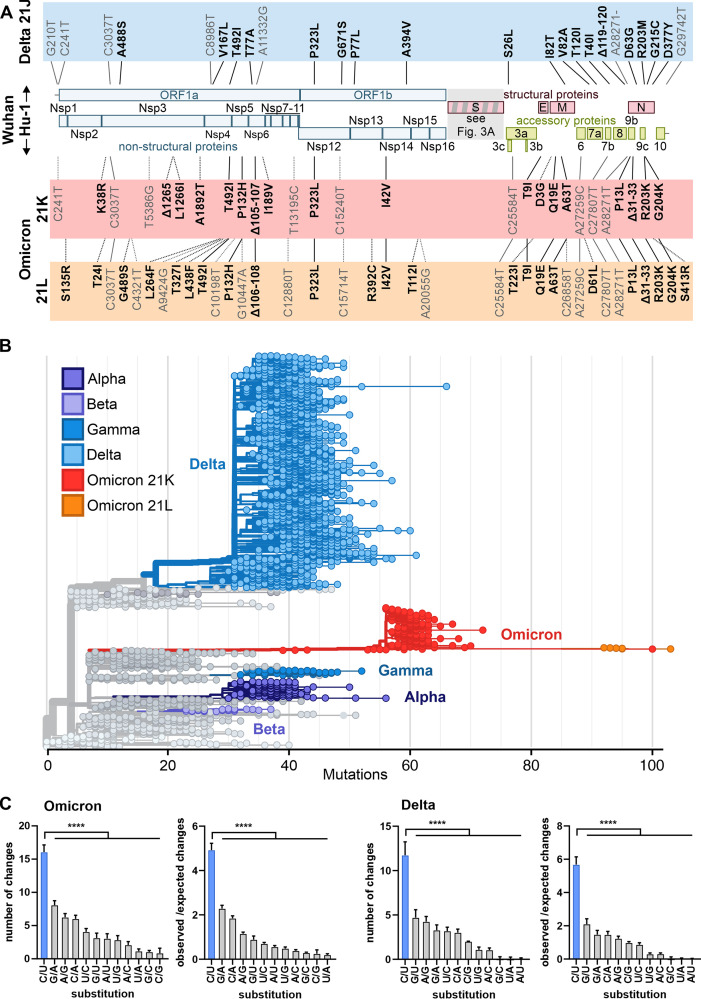
FIG 1
FIG 1
Features of the Omicron genome and potential consequences of changes outside the Spike gene. (A) Schematic depiction of the SARS-CoV-2 genome and highlighting of non-Spike defining mutations (according to CoVariants data retrieved on 17 January 2022) in the Delta (blue, prevalent 21J clade; https://covariants.org/variants/21J.Delta) and Omicron (red, 21K, also known as BA.1, https://covariants.org/variants/21K.Omicron; orange, 21J, also known as BA.2, https://covariants.org/variants/21L.Omicron; shared mutations are indicated by solid lines) VOCs compared to the Wuhan Hu-1 isolate. Nonsynonymous (bold) and synonymous (nonbold) mutations are indicated. Positions are given relative to the start of the altered protein (nonsynonymous mutations) or the first nucleotide of the genome (synonymous mutations). Nonstructural proteins, Nsp1 to -16 (blue). Structural proteins, Spike (S), Envelope (E), Membrane (M), and Nucleocapsid (N) (red). Accessory proteins, ORF3 to -10 (green). (B) Phylogenetic analysis of representative SARS-CoV-2 isolates scaled according to their divergence compared to the Wuhan Hu-1 sequence. Retrieved from Nextstrain on 18 January 2022 (https://nextstrain.org/ncov/gisaid/global?m=div) and modified. Color coding according to VOC as indicated. (C) Types of single nucleotide substitutions in SARS-CoV-2 Omicron and Delta VOCs compared to Wuhan Hu-1 reference strain. Shown are absolute numbers and ratios of changes observed to changes expected from random mutations based on SARS-CoV-2 nucleotide composition. Sequences were obtained from GISAID and NCBI virus databases (96, 97) and aligned to Wuhan Hu-1 strain (NCBI: NC_045512.2) using Clustal Omega (98). Mean of n = 475 (Delta) or n = 77 (Omicron) + standard deviation. P < 0.0001 (****), one-way paired analysis of variance with multiple comparisons to C/U set.
FIG 2
FIG 2
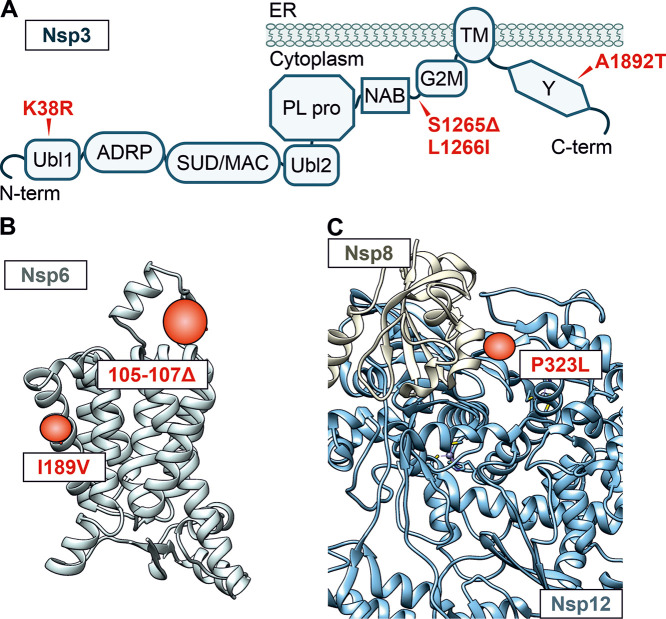
Alterations in Nsp3, Nsp6, and Nsp8/Nsp12. (A) Schematic depiction of the domain arrangement of Nsp3. Ubl1, ubiquitin-like domain 1; ADRP, ADP-ribose-1″-phosphate phosphatase; SUD/MAC, SARS-CoV unique/macrodomain; Ubl2, ubiquitin-like domain 2; PL pro, papain-like protease; NAB, nucleic acid-binding domain; G2M, group 2-specific marker; TM, transmembrane domain; Y, Y domain. Mutations in the Omicron consensus sequence compared to Hu-1 are highlighted in red, and position is indicated with an arrow. (B) Alpha-fold prediction of the Nsp6 structure. Regions that are altered in the Omicron VOC are highlighted in red. Respective amino acid deletions (positions 105 to 107) or changes (I189V) are labeled in the box. (C) Structural representation of the complex between Hu-1 Nsp8 (tan) and Nsp12 (blue) derived from cryo-EM data (PDB 6YYT). The alteration in the Omicron VOC at the interface is highlighted in red (P323L).
FIG 3
FIG 3
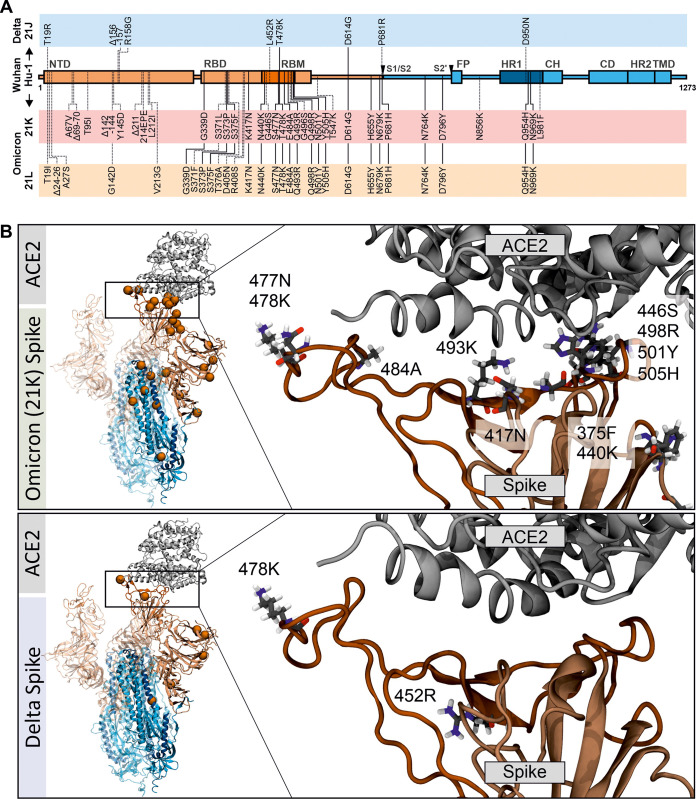
Localization and potential interactions of amino acid changes in the Omicron Spike. (A) Schematic depiction of SARS-CoV-2 Spike, its domains, and amino acid alterations in the Delta 21J and Omicron 21K and 21L VOCs compared to the Wuhan Hu-1 sequence. S1 subunit: N-terminal domain (NTD) and receptor-binding domain (RBD) (orange). Receptor-binding motif, RBM (dark orange). S2 subunit: fusion peptide (FP) (blue), heptad repeat 1 (HR1) (dark blue), central helix (CH), connector domain (CD), heptad repeat 2 (HR2), and transmembrane domain (TM) (blue). Shared amino acid exchanges are indicated by solid lines. (B) Position of changes in the three-dimensional structure of the Spike/ACE2 complex based on the CoV-RDB (99). (Left) Overview of the positions of the mutations (orange) in Omicron and Delta Spikes, as indicated. (Right) Focused view of the mutations in the RBD. The mutated amino acid is shown in atomic stick representation. Shown are sample snapshots from reactive molecular dynamics simulations performed to relax the structure as reported previously (100). Initial atomic positions were based on PDB 7A96 (101).

References

    1. World Health Organization. 2021. Classification of Omicron (B.1.1.529): SARS-CoV-2 variant of concern. https://www.who.int/news/item/26-11-2021-classification-of-omicron-(b.1.....
    1. Dai L, Gao GF. 2021. Viral targets for vaccines against COVID-19. Nat Rev Immunol 21:73–82. 10.1038/s41577-020-00480-0. - DOI - PMC - PubMed
    1. Callaway E. 2021. Heavily mutated Omicron variant puts scientists on alert. Nature 600:21. 10.1038/d41586-021-03552-w. - DOI - PubMed
    1. Grabowski F, Kochańczyk M, Lipniacki T. 2022. The spread of SARS-CoV-2 variant Omicron with the doubling time of 2.0–3.3 days can be explained by immune evasion. medRxiv. https://www.medrxiv.org/content/10.1101/2021.12.08.21267494v2. - DOI - PMC - PubMed
    1. Bai Y, Du Z, Xu M, Wang L, Wu P, Lau E, Cowling BJ, Meyers LA. 2021. International risk of SARS-CoV-2 Omicron variant importations originating in South Africa. medRxiv. https://www.medrxiv.org/content/10.1101/2021.12.07.21267410v1. - DOI - PMC - PubMed

Publication types

Substances

Supplementary concepts