. 2022 Feb 1;5(2):e2148474.
doi: 10.1001/jamanetworkopen.2021.48474.

Association of the Timing of Postpartum Intrauterine Device Insertion and Breastfeeding With Risks of Intrauterine Device Expulsion

Affiliations

Association of the Timing of Postpartum Intrauterine Device Insertion and Breastfeeding With Risks of Intrauterine Device Expulsion

Mary Anne Armstrong et al. JAMA Netw Open. .

Abstract

Importance: Intrauterine device (IUD) expulsion increases the risk of unintended pregnancy; how timing of postpartum IUD insertion and breastfeeding are associated with risk of expulsion is relevant to the benefit-risk profile.

Objective: To evaluate the association of postpartum timing of IUD insertion and breastfeeding status with incidence and risk of IUD expulsion.

Design, setting, and participants: The Association of Perforation and Expulsion of Intrauterine Devices (APEX-IUD) cohort study included women aged 50 years or younger with an IUD insertion between 2001 and 2018. The breastfeeding analysis focused on a subcohort of women at 52 or fewer weeks post partum with known breastfeeding status. The study was conducted using data from electronic health records (EHRs) at 4 research sites with access to EHR: 3 Kaiser Permanente sites (Northern California, Southern California, Washington) and the Regenstrief Institute (Indiana). Data analysis was conducted from June to November 2019.

Exposures: Timing of IUD insertion post partum was categorized into discrete time periods: 0 to 3 days, 4 days to 6 or fewer weeks, more than 6 weeks to 14 or fewer weeks, more than 14 weeks to 52 or fewer weeks, and non-post partum (>52 weeks or no evidence of delivery). Breastfeeding status at the time of insertion was determined from clinical records, diagnostic codes, or questionnaires from well-baby visits.

Main outcomes and measures: Incidence rates and adjusted hazard ratios (aHRs) were estimated using propensity scores to adjust for confounding.

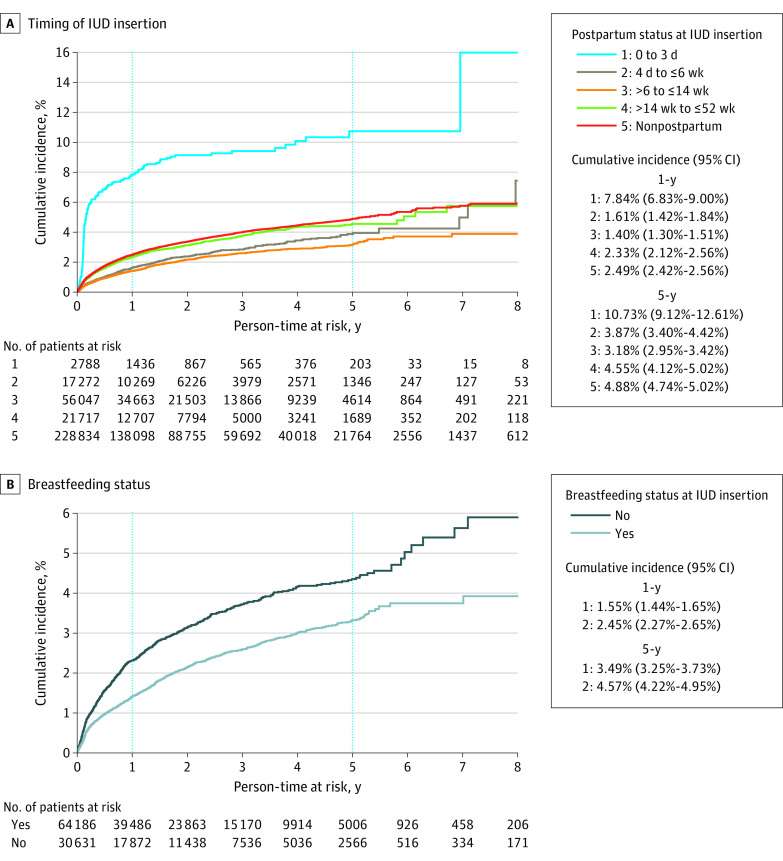
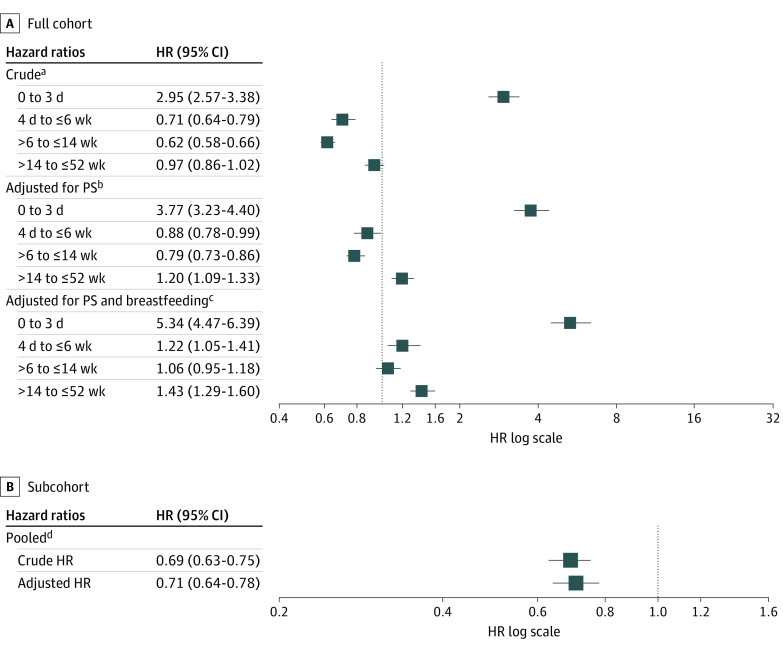
Results: The full cohort included 326 658 women (mean [SD] age, 32.0 [8.3] years; 38 911 [11.9%] Asian or Pacific Islander; 696 [0.2%] Hispanic Black; 56 180 [17.2%] Hispanic other; 42 501 [13.0%] Hispanic White; 28 323 [8.7%] non-Hispanic Black; 137 102 [42.0%] non-Hispanic White), and the subcohort included 94 817 women. Most IUDs were levonorgestrel-releasing (259 234 [79.4%]). There were 8943 expulsions. The 5-year cumulative incidence of IUD expulsion was highest for insertions 0 to 3 days post partum (10.73%; 95% CI, 9.12%-12.61%) and lowest for insertions more than 6 weeks to 14 or fewer weeks post partum (3.18%; 95% CI, 2.95%-3.42%). Adjusted HRs using women with non-post partum IUD insertion as the referent were 5.34 (95% CI, 4.47-6.39) for those with postpartum insertion at 0 to 3 days; 1.22 (95% CI, 1.05-1.41) for those with postpartum insertion at 4 days to 6 or fewer weeks; 1.06 (95% CI, 0.95-1.18) for those with postpartum insertion at more than 6 to 14 or fewer weeks; and 1.43 (95% CI, 1.29-1.60) for those with postpartum insertion at more than 14 to 52 or fewer weeks. In the subcohort, 5-year cumulative incidence was 3.49% (95% CI, 3.25%-3.73%) for breastfeeding women and 4.57% (95% CI, 4.22%-4.95%) for nonbreastfeeding women; the adjusted HR for breastfeeding vs not breastfeeding was 0.71 (95% CI, 0.64-0.78).

Conclusions and relevance: In this study of real-world data, IUD expulsion was rare but more common with immediate postpartum insertion. Breastfeeding was associated with lower expulsion risk.


Conflict of interest statement

Conflict of Interest Disclosures: Mss Armstrong, Postlethwaite, Alabaster, and Chillemi; Drs Raine-Bennett, Reed, Gatz, Getahun, Schoendorf, and Ritchey; and Mrs Merchant reported receiving grants from Bayer AG during the conduct of the study. Dr Raine-Bennett reported becoming chief executive officer of Medicines360, which holds a new drug application for a hormonal intrauterine device, on July 1, 2021, after work for this study was complete. Dr Gatz reported receiving grants from Bayer AG outside the submitted work. Dr Schoendorf reported receiving personal fees from Bayer AG during the conduct of the study and outside the submitted work. Drs Fassett, Shi, and Xie; Mss Chiu and Im; and Mr Takhar reported receiving grants from Bayer AG as employees of Kaiser Permanente Southern California (KPSC) during the conduct of the study. Dr Peipert reported receiving grants from Bayer, Merck, and CooperSurgical outside the submitted work. Mss Saltus and Wang, Drs Zhou and Anthony, and Mrs Hunter reported receiving support from Bayer AG and being employees of RTI Health Solutions, which provides consulting and other research services to pharmaceutical, device, governmental and nongovernmental organizations, during the conduct of the study. Dr Ritchey reported receiving personal fees from Bayer outside the submitted work and consulting for various pharmaceutical, medical device, and database companies regarding real-world use of data and conducting real-world data studies. Drs Pisa and Asiimwe reported being employees of Bayer during the conduct of the study and outside the submitted work. No other disclosures were reported.

Figures

Figure 1.
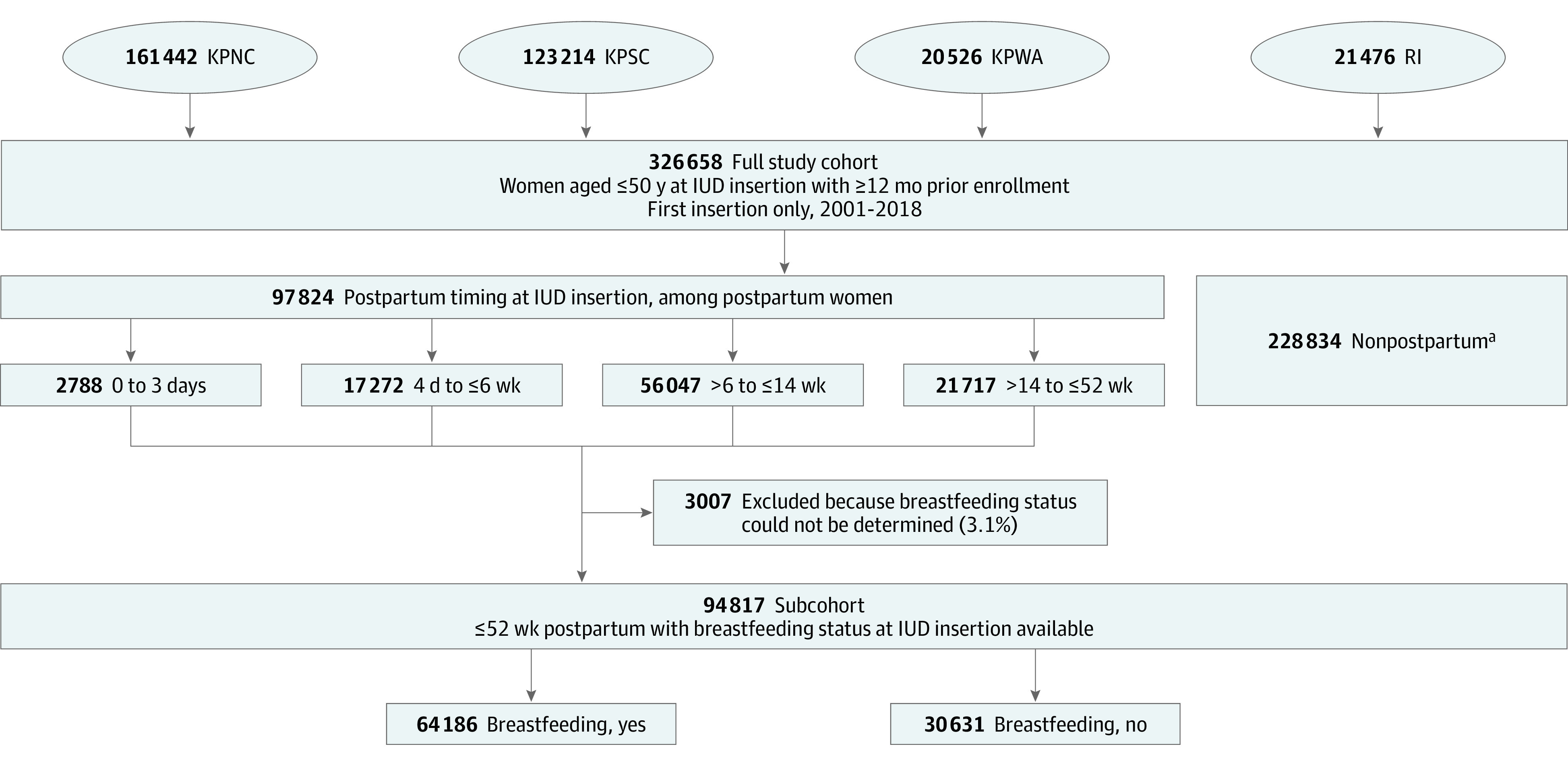
Figure 1.. Study Population
At the time of this study, the electronic health records identified biologic sex, not gender. We recognize that intrauterine (IUD) insertions occur among individuals with a uterus, most of whom identify as women, but a small proportion of individuals in our cohort may identify as a different gender. KPNC indicates Kaiser Permanente Northern California; KPSC, Kaiser Permanente Southern California; KPWA, Kaiser Permanente Washington; RI, Regenstrief Institute. aNonpostpartum women had no evidence of delivery within 52 weeks before IUD insertion, and included women more than 52 weeks post partum and nulliparous women.
Figure 2.
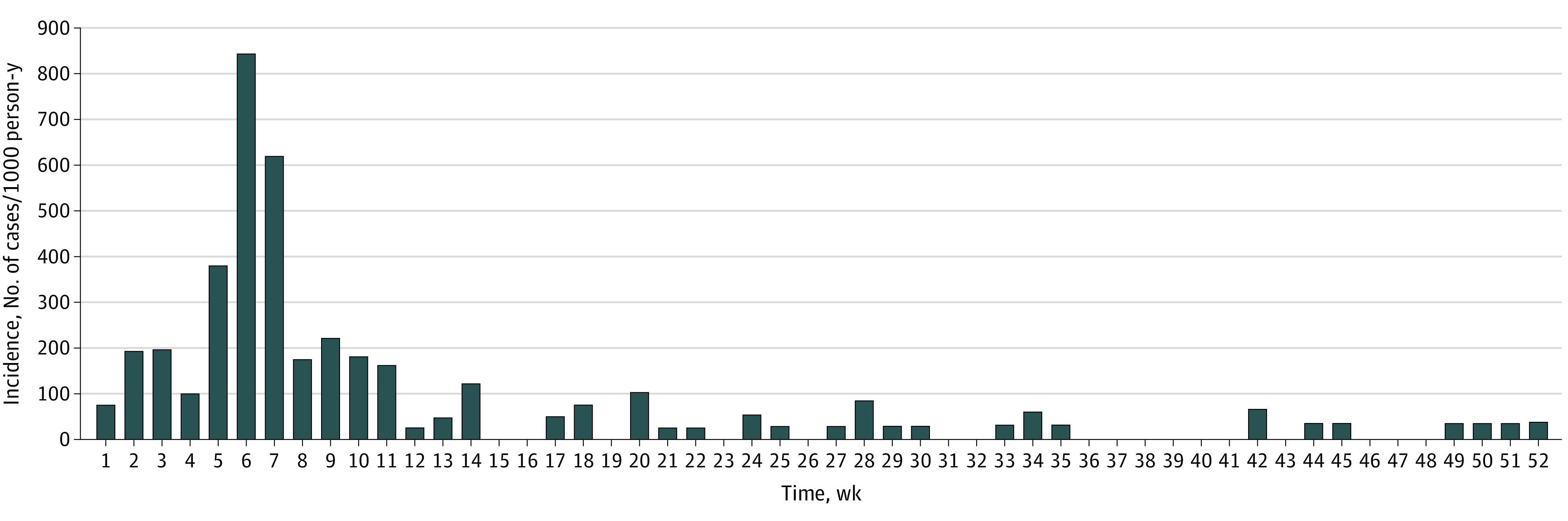
Figure 2.. Incidence Rate of Expulsion Detected by Week in the First Year Since Intrauterine Device Insertion for Women With Intrauterine Devices Inserted at 0 to 3 Days Post Partum
Figure 3.
Figure 3.. Cumulative Incidence of Intrauterine Device (IUD) Expulsion by Timing of IUD Insertion and Breastfeeding Status
Figure 4.
Figure 4.. Crude, Propensity Score (PS)–Adjusted, and Fully Adjusted Hazard Ratios (HRs) for Intrauterine Device Expulsion for Full Cohort and Subcohort
A, Reference group was women who were non–post partum. B, Reference group was women who were not breastfeeding. aPS variables were intrauterine device type; menorrhagia; age (in tertiles); race and ethnicity, calendar year index date; body mass index (categorical); dysmenorrhea; uterine fibroids; parity; concomitant gynecologic procedures; difficult insertion; clinician experience; site; and age × site, calendar year × site, parity × site interactions. bAdjusted for PSs using overlap weighting. cAdjusted for PSs and breastfeeding status. dPS variables were postpartum timing, intrauterine type, menorrhagia, age (in tertiles), race and ethnicity, calendar year index date, body mass index (categorical), dysmenorrhea; uterine fibroids; parity; concomitant gynecologic procedures; difficult insertion; clinician experience; live birth in 52 weeks before index date; site; and postpartum × site interaction.

References

    1. Trussell J. Contraceptive failure in the United States. Contraception. 2011;83(5):397-404. doi:10.1016/j.contraception.2011.01.021 - DOI - PMC - PubMed
    1. Winner B, Peipert JF, Zhao Q, et al. . Effectiveness of long-acting reversible contraception. N Engl J Med. 2012;366(21):1998-2007. doi:10.1056/NEJMoa1110855 - DOI - PubMed
    1. Averbach SH, Ermias Y, Jeng G, et al. . Expulsion of intrauterine devices after postpartum placement by timing of placement, delivery type, and intrauterine device type: a systematic review and meta-analysis. Am J Obstet Gynecol. 2020;223(2):177-188. doi:10.1016/j.ajog.2020.02.045 - DOI - PMC - PubMed
    1. American College of Obstetricians and Gynecologists’ Committee on Obstetric Practice . Committee opinion No. 670: immediate postpartum long-acting reversible contraception. Obstet Gynecol. 2016;128(2):e32-e37. doi:10.1097/AOG.0000000000001587 - DOI - PubMed
    1. Cunningham FG, Leveno KJ, Bloom SL, et al. . Williams Obstetrics. 25th ed. McGraw Hill; 2018.

Publication types