. 2022 Mar;19(2):513-527.
doi: 10.1007/s13311-022-01203-0. Epub 2022 Feb 28.

Ceruletide and Alpha-1 Antitrypsin as a Novel Combination Therapy for Ischemic Stroke

Affiliations

Ceruletide and Alpha-1 Antitrypsin as a Novel Combination Therapy for Ischemic Stroke

Alba Simats et al. Neurotherapeutics. 2022 Mar.

Abstract

Ischemic stroke is a primary cause of morbidity and mortality worldwide. Beyond the approved thrombolytic therapies, there is no effective treatment to mitigate its progression. Drug repositioning combinational therapies are becoming promising approaches to identify new uses of existing drugs to synergically target multiple disease-response mechanisms underlying complex pathologies. Here, we used a systems biology-based approach based on artificial intelligence and pattern recognition tools to generate in silico mathematical models mimicking the ischemic stroke pathology. Combinational treatments were acquired by screening these models with more than 5 million two-by-two combinations of drugs. A drug combination (CA) formed by ceruletide and alpha-1 antitrypsin showing a predicted value of neuroprotection of 92% was evaluated for their synergic neuroprotective effects in a mouse pre-clinical stroke model. The administration of both drugs in combination was safe and effective in reducing by 39.42% the infarct volume 24 h after cerebral ischemia. This neuroprotection was not observed when drugs were given individually. Importantly, potential incompatibilities of the drug combination with tPA thrombolysis were discarded in vitro and in vivo by using a mouse thromboembolic stroke model with t-PA-induced reperfusion, revealing an improvement in the forepaw strength 72 h after stroke in CA-treated mice. Finally, we identified the predicted mechanisms of action of ceruletide and alpha-1 antitrypsin and we demonstrated that CA modulates EGFR and ANGPT-1 levels in circulation within the acute phase after stroke. In conclusion, we have identified a promising combinational treatment with neuroprotective effects for the treatment of ischemic stroke.

Keywords: Alpha-1 antitrypsin; Ceruletide; Combinational therapy; Ischemic stroke; Neuroprotection.


Conflict of interest statement

A.S., L.R., and J.M. are co-inventors of a patent covering “Methods and compositions for treating ischaemia in a subject” (Application nº EP19382600.5), co-owned by VHIR and Anaxomics Biotech. Other authors declare no conflicts of interest.

Figures
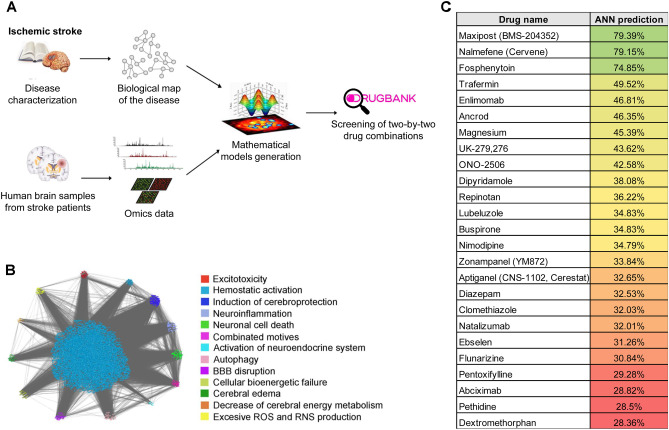
Fig. 1
Fig. 1
In silico mathematical models of ischemic stroke. A Schematic representation of the experimental design. B Snapshot of the full protein network modelled for ischemic stroke, visualized through the Cytoscape software platform. C Artificial Neural Network (ANN) predictive value of treatments already tested in clinical studies of ischemic stroke that have failed to show neuroprotective effect in patients. Gradient of colors (from red to green) indicates increasing % of ANN predictive value
Fig. 2
Fig. 2
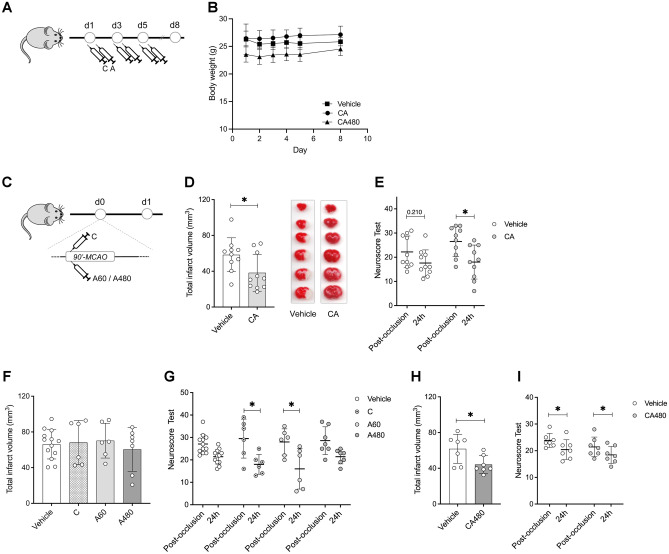
Administration of CA showed neuroprotection after stroke. A Experimental design of the safety study. B Body weight monitoring of animals treated with vehicle or ceruletide 0.1 mg/kg and alpha-1 antitrypsin at a dose of 60 mg/kg (CA60) or 480 mg/kg (CA480). C Experimental design of the efficacy study. D Infarct volumes (mm3) of animals treated with vehicle (n = 10) or ceruletide (0.1 mg/kg) + alpha-1 antitrypsin (60 mg/kg) (CA, n = 10) 24 h after cerebral ischemia. E Neurological deficits of animals evaluated post-occlusion (80 min after MCAO induction) and 24 h after the ischemic event. F Infarct volumes (mm3) of animals treated with vehicle (n = 10) or single drugs (n = 6 for ceruletide (C), n = 6 for alpha-1 antitrypsin at a dose of 60 mg/kg (A60) and n = 7 for alpha-1 antitrypsin at 480 mg/kg (A480)). G Neurological deficits of animals evaluated post-occlusion and 24 h after the ischemic event. H Infarct volumes (mm3) of animals treated with vehicle (n = 10) or ceruletide (0.1 mg/kg) + alpha-1 antitrypsin (480 mg/kg) (CA480, n = 10) 24 h after cerebral ischemia. I Neurological deficits of animals evaluated post-occlusion and 24 h after the ischemic event. In all cases, mean ± SD is shown. * indicates p < 0.05 and **p < 0.01
Fig. 3
Fig. 3
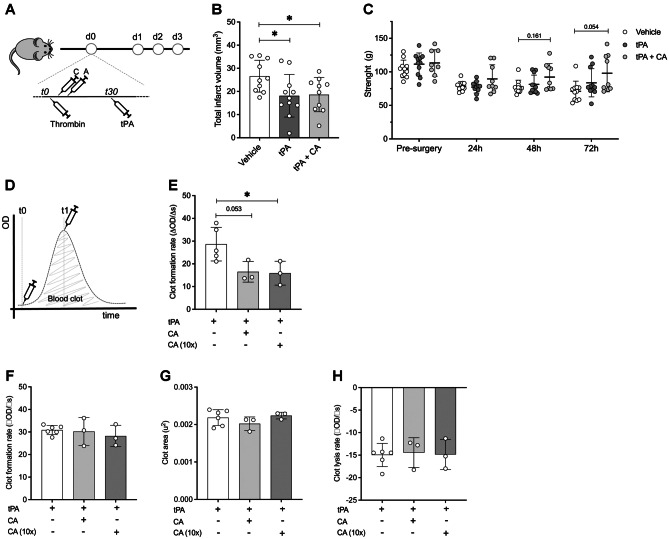
CA does not impair the thrombolytic activity of t-PA. A Experimental design. Drugs were given intravenously at a dose of 0.1 mg/kg for ceruletide and 60 mg/kg for alpha-1 antitrypsin. B Infarct volumes (mm3) of animals treated with vehicle (vehicle, n = 10), t-PA (n = 11), and t-PA together with ceruletide + alpha-1 antitrypsin (tPA + CA, n = 9) 24 h after cerebral ischemia. C Grip strength test measurements performed before MCAO and 24, 48, and 72 h after surgery. Histograms represent strength of both forepaws. Data was assessed in grams. D Representation of the clot formation and lysis experiment showing the two time-points of drug administration: t0 and t1. E Clot formation rate when drugs were added at t0. F Clot formation rate when drugs were added at t1. G Clot area and H clot lysis rate parameters of the experiments performed when drugs were added at t1. In all cases, mean ± SD is shown. * indicates p < 0.05 and #p < 0.1
Fig. 4
Fig. 4
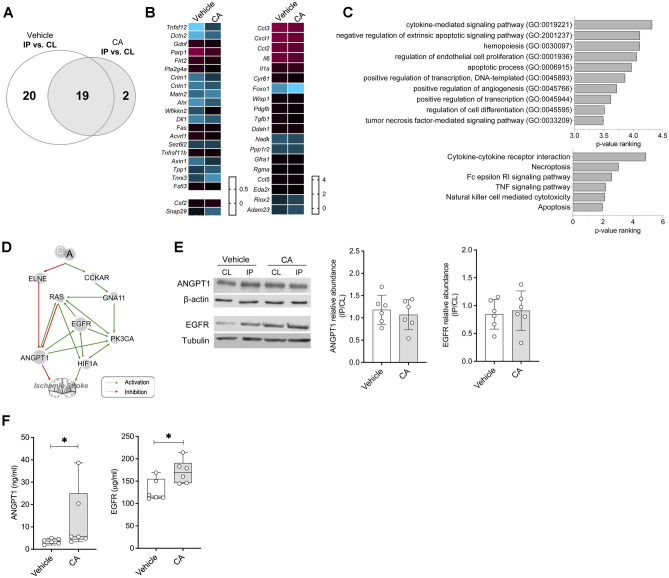
Identification and validation of the synergic mechanisms of action of CA. A Venn’s diagram of the differentially expressed proteins between the IP and CL brain hemispheres of vehicle- and CA-treated mice evaluated in the Olink proteomic array. B Heat maps of the differentially expressed proteins between the IP and CL brain hemispheres of mice treated with vehicle (left) or CA (right). C Biological significance analysis of the proteins modulated by CA. D Predicted molecular mechanism of action of CA on ischemic stroke obtained from the in silico generated mathematical models of stroke. E Representative Western blot images and quantification of brain levels of ANGPT1 and EGFR in vehicle- and CA-treated animals (n = 5/group). The ratio between IP and CL levels within each animal is depicted. F Quantification of ANGPT1 and EGFR levels in mouse plasma samples (n = 7/group). In all cases, mean ± SD is shown. * indicates p < 0.05 and **p < 0.01. Abbreviations: ANGPT1, angiopoetin-1; CCKAR, cholecystokinin receptor type A; CL, healthy contralateral brain hemisphere; EGFR, epidermal growth factor receptor; ELNE, neutrophil elastase; GNA11, G protein subunit alpha 11; HIF1A; hypoxia-inducible factor 1-alpha; IP, ipsilateral brain hemisphere; PK3CA, phosphatidylinositol-4,5-bisphosphate 3-kinase catalytic subunit alpha

References

    1. Benjamin EJ, Blaha MJ, Chiuve SE, Cushman M, Das SR, Deo R, et al. Heart disease and stroke statistics-2017 update: a report from the American Heart Association. Circulation. 2017;135:e146–603. doi: 10.1161/CIR.0000000000000485. - DOI - PMC - PubMed
    1. Fiehler J, Gerloff C. Mechanical thrombectomy in stroke. Dtsch Arztebl Int. 2015;112:830–836. - PMC - PubMed
    1. Hacke W, Kaste M, Bluhmki E, Brozman M, Dávalos A, Guidetti D, et al. Thrombolysis with alteplase 3 to 4.5 hours after acute ischemic stroke. N Engl J Med [Internet]. 2008;359:1317–29. Available from: http://www.nejm.org/doi/abs/10.1056/NEJMoa0804656. - DOI - PubMed
    1. Shkirkova K, Saver JL, Starkman S, Wong G, Weng J, Hamilton S, et al. Frequency, predictors, and outcomes of prehospital and early postarrival neurological deterioration in acute stroke: exploratory analysis of the FAST-MAG randomized clinical trial. JAMA Neurol. 2018. - PMC - PubMed
    1. Onwuekwe I, Ezeala-Adikaibe B. Ischemic stroke and neuroprotection. Ann Med Health Sci Res. 2012. - PMC - PubMed

Publication types