. 2022 Feb 28;12(1):3253.
doi: 10.1038/s41598-022-06754-y.

Tunable x-ray free electron laser multi-pulses with nanosecond separation

Affiliations

Tunable x-ray free electron laser multi-pulses with nanosecond separation

Franz-Josef Decker et al. Sci Rep. .

Abstract

X-ray Free Electron Lasers provide femtosecond x-ray pulses with narrow bandwidth and unprecedented peak brightness. Special modes of operation have been developed to deliver double pulses for x-ray pump, x-ray probe experiments. However, the longest delay between the two pulses achieved with existing single bucket methods is less than 1 picosecond, thus preventing the exploration of longer time-scale dynamics. We present a novel two-bucket scheme covering delays from 350 picoseconds to hundreds of nanoseconds in discrete steps of 350 picoseconds. Performance for each pulse can be similar to the one in a single pulse operation. The method has been experimentally tested with the Linac Coherent Light Source (LCLS-I) and the copper linac with LCLS-II hard x-ray undulators.


Conflict of interest statement

The authors declare no competing interests.

Figures

Figure 1
Figure 1
Schematic layout of the LCLS copper linac configuration. Electron bunches are extracted at a normal conducting gun and subsequently accelerated in Linac sections and compressed in the first (BC1) and second (BC2) bunch compressors. A laser heater increases the electrons energy spread to suppress a microbunching instability. X-band linearizer L1X provides longitudinal time-energy electron bunch control for improved bunch compression and reduces phase space nonlinearities. Transverse deflecting cavities (XTCAV) are mainly used for diagnostic purposes. In the beam switchyard (BSY), the electron bunches are directed to either SXR or HXR undulator lines. In the undulator lines, the electron bunches produce x-ray Free-electron laser pulses. Downstream from the undulator, the electrons are discarded after a vertical bend in the beam dumps, while the x-rays are delivered to the experimental stations.
Figure 2
Figure 2
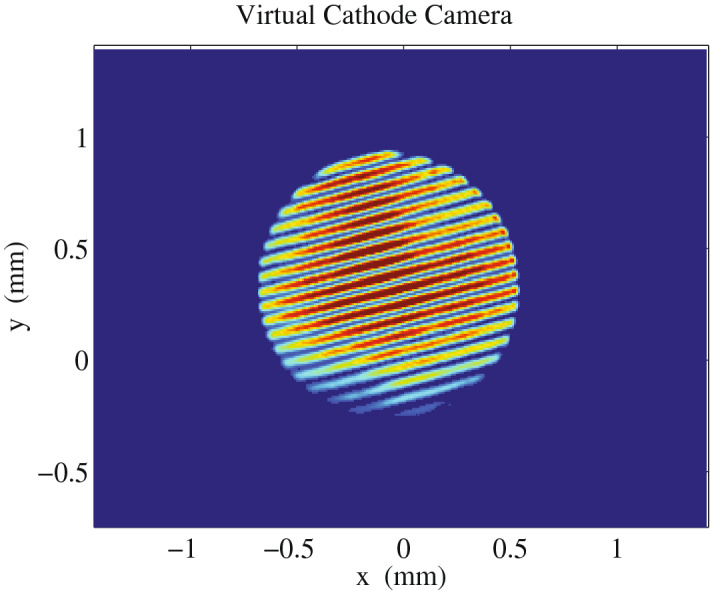
Interference fringes at the Virtual Cathode Camera when the two UV drive lasers are overlapped in time.
Figure 3
Figure 3
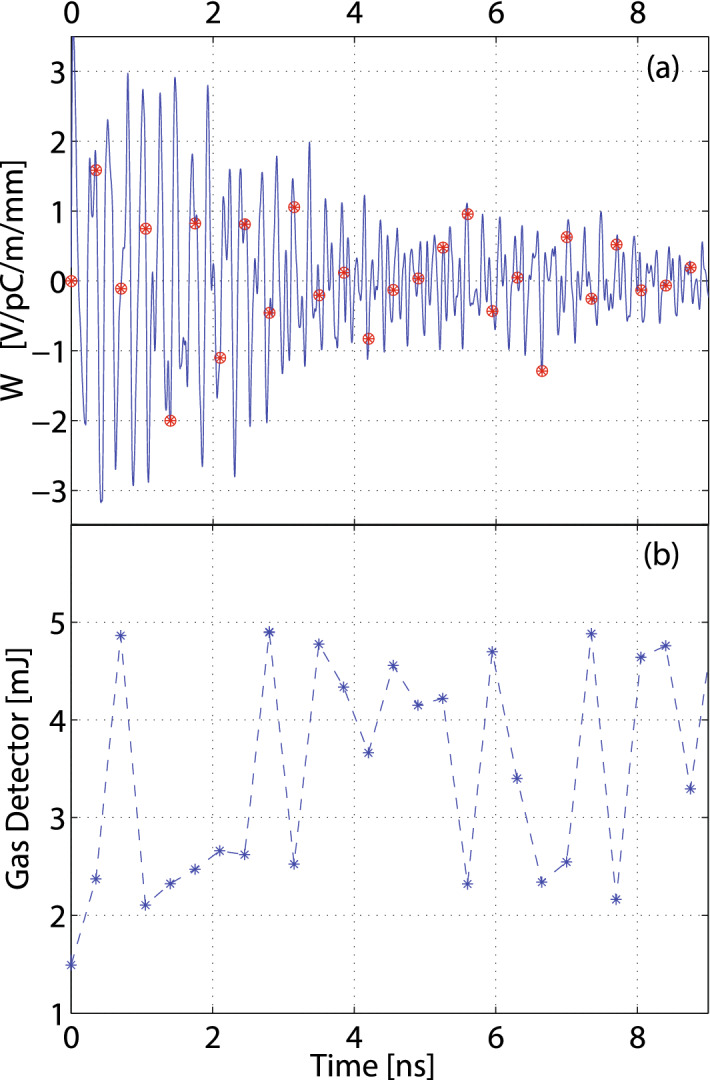
Transverse wakefields and their impact on the lasing process for short delays: (a) long-range transverse wakefield for the S-band accelerating structure. Red dots represent 350 ps sampling, (b) typical LCLS-I lasing energy performance as a function of the two-bucket delay (with no active trajectory correction).
Figure 4
Figure 4
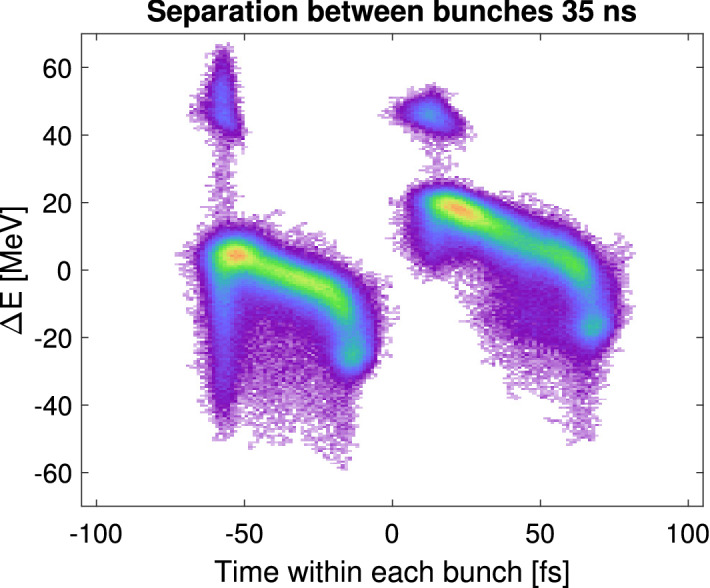
XTCAV image of the two-bunch beam with 35 ns separation (overlapped on the same fs scale). Leading (right) bunch produced about 0.5 mJ and the trailing (left) bunch lased at about 2 mJ at 9 keV photon energy.
Figure 5
Figure 5
Micro-Channel Plate traces for different two-bucket delay configurations in the short delay regime. The recorded signal (black) is decomposed in the sum (dashed red) of two contributions, the leading pulse (blue) and the trailing pulse (green). The recorded signal has been filtered in the frequency domain removing components corresponding to 1, 2 and 3 samples separation.
Figure 6
Figure 6
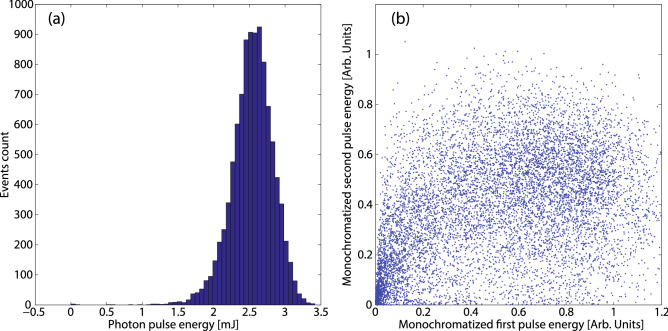
(a) Pulse energy histogram for two-bucket double pulses before monochromator. (b) Intensity of the first pulse vs intensity of the second pulse on 10000 consecutive shots after the monochromator.
Figure 7
Figure 7
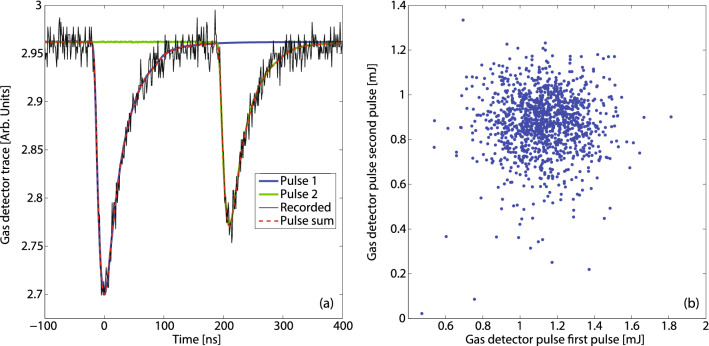
(a) Single-shot gas monitor detector traces for a two-bucket configuration with 210 ns delay (CBXFEL-like case). The recorded signal (black) is decomposed in the sum (dashed red) of two contributions, the first pulse (blue) and the trailing pulse (green). The first pulse energy was measured to be 1.25 mJ, and the second pulse energy was measured to be 0.91 mJ. (b) Intensity of the first pulse versus intensity of the second pulse on 1200 consecutive shots.
Figure 8
Figure 8
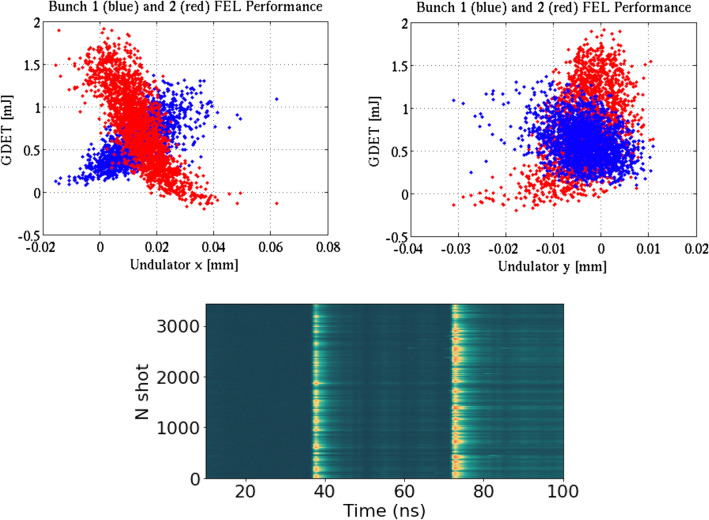
X and Y undulator trajectory displacements in the HXR line for the first and second electron bunches, 35 ns apart, as a function of their XFEL performance (top row). LCLS-HXR double bunch time-resolved profile was registered with a fast rise-time diode (bottom).
Figure 9
Figure 9
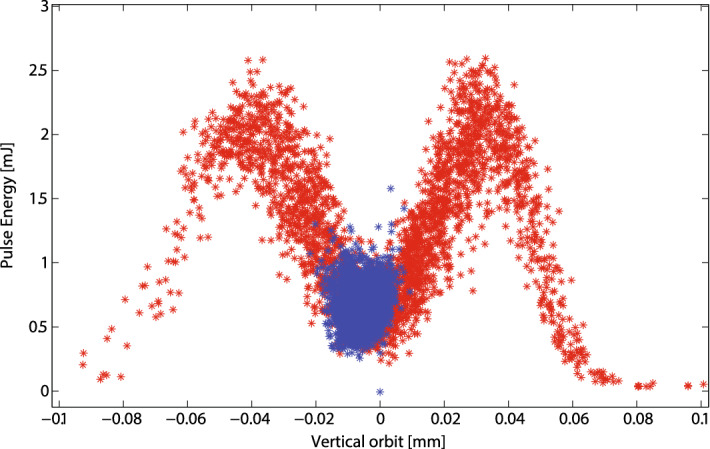
9.5 keV x-ray pulse energies vs largest vertical electrons measured trajectory in the undulator, for a configuration involving two different x-ray pointing directions (LCLS-I). Two different pointings are achieved with the electron bunches travelling on different vertical orbits. For measured orbits of ±40μm a single bunch reaches full lasing. For measured orbits close to the undulator axis, both bunches are lasing with a reduction of performance. The red dataset was recorded with a large dispersion of transverse kicks imparted by TCAV3 and shows the full correlation. The blue dataset represents the actual working point with small orbit dispersion.

References

    1. Emma P, et al. First lasing and operation of an angstrom-wavelength free-electron laser. Nat. Photon. 2009;4:641–647. doi: 10.1038/nphoton.2010.176. - DOI
    1. Ishikawa T, et al. A compact x-ray free-electron laser emitting in the sub-angstrom region. Nat. Photon. 2012;6:540–544. doi: 10.1038/nphoton.2012.141. - DOI
    1. Allaria E, et al. Two-stage seeded soft-x-ray free-electron laser. Nat. Photon. 2013;7:913–918. doi: 10.1038/nphoton.2013.277. - DOI
    1. Ackermann W, et al. Operation of a free-electron laser from the extreme ultraviolet to the water window. Nat. Photon. 2007;1:336–342. doi: 10.1038/nphoton.2007.76. - DOI
    1. Bostedt C, et al. Linac coherent light source: the first five years. Rev. Mod. Phys. 2016;88:015007. doi: 10.1103/RevModPhys.88.015007. - DOI