. 2022 Feb 28;12(1):3315.
doi: 10.1038/s41598-022-07365-3.

The role of the anterior insular during targeted helping behavior in male rats

Affiliations

The role of the anterior insular during targeted helping behavior in male rats

Stewart S Cox et al. Sci Rep. .

Abstract

Empathy, the understanding of the emotional state of others, can be examined across species using the Perception Action Model, where shared affect promotes an action by "Observers" to aid a distressed "Target". The anterior insula (AI) has garnered interest in empathic behavior due to its role integrating sensory and emotional information of self and other. In the following studies, the AI was inhibited pharmacologically and chemogenetically during targeted helping. We demonstrate the insula is active during, and is necessary for the maintenance of, targeted helping. Analysis of ultrasonic vocalizations revealed distress calls from Targets increased when Observers' helping was attenuated due to insula inhibition. Targets' elevated distress was directly correlated to Observers' diminished helping behavior, suggesting emotional transfer between Observer and Target is blunted following Observer AI inhibition. Finally, the AI may selectively blunt targeted helping, as social exploration did not change in a social reward place conditioning task. These studies help further establish the anterior insula as a critical node in the empathic brain during targeted helping, even in the absence of direct social contact.


Conflict of interest statement

The authors declare no competing interests.

Figures
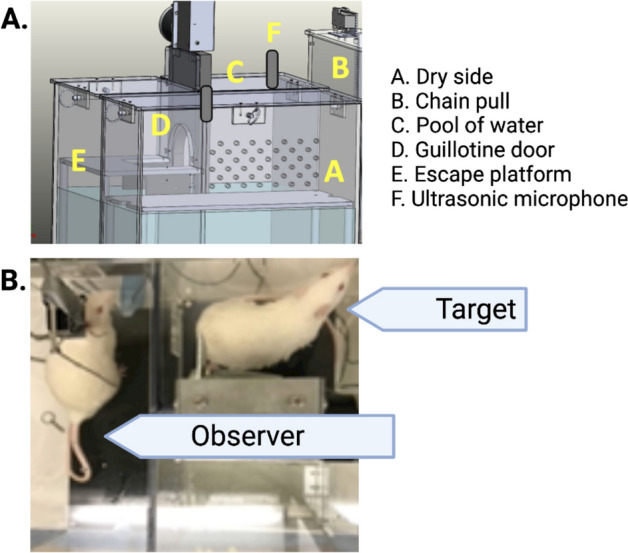
Figure 1
Figure 1
The insula is active during targeted helping. (A) Depiction of the apparatus used during the social contact-independent targeted helping task. Observers pull a chain that opens an automated guillotine door, allowing the Target to escape the distressing context into a separate dry platform. Ultrasonic vocalizations were recorded in some of the following experiments using two high quality condenser microphones attached to the top of the dry and water compartments. (B) This photo depicts an Observer in the dry side of the apparatus and a Target on the escape platform after being released from the pool of water.
Figure 2
Figure 2
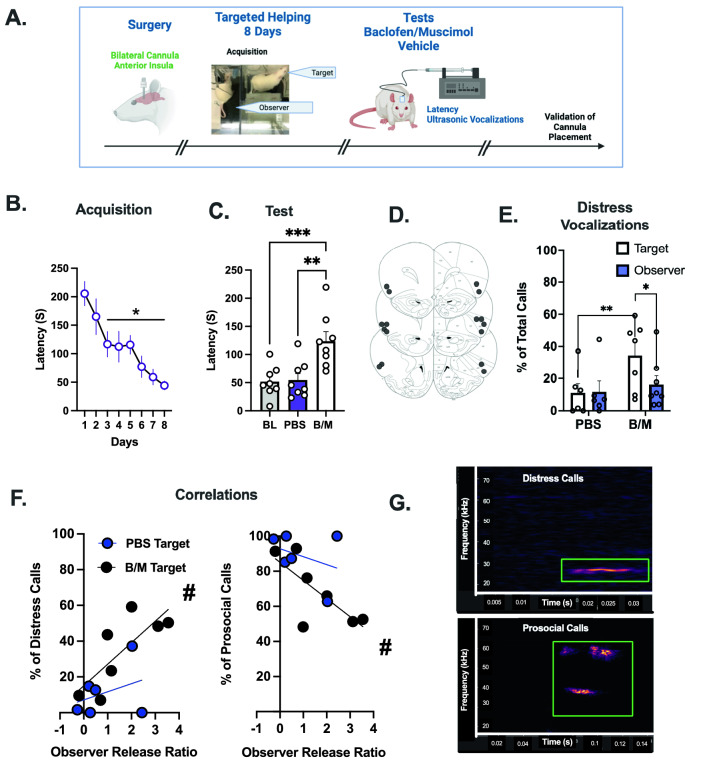
Pharmacological Inhibition of the AI Attenuates Targeted Helping. (A) A timeline for Experiment 2. Direct pharmacological inhibition of the anterior insula (AI) via bilateral indwelling cannulae was performed to determine if AI activity is necessary for social contact-independent targeted helping. Following surgeries, Observers performed 8 days of acquisition in the targeted helping task. (B) The latency for Observers to release the Target significantly decreased across time, with the latencies on days 3–8 significantly faster compared to day 1, indicating Observers learned to release their conspecific. (C) On test days 9–10, rats either received direct micro infusions of baclofen/muscimol (B/M) or phosphate buffered saline (PBS) into the AI. Rats that received B/M demonstrated a significantly potentiated change in latency compared to the PBS group and to baseline (BL; average of the last 2 days of acquisition). (D) A representative image of the cannulae placement of each rat bilaterally. (E) Ultrasonic vocalizations (USV) were recorded on test days, and distress calls were analyzed as a proportion of total calls made during the task. Targets made significantly more USV within the distress frequency range on tests days when their respective Observer received B/M infusions compared to PBS. (F) To understand the relationship between the blunted helping behavior and enhanced distress calls, a Pearson correlation was performed between Observers’ release ratio (AcqTest-AcqBLAcqBL) and the percent of distress (left) and prosocial (right) calls made by their respective Targets. A significant correlation was found on days when Observers received B/M infusion, but not PBS. (G) Representative images of USVs that fall within the distress frequency range (18–35 kHz) and prosocial range (> 35 kHz) are shown here. *significant difference from day 1, p < 0.05. **significant difference from PBS, p < 0.005. ***significant difference from BL, p < 0.005. # Significant correlation, p < 0.05.
Figure 3
Figure 3
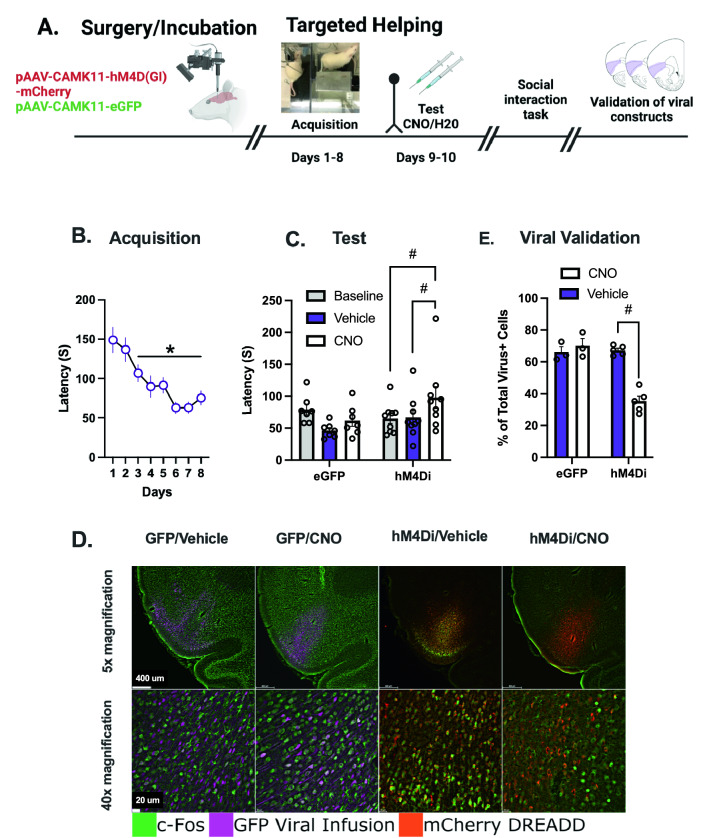
Experiment 3, Chemogenetic Inhibition of the AI Attenuates Targeted Helping. (A) Experimental 3 timeline. Male Sprague Dawley Observer rats underwent stereotax surgeries and received micro infusions of either the control virus (AAV8-CaMKIIα-EGFP, “EGFP”, n = 8) or the inhibitory DREADD virus (AAV8-CaMKIIα-hM4D(Gi), “hM4Di”, n = 10). After 3 weeks of recovery and viral incubation, rats went through the targeted helping task for 8 days. On the final 2 days of targeted helping, Observers received either clozapine-N-oxide (CNO) or water injections (i.p.) in a within-subjects experimental paradigm. Next, rats underwent a social reward place conditioning task (shown in Fig. 4). On the day animals were sacrificed, Observers were injected with either CNO or water and again performed the targeted helping task. (B) During the targeted helping task, Observers learned to release a distressed conspecific faster on days 3–8 compared to day 1. (C) On test days, Observers infused with the Gi DREADD injected with CNO had latencies significantly higher than their baseline (BL, days 7–8) and vehicle. There were no differences in eGFP viral control animals in response to CNO or vehicle. (D) Representative images of the AI in the viral control (EGFP) and hM4Di groups with either vehicle or CNO infusions. (E) 90 min following targeted helping, the animals were sacrificed to stain for c-fos in the AI to confirm both placement and activity of the inhibitory DREADDs by quantifying Fos + /Virus + cells as a percentage of total Virus + cells. Rats having received the Gi DREADD infusion and CNO injections 30 min prior to behavior had significantly fewer Fos + /Virus + cells compared to all other animals, indicating the DREADD construct was activated exclusively following CNO injection. *Significant difference from day 1, p < 0.05. #Significant difference from Veh and/or BL, p < 0.05
Figure 4
Figure 4
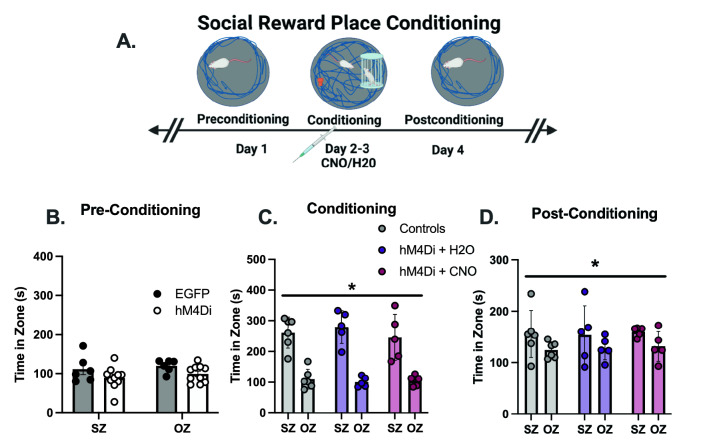
Social Interaction Does Not Differ Following Insula Inhibition. (A) Rats underwent a social reward place conditioning task. On preconditioning day 1, rats were placed in the open field and given 10 min to explore the environment. On conditioning days 2–4, Observers were injected with water or CNO 30 min prior to the task in a between subject’s design and given the opportunity to explore an unfamiliar rat and an unfamiliar object simultaneously. Finally, on day 5, rats were returned to the empty open field for a post-conditioning assessment. Time spent in the social zone (SZ) and the object zone (OZ) were recorded. (B) Rats did not exhibit a side bias within the open field, equally preferring the SZ and OZ on pre-conditioning day. (C) On conditioning days, a main effect of zone was observed in which all groups preferred the SZ over the OZ. (D) During post-conditioning day 5, a main effect of side was again observed, in which the time spent in the SZ was greater than the OZ. However, all groups equally preferred the SZ over the OZ. *Significant effect of zone, p < 0.05.

References

    1. Hoffman ML. Developmental synthesis of affect and cognition and its implications for altruistic motivation. Dev. Psychol. 1975;11(5):607–622. doi: 10.1037/0012-1649.11.5.607. - DOI
    1. de Waal FBM. The Age of Empathy: Nature’s Lessons for a Kinder Society. Three Rivers Press; 2009.
    1. Lahvis GP. Social reward and empathy as proximal contributions to altruism: The camaraderie effect. Curr. Top. Behav. Neurosci. 2017;30:127–157. doi: 10.1007/7854_2016_449. - DOI - PMC - PubMed
    1. Meyza KZ, Bartal IB-A, Monfils MH, Panksepp JB, Knapska E. The roots of empathy: Through the lens of rodent models. Neurosci. Biobehav. Rev. 2017;76(Pt B):216–234. doi: 10.1016/j.neubiorev.2016.10.028. - DOI - PMC - PubMed
    1. Decety J. The neuroevolution of empathy. Ann. N. Y. Acad. Sci. 2011;1231:35–45. doi: 10.1111/j.1749-6632.2011.06027.x. - DOI - PubMed

Publication types