


Risk factors for HCC in contemporary cohorts of patients with cirrhosis
- PMID: 35229329
- PMCID: PMC9433461
- DOI: 10.1002/hep.32434
Risk factors for HCC in contemporary cohorts of patients with cirrhosis
Abstract
Background and aims: Etiological risk factors for cirrhosis have changed in the last decade. It remains unclear to what extent these trends in cirrhosis risk factors have changed HCC risk.
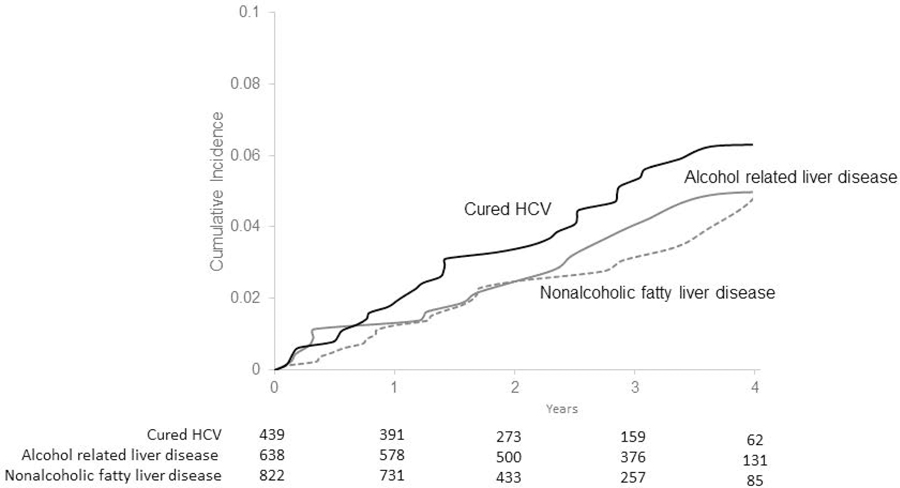
Approach and results: We used data from two contemporary, prospective multiethnic cohorts of patients with cirrhosis: the Texas Hepatocellular Carcinoma Consortium Cohort and the Houston Veterans Administration Cirrhosis Surveillance Cohort. Patients with cirrhosis were enrolled from seven US centers and followed until HCC diagnosis, transplant, death, or June 30, 2021. We calculated the annual incidence rates for HCC and examined the effects of etiology, demographic, clinical, and lifestyle factors on the risk of HCC. We included 2733 patients with cirrhosis (mean age 60.1 years, 31.3% women). At enrollment, 19.0% had active HCV, 23.3% had cured HCV, 16.1% had alcoholic liver disease, and 30.1% had NAFLD. During 7406 person-years of follow-up, 135 patients developed HCC at an annual incidence rate of 1.82% (95% CI, 1.51-2.13). The annual HCC incidence rate was 1.71% in patients with cured HCV, 1.32% in patients with alcoholic liver disease, and 1.24% in patients with NAFLD cirrhosis. Compared to patients with NAFLD, the risk of progression to HCC was 2-fold higher in patients with cured HCV (HR, 2.04; 95% CI, 1.24-3.35). Current smoking (HR, 1.63; 95% CI, 1.01-2.63) and overweight/obesity (HR, 1.79; 95% CI, 1.08-2.95) were also associated with HCC risk.
Conclusions: HCC incidence among patients with cirrhosis was lower than previously reported. HCC risk was variable across etiologies, with higher risk in patients with HCV cirrhosis and lower risk in those with NAFLD cirrhosis. Current smoking and overweight/obesity increased HCC risk across etiologies.
Copyright © 2023 American Association for the Study of Liver Diseases.
Figures
References
-
- Nathalie Ganne-Carrié 1 CC, Bourcier 3 Valérie, Archambeaud 4 Isabelle, Perarnau 5 Jean-Marc, Oberti 6 Frédéric, Roulot 7 Dominique, Moreno 8 Christophe, Louvet 9 Alexandre, Dao 10 Thông, Moirand 11 Romain, Goria 12 Odile, Nguyen-Khac 13 Eric, Carbonell 14 Nicolas, Antonini 15 Térésa, Pol 16 Stanislas, de Ledinghen 17 Victor, Ozenne 18 Violaine, Henrion 19 Jean, Péron 20 Jean-Marie, Tran 21 Albert, Perlemuter 22 Gabriel, Amiot 23 Xavier, Zarski 24 Jean-Pierre, Beaugrand 3 Michel, Chevret 2 Sylvie. Estimate of hepatocellular carcinoma incidence in patients with alcoholic cirrhosis. J Hepatol. 2018;69(6):1274–1283. doi:10.1016 - PubMed
Publication types
MeSH terms
Grants and funding
LinkOut - more resources
Full Text Sources
Medical
