


Comparison of lichen sclerosus in boys and girls: A systematic literature review of epidemiology, symptoms, genetic background, risk factors, treatment, and prognosis
- PMID: 35229894
- PMCID: PMC9545843
- DOI: 10.1111/pde.14967
Comparison of lichen sclerosus in boys and girls: A systematic literature review of epidemiology, symptoms, genetic background, risk factors, treatment, and prognosis
Abstract
Background: Studies concerning pediatric lichen sclerosus are limited, and, to date, there have been no studies comparing the course of lichen sclerosus in boys and girls. We sought to examine all publications on boys and girls with lichen sclerosus and assess and compare epidemiology, symptoms and signs, genetic background, risk factors, treatment, and prognosis.
Methods: A systematic search was performed in the Embase, Medline, Cochrane, and Web of Science databases. Inclusion criteria were information on children ages 0-18 years and a clinical or histologic diagnosis of lichen sclerosus. Literature from 1985 to 2021 was reviewed.
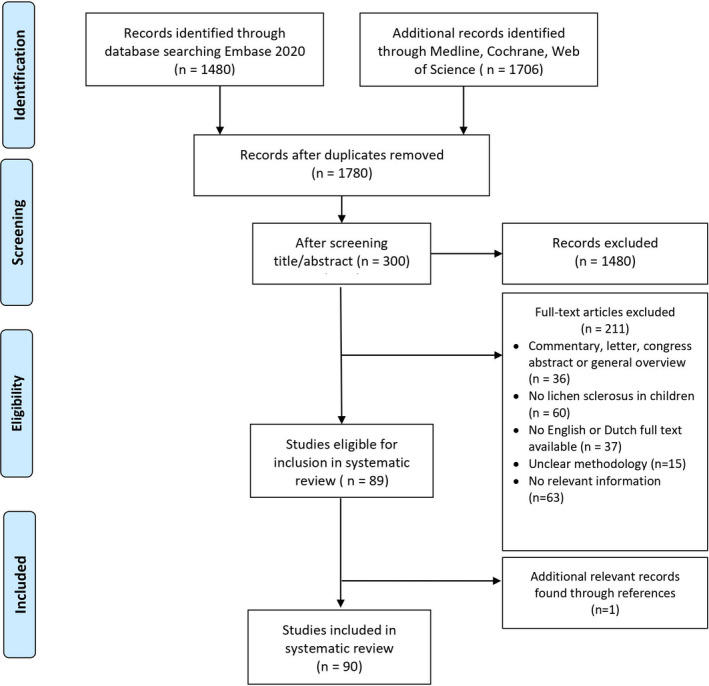
Results: A total of 1780 articles were retrieved from the search, of which 90 articles were eligible for inclusion. Boys and girls present similarly on many aspects; nonetheless, treatment and follow-up are approached differently.
Conclusions: Though the clinical approach is often different, lichen sclerosus in boys and girls demonstrates many similarities. More research is needed, especially on follow-up, to gain a better understanding of the course of lichen sclerosus and establish an advanced management plan for children.
Keywords: balanitis xerotica obliterans; children; lichen sclerosus; pediatric lichen sclerosus; phimosis.
© 2022 The Authors. Pediatric Dermatology published by Wiley Periodicals LLC.
Conflict of interest statement
The authors have no conflicts of interest to declare.
Figures
References
-
- Breisky . Ein wenig beobachtet Form von Hautatrophie am Pudendum muliebre. Z Heilk. 1885;6:69.
-
- Hallopeau H. Leçons clinique sur les maladies cutanées et syphilitiques. Union Méd. 1887;43:742.
-
- Tong LX, Sun GS, Teng JMC. Pediatric lichen sclerosus: a review of the epidemiology and treatment options. Pediatr Dermatol. 2015;32(5):593‐599. - PubMed
-
- Stühmer A. Balanitis xerotic obliterans (post‐operationem) und ihre Beziehungen zur "Kraurosis glandis et praeputii penis". Arch F Dermat U. 1928;165:343.
Publication types
MeSH terms
LinkOut - more resources
Full Text Sources
