


Non-targeted metabolomics and associations with per- and polyfluoroalkyl substances (PFAS) exposure in humans: A scoping review
- PMID: 35231839
- PMCID: PMC8969205
- DOI: 10.1016/j.envint.2022.107159
Non-targeted metabolomics and associations with per- and polyfluoroalkyl substances (PFAS) exposure in humans: A scoping review
Abstract
Objective: To summarize the application of non-targeted metabolomics in epidemiological studies that assessed metabolite and metabolic pathway alterations associated with per- and polyfluoroalkyl substances (PFAS) exposure.
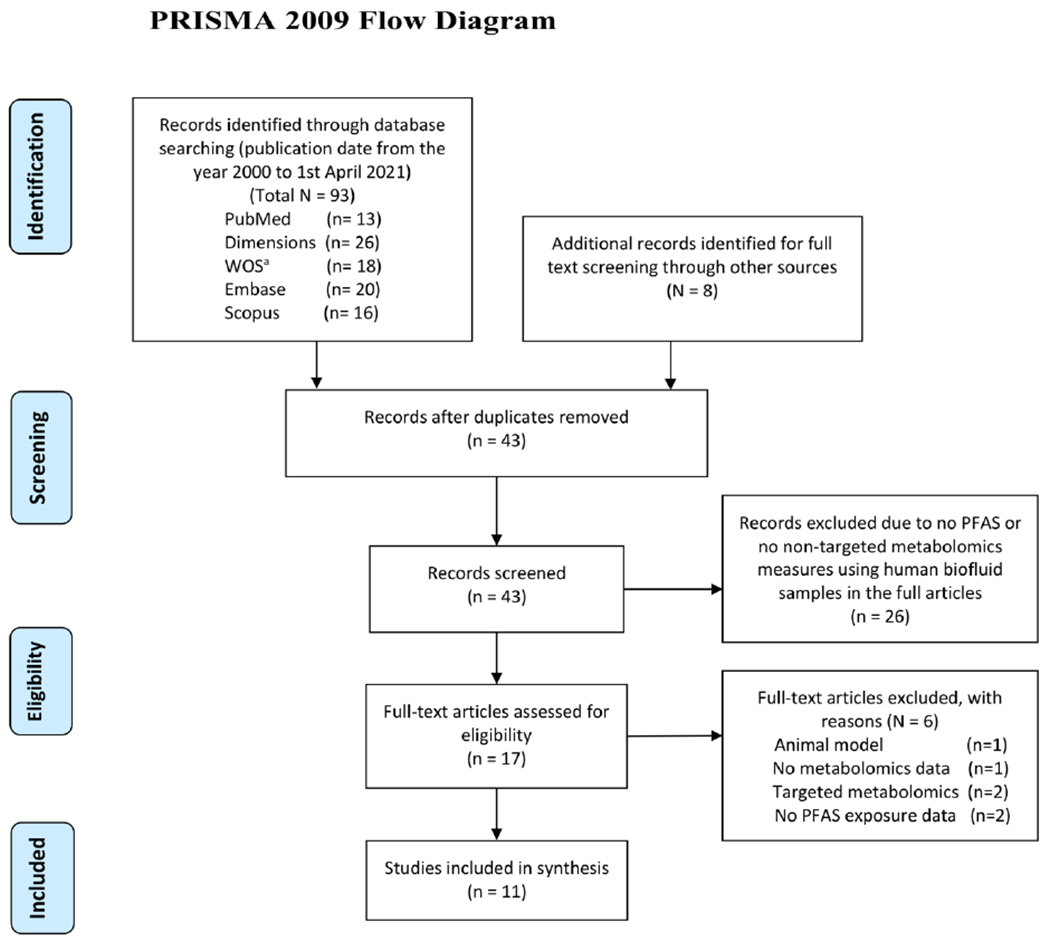
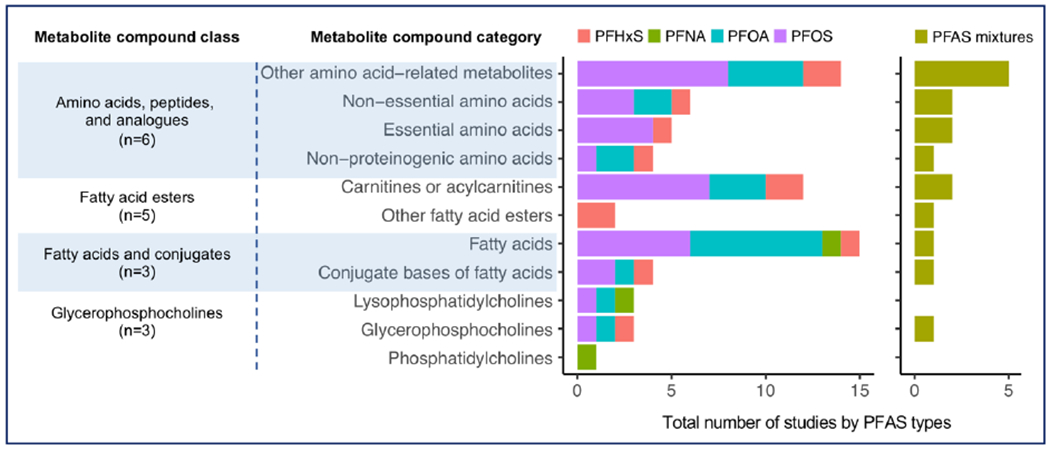
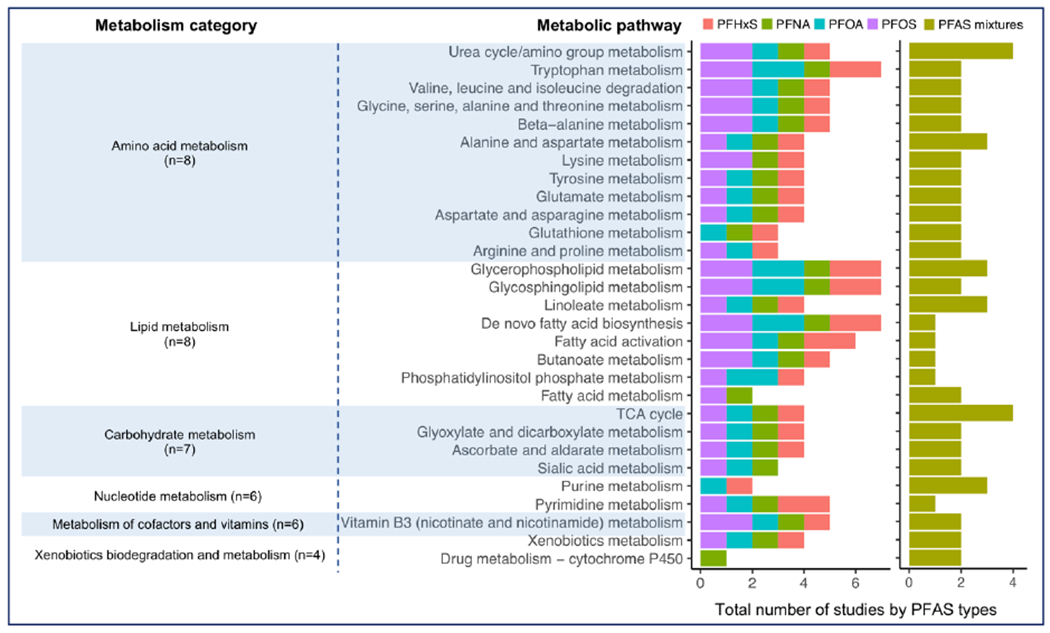
Recent findings: Eleven human studies published before April 1st, 2021 were identified through database searches (PubMed, Dimensions, Web of Science Core Collection, Embase, Scopus), and citation chaining (Citationchaser). The sample sizes of these studies ranged from 40 to 965, involving children and adolescents (n = 3), non-pregnant adults (n = 5), or pregnant women (n = 3). High-resolution liquid chromatography-mass spectrometry was the primary analytical platform to measure both PFAS and metabolome. PFAS were measured in either plasma (n = 6) or serum (n = 5), while metabolomic profiles were assessed using plasma (n = 6), serum (n = 4), or urine (n = 1). Four types of PFAS (perfluorooctane sulfonate(n = 11), perfluorooctanoic acid (n = 10), perfluorohexane sulfonate (n = 9), perfluorononanoic acid (n = 5)) and PFAS mixtures (n = 7) were the most studied. We found that alterations to tryptophan metabolism and the urea cycle were most reported PFAS-associated metabolomic signatures. Numerous lipid metabolites were also suggested to be associated with PFAS exposure, especially key metabolites in glycerophospholipid metabolism which is critical for biological membrane functions, and fatty acids and carnitines which are relevant to the energy supply pathway of fatty acid oxidation. Other important metabolome changes reported included the tricarboxylic acid (TCA) cycle regarding energy generation, and purine and pyrimidine metabolism in cellular energy systems.
Conclusions: There is growing interest in using non-targeted metabolomics to study the human physiological changes associated with PFAS exposure. Multiple PFAS were reported to be associated with alterations in amino acid and lipid metabolism, but these results are driven by one predominant type of pathway analysis thus require further confirmation. Standardizing research methods and reporting are recommended to facilitate result comparison. Future studies should consider potential differences in study methodology, use of prospective design, and influence from confounding bias and measurement errors.
Keywords: Exposome; Metabolomics; Perfluorinated compounds; Persistent organic pollutants; Polyfluoroalkyl substances.
Copyright © 2022 The Authors. Published by Elsevier Ltd.. All rights reserved.
Figures
References
-
- Alderete TL; Jin R; Walker DI; Valvi D; Chen Z; Jones DP; Peng C; Gilliland FD; Berhane K; Conti DV; Goran MI; Chatzi L Perfluoroalkyl substances, metabolomic profiling, and alterations in glucose homeostasis among overweight and obese Hispanic children: A proof-of-concept analysis. Environ Int 2019;126:445–453 - PMC - PubMed
-
- Alemany M The problem of nitrogen disposal in the obese. Nutr Res Rev 2012;25:18–28 - PubMed
-
- Barnes S; Benton HP; Casazza K; Cooper SJ; Cui X; Du X; Engler JA; Kabarowski JH; Li S; Pathmasiri W; Prasain JK; Renfrow MB; Tiwari HK Training in metabolomics research. II. Processing and statistical analysis of metabolomics data, metabolite identification, pathway analysis, applications of metabolomics and its future. J Mass Spectrom 2016a;51:535–548 - PMC - PubMed
-
- Barnes S; Benton HP; Casazza K; Cooper SJ; Cui X; Du X; Engler JA; Kabarowski JH; Li S; Pathmasiri W; Prasain JK; Renfrow MB; Tiwari HK Training in metabolomics research. I. Designing the experiment, collecting and extracting samples and generating metabolomics data. J Mass Spectrom 2016b;51:ii–iii - PubMed
Publication types
MeSH terms
Substances
Grants and funding
LinkOut - more resources
Full Text Sources
Miscellaneous
