


Effects of school-based high-intensity interval training on body composition, cardiorespiratory fitness and cardiometabolic markers in adolescent boys with obesity: a randomized controlled trial
- PMID: 35232402
- PMCID: PMC8886768
- DOI: 10.1186/s12887-021-03079-z
Effects of school-based high-intensity interval training on body composition, cardiorespiratory fitness and cardiometabolic markers in adolescent boys with obesity: a randomized controlled trial
Abstract
Background: With accumulating evidence suggesting that CVD has its origins in childhood obesity. The purpose of this study was to determine the effect of a real-world school-based high-intensity interval training intervention on body composition, cardiorespiratory fitness and cardiometabolic markers in obese boys aged 10 to 13 years.
Methods: Forty-five adolescent boys with obesity (age = 11.2 ± 0.7 years, BMI = 24.2 ± 1.0 kg/m2), were randomized to high-intensity interval training group (HIIT, n = 15), moderate-intensity continuous training group (MICT, n = 15), or a control group (CON, n = 15). The intervention groups performed three weekly exercise sessions over 12 weeks. HIIT group performed two sets of eight bouts of 15 s run at high-intensity [90 ~ 100% maximal aerobic speed (MAS)] separated by eight bouts of 15 s recovery run at low-intensity (50% MAS), MICT group performed 30 min run at moderate intensity (60 ~ 70% MAS) and CON group were instructed to continue their normal behaviors. All participants had indices of body composition, cardiorespiratory fitness (CRF) and cardiometabolic markers measured at baseline and post-intervention. Statistical differences between and within groups were determined by use of two-way analysis of variance (ANOVA) with repeated measures.
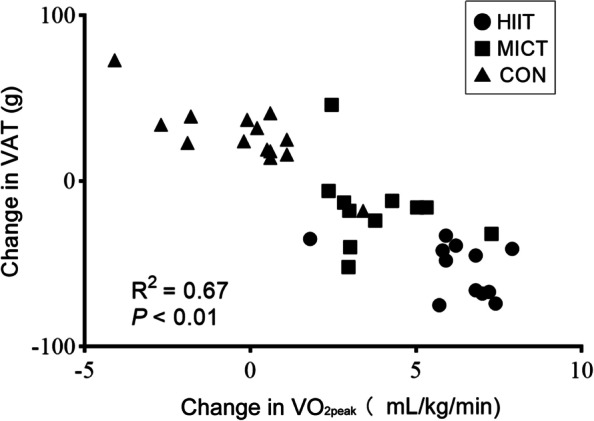
Results: Following the school-based training program, BMI and body fat mass decreased (BMI: - 1.8 kg/m2 vs. - 1.2 kg/m2, P < 0.01; FM: - 1.6 kg, P < 0.05 vs. -3.7 kg, P < 0.01) in HIIT and MICT group, but there was no significant difference between the two interventions; [Formula: see text] both increased significantly in two intervention groups, and the increment of HIIT group was significantly greater than that of MICT (6.1 mL/kg/min vs. 3.8 mL/kg/min, P < 0.01), Visceral adipose tissue was significant decrease in HIIT group (- 53 g vs. -17 g, P < 0.01) whilst the MICT group experienced a significant decrease in body fat percentage (- 3.1 ± 1.0 kg, P < 0.01), but there were no significant difference between the two interventions. Low-density lipoprotein cholesterol decreased only in HIIT group (- 17.2%, P < 0.05). Significant decrease in the usual index of insulin resistance (HOMA-IR) occurred in HIIT and MICT groups (- 27.3 and - 28.6%, respectively; P < 0.05).
Conclusions: Our results demonstrated that high-intensity interval training based on running can be used to improve the physical health of obese adolescents in school. Further investigations involving a larger cohort of participants, taken from different schools, is recommended.
Trial registration: title Effect of High Intensity Interval Training on Obese Children and Adolescents, time 16/12/2017, ID ChiCTR-IOR-17013992 , website http://www.chictr.org.cn.
© 2022. The Author(s).
Conflict of interest statement
The authors declare that they have no competing interests.
Figures


References
-
- Weihrauch-Bluher S, Schwarz P, Klusmann JH. Childhood obesity: increased risk for cardiometabolic disease and cancer in adulthood. Metab Clin Exp. 2019;92:147–152. - PubMed
-
- Donnelly JE, Blair SN, Jakicic JM, et al. American College of Sports Medicine Position Stand. Appropriate physical activity intervention strategies for weight loss and prevention of weight regain for adults. Med Sci Sports Exerc. 2009;41(2):459–71. - PubMed
Publication types
MeSH terms
Substances
LinkOut - more resources
Full Text Sources
Medical
