Review
. 2022 Jan:59:101594.
doi: 10.1016/j.smim.2022.101594. Epub 2022 Feb 26.

APOE mediated neuroinflammation and neurodegeneration in Alzheimer's disease

Affiliations
Review

APOE mediated neuroinflammation and neurodegeneration in Alzheimer's disease

Samira Parhizkar et al. Semin Immunol. 2022 Jan.

Abstract

Neuroinflammation is a central mechanism involved in neurodegeneration as observed in Alzheimer's disease (AD), the most prevalent form of neurodegenerative disease. Apolipoprotein E4 (APOE4), the strongest genetic risk factor for AD, directly influences disease onset and progression by interacting with the major pathological hallmarks of AD including amyloid-β plaques, neurofibrillary tau tangles, as well as neuroinflammation. Microglia and astrocytes, the two major immune cells in the brain, exist in an immune-vigilant state providing immunological defense as well as housekeeping functions that promote neuronal well-being. It is becoming increasingly evident that under disease conditions, these immune cells become progressively dysfunctional in regulating metabolic and immunoregulatory pathways, thereby promoting chronic inflammation-induced neurodegeneration. Here, we review and discuss how APOE and specifically APOE4 directly influences amyloid-β and tau pathology, and disrupts microglial as well as astroglial immunomodulating functions leading to chronic inflammation that contributes to neurodegeneration in AD.

Keywords: Alzheimer’s disease; Apolipoprotein E; Astrocytes; Inflammation; Microglia; Neurodegeneration.


Conflict of interest statement

Declaration of interests

D.M.H. is as an inventor on a patent licensed by Washington University to C2N Diagnostics on the therapeutic use of anti-tau antibodies. D.M.H. co-founded and is on the scientific advisory board of C2N Diagnostics. C2N Diagnostics has licensed certain anti-tau antibodies to AbbVie for therapeutic development. D.M.H. is on the scientific advisory board of Denali and consults for Genentech, Merck, and Cajal Neuroscience. S.P. declares no competing interests.

Figures
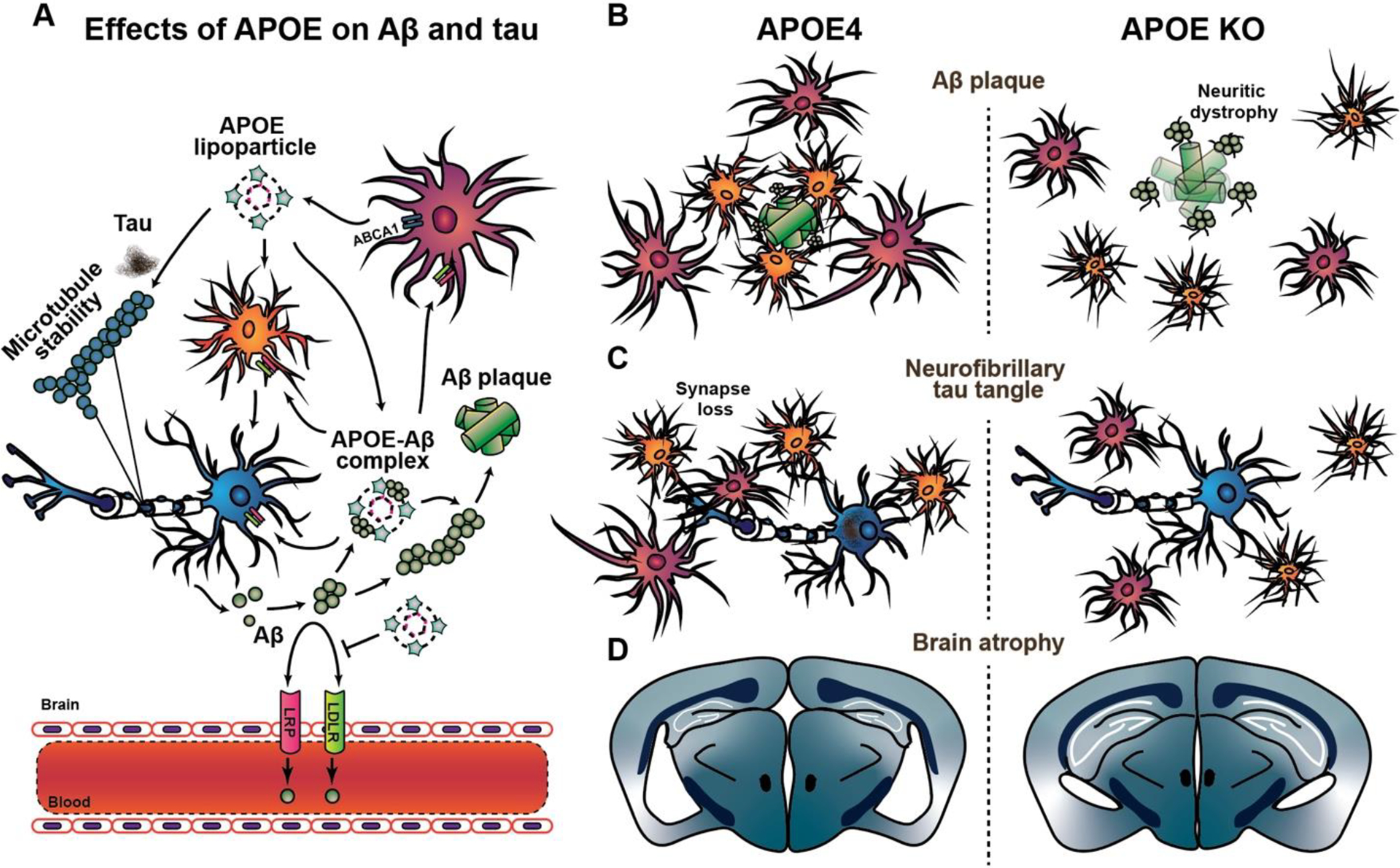
Figure 1.
Figure 1.. ApoE4 as a risk factor for AD.
A. Under physiological conditions, APOE is mainly produced and lipidated by ABCA1, and thereafter secreted into the interstitial fluid by glia. LDLR and LRP clear Aβ into neurons and glia and facilitate transport across the BBB, which is impaired by APOE4. Amyloidogenic APP processing leads to Aβ production and release from neurons into the interstitial fluid (ISF). APOE likely binds to smaller oligomeric soluble Aβ species to facilitate its fibrilization into Aβ plaques in an isoform-dependent manner. Similarly, APOE, especially E4, enhances tau pathogenesis, but whether this interaction influences tau aggregation, microtubule instability, or both, is unclear. B. APOE4 promotes a disease-associated microglial and astroglial reactivity to dense core Aβ plaques, where these glial cells are commonly observed clustering around plaques in attempt to phagocytose them. The absence of APOE leads to diffused plaques with reduced peri-plaque microglial clustering as well as increased dystrophic neurites with enhanced plaque-associated tau pathology. C. APOE4 increases tau pathogenesis and leads to increased astroglial and microglial-mediated inflammation, with enhanced synaptic engulfment, whereas the absence of APOE in APOE KO mice blocks this glial-mediated inflammation D. A progressively persistent inflammatory response over time leads to significant neurodegeneration in the presence of APOE4, as marked by brain atrophy and ventricular enlargement. The absence of APOE blocks both the inflammation and the brain atrophy.

References

    1. Strittmatter WJ et al. , “Apolipoprotein E: high-avidity binding to beta-amyloid and increased frequency of type 4 allele in late-onset familial Alzheimer disease.,” Proc. Natl. Acad. Sci. U. S. A, vol. 90, no. 5, p. 1977, Mar. 1993, doi: 10.1073/PNAS.90.5.1977. - DOI - PMC - PubMed
    1. Corder EH et al. , “Protective effect of apolipoprotein E type 2 allele for late onset Alzheimer disease,” Nat. Genet, vol. 7, no. 2, pp. 180–184, Jun. 1994, doi: 10.1038/NG0694-180. - DOI - PubMed
    1. Chen Y, Strickland MR, Soranno A, and Holtzman DM, “Apolipoprotein E: Structural Insights and Links to Alzheimer Disease Pathogenesis,” Neuron, vol. 109, no. 2, pp. 205–221, Jan. 2021, doi: 10.1016/J.NEURON.2020.10.008. - DOI - PMC - PubMed
    1. Corder EH et al. , “Gene dose of apolipoprotein E type 4 allele and the risk of Alzheimer’s disease in late onset families,” Science, vol. 261, no. 5123, pp. 921–923, 1993, doi: 10.1126/SCIENCE.8346443. - DOI - PubMed
    1. Schmechel DE et al. , “Increased amyloid beta-peptide deposition in cerebral cortex as a consequence of apolipoprotein E genotype in late-onset Alzheimer disease,” Proc. Natl. Acad. Sci. U. S. A, vol. 90, no. 20, pp. 9649–9653, Oct. 1993, doi: 10.1073/PNAS.90.20.9649. - DOI - PMC - PubMed

Publication types

Substances
