Review
. 2022 Feb 28;10(1):147-158.
doi: 10.14218/JCTH.2021.00179. Epub 2021 Aug 10.

Treatments of Hepatocellular Carcinoma with Portal Vein Tumor Thrombus: Current Status and Controversy

Affiliations
Review

Treatments of Hepatocellular Carcinoma with Portal Vein Tumor Thrombus: Current Status and Controversy

Zhu-Jian Deng et al. J Clin Transl Hepatol. .

Abstract

The proportions of patients with hepatocellular carcinoma (HCC) involving portal vein tumor thrombus (PVTT) varies greatly in different countries or regions, ranging from 13% to 45%. The treatment regimens for PVTT recommended by HCC guidelines in different countries or regions also vary greatly. In recent years, with the progress and development of surgical concepts, radiotherapy techniques, systematic therapies (for example, VEGF inhibitors, tyrosine kinase inhibitors and immune checkpoint inhibitors), patients with HCC involving PVTT have more treatment options and their prognoses have been significantly improved. To achieve the maximum benefit, both clinicians and patients need to think rationally about the indications of treatment modalities, the occurrence of severe adverse events, and the optimal fit for the population. In this review, we provide an update on the treatment modalities available for patients with HCC involving PVTT. Trials with large sample size for patients with advanced or unresectable HCC are also reviewed.

Keywords: Hepatocellular carcinoma; Portal vein tumor thrombus; Treatment modality.


Conflict of interest statement

JHZ has been an editorial board member of Journal of Clinical and Translational Hepatology since 2021. The other authors have no conflict of interests related to this publication.

Figures
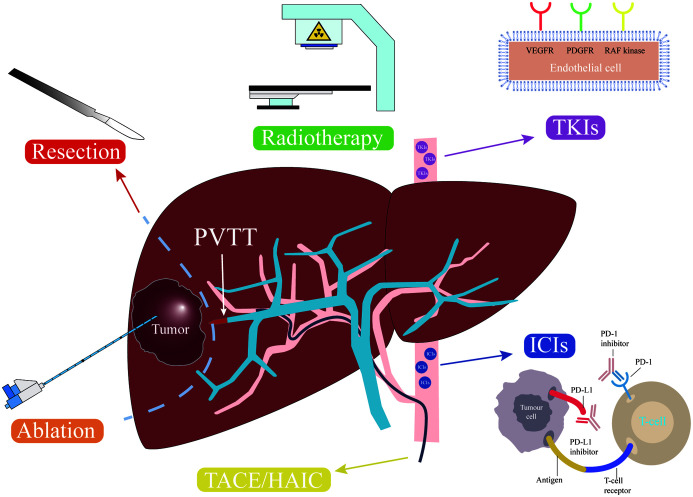
Fig. 1
Fig. 1. Different therapeutic methods have different mechanisms of action for patients with HCC involving PVTT.
HAIC, hepatic arterial infusion chemotherapy; HCC, hepatocellular carcinoma; ICIs, immune checkpoint inhibitors; PVTT, portal vein tumor thrombus; TACE, transarterial chemoembolization; TKI, tyrosine kinase inhibitors.
Fig. 2
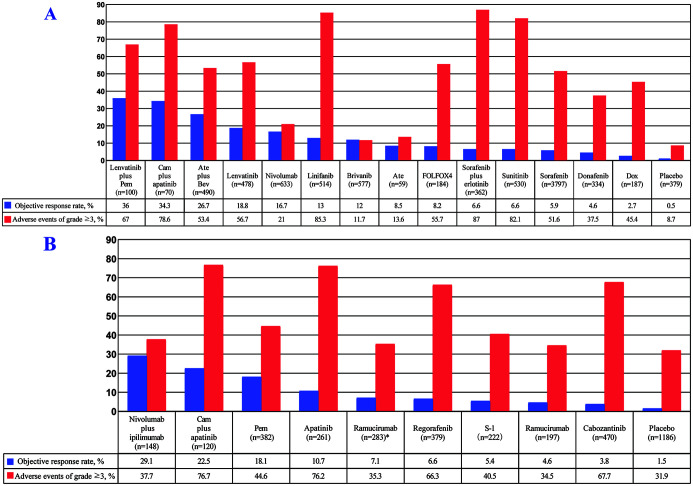
Fig. 2. Percentages of ORRs and adverse events of at least grade 3 in clinical trials of systematic therapy for advanced or unresectable HCC.
(A) First-line therapy. (B) Second-line therapy. The level of response was measured according to RECIST 1.1. The total sample size equals the sum of the sample sizes for each trial. Percentages were obtained by the number of cases (ORR or adverse eventsof grade ≥3) in each trial divided by the total sample size of trials. *For patients with α-fetoprotein concentrations of at least 400 ng/mL. Ate, atezolizumab; Bev, bevacizumab; Cam, camrelizumab; Dox, doxorubicin; FOLFOX4, intravenously infusional fluorouracil, leucovorin, and oxaliplatin; Pem, pembrolizumab.

References

    1. Sung H, Ferlay J, Siegel RL, Laversanne M, Soerjomataram I, Jemal A, et al. Global cancer statistics 2020: GLOBOCAN estimates of incidence and mortality worldwide for 36 cancers in 185 countries. CA Cancer J Clin. 2021;71(3):209–249. doi: 10.3322/caac.21660. - DOI - PubMed
    1. Zhong JH, Peng NF, You XM, Ma L, Xiang X, Wang YY, et al. Tumor stage and primary treatment of hepatocellular carcinoma at a large tertiary hospital in China: a real-world study. Oncotarget. 2017;8(11):18296–18302. doi: 10.18632/oncotarget.15433. - DOI - PMC - PubMed
    1. Chan SL, Chong CC, Chan AW, Poon DM, Chok KS. Management of hepatocellular carcinoma with portal vein tumor thrombosis: review and update at 2016. World J Gastroenterol. 2016;22(32):7289–7300. doi: 10.3748/wjg.v22.i32.7289. - DOI - PMC - PubMed
    1. Xiang X, Lau WY, Wu ZY, Zhao C, Ma YL, Xiang BD, et al. Transarterial chemoembolization versus best supportive care for patients with hepatocellular carcinoma with portal vein tumor thrombusa multicenter study. Eur J Surg Oncol. 2019;45(8):1460–1467. doi: 10.1016/j.ejso.2019.03.042. - DOI - PubMed
    1. European Association for the Study of the Liver EASL clinical practice guidelines: management of hepatocellular carcinoma. J Hepatol. 2018;69(1):182–236. doi: 10.1016/j.jhep.2018.03.019. - DOI - PubMed