


Molecular Phenomic Approaches to Deconvolving the Systemic Effects of SARS-CoV-2 Infection and Post-acute COVID-19 Syndrome
- PMID: 35233558
- PMCID: PMC8295979
- DOI: 10.1007/s43657-021-00020-3
Molecular Phenomic Approaches to Deconvolving the Systemic Effects of SARS-CoV-2 Infection and Post-acute COVID-19 Syndrome
Abstract
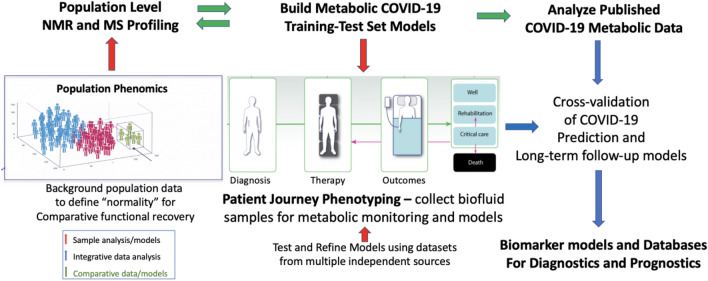
SARS COV-2 infection causes acute and frequently severe respiratory disease with associated multi-organ damage and systemic disturbances in many biochemical pathways. Metabolic phenotyping provides deep insights into the complex immunopathological problems that drive the resulting COVID-19 disease and is also a source of novel metrics for assessing patient recovery. A multiplatform metabolic phenotyping approach to studying the pathology and systemic metabolic sequelae of COVID-19 is considered here, together with a framework for assessing post-acute COVID-19 Syndrome (PACS) that is a major long-term health consequence for many patients. The sudden emergence of the disease presents a biological discovery challenge as we try to understand the pathological mechanisms of the disease and develop effective mitigation strategies. This requires technologies to measure objectively the extent and sub-phenotypes of the disease at the molecular level. Spectroscopic methods can reveal metabolic sub-phenotypes and new biomarkers that can be monitored during the acute disease phase and beyond. This approach is scalable and translatable to other pathologies and provides as an exemplar strategy for the investigation of other emergent zoonotic diseases with complex immunological drivers, multi-system involvements and diverse persistent symptoms.
Keywords: COVID-19; Metabolic Phenoconversion; Phenoreversion; Post-acute COVID-19 Syndrome (PACS); SARS COV-2; Spectroscopy.
© The Author(s) 2021.
Conflict of interest statement
Conflicts of InterestsThe author declares no competing financial interests. JK is the associate editor of Phenomics, and he was not involved in reviewing this paper.
Figures
References
-
- Ahmed H, Patel K, Greenwood DC, Halpin S, Lewthwaite P, Salawu A, Eyre L, Breen A, O’Connor R, Jones A, Sivan M. Long-term clinical outcomes in survivors of severe acute respiratory syndrome and Middle East respiratory syndrome coronavirus outbreaks after hospitalisation or ICU admission: a systematic review and meta-analysis. J Rehabil Med. 2020;52(5):jrm00063. doi: 10.2340/16501977-2694. - DOI - PubMed
-
- Barberis E, Timo S, Amede E, Vanella VV, Puricelli C, Cappellano G, Raineri D, Cittone MG, Rizzi E, Pedrinelli AR, Vassia V, Casciaro FG, Priora S, Nerici I, Galbiati A, Hayden E, Falasca M, Vaschetto R, Sainaghi PP, Dianzani U, Rolla R, Chiocchetti A, Baldanzi G, Marengo E, Manfredi M. Large-scale plasma analysis revealed new mechanisms and molecules associated with the host response to SARS-CoV-2. Int J Mol Sci. 2020;21(22):8623. doi: 10.3390/ijms21228623. - DOI - PMC - PubMed
-
- Bergamaschi L, Mescia F, Turner L, Hanson AL, Kotagiri P, Dunmore BJ, Ruffieux H, De Sa A, Huhn O, Morgan MD, Gerber PP, Wills MR, Baker S, Calero-Nieto FJ, Doffinger R, Dougan G, Elmer A, Goodfellow IG, Gupta RK, Hosmillo M, Hunter K, Kingston N, Lehner PJ, Matheson NJ, Nicholson JK, Petrunkina AM, Richardson S, Saunders C, Thaventhiran JED, Toonen EJM, Weekes MP, Cambridge Institute of Therapeutic I. Infectious Disease-National Institute of Health Research CBC. Gottgens B, Toshner M, Hess C, Bradley JR, Lyons PA, Smith KGC. Longitudinal analysis reveals that delayed bystander CD8+ T cell activation and early immune pathology distinguish severe COVID-19 from mild disease. Immunity. 2021;54(6):1257–1275.e8. doi: 10.1016/j.immuni.2021.05.010. - DOI - PMC - PubMed
Publication types
LinkOut - more resources
Full Text Sources
Miscellaneous