


Proton and calcium pumping P-type ATPases and their regulation of plant responses to the environment
- PMID: 35235671
- PMCID: PMC8644242
- DOI: 10.1093/plphys/kiab330
Proton and calcium pumping P-type ATPases and their regulation of plant responses to the environment
Erratum in
-
Corrigendum to: Proton and calcium pumping P-type ATPases and their regulation of plant responses to the environment.Plant Physiol. 2022 Mar 28;188(4):2379-2381. doi: 10.1093/plphys/kiab580. Plant Physiol. 2022. PMID: 34927691 Free PMC article. No abstract available.
Abstract
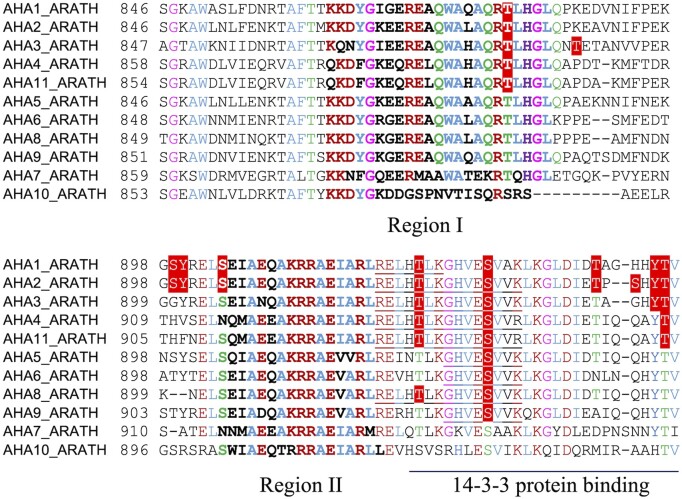
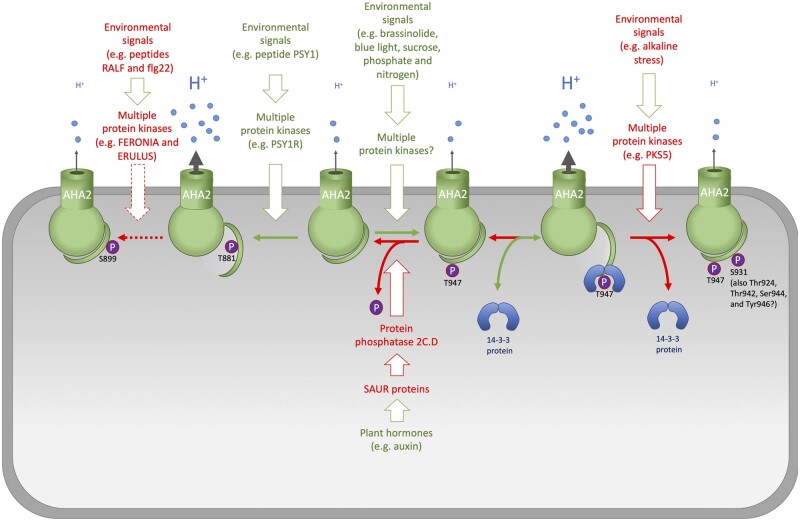
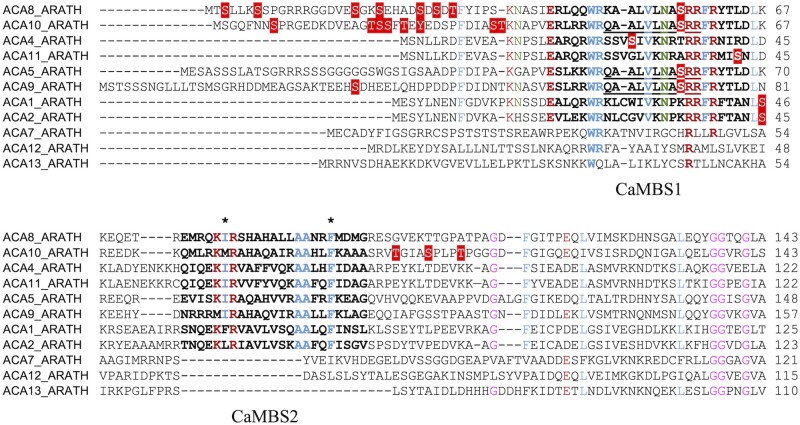
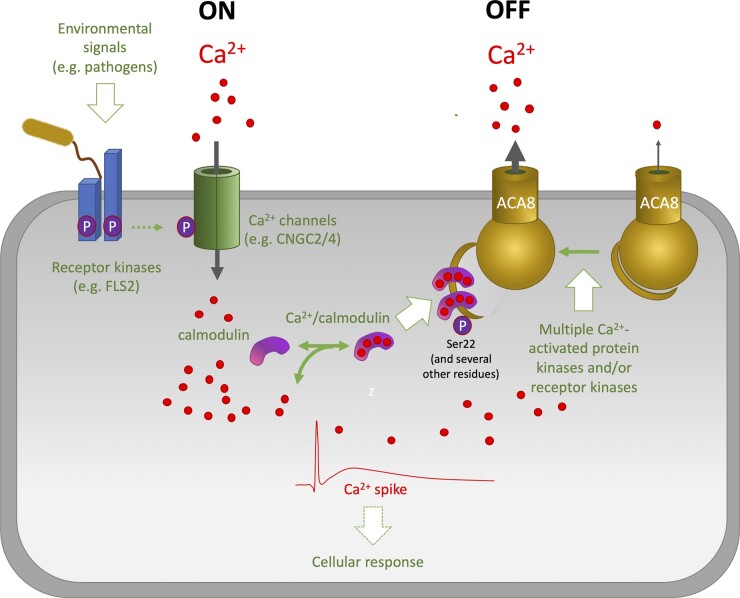
Plant plasma membrane H+-ATPases and Ca2+-ATPases maintain low cytoplasmic concentrations of H+ and Ca2+, respectively, and are essential for plant growth and development. These low concentrations allow plasma membrane H+-ATPases to function as electrogenic voltage stats, and Ca2+-ATPases as "off" mechanisms in Ca2+-based signal transduction. Although these pumps are autoregulated by cytoplasmic concentrations of H+ and Ca2+, respectively, they are also subject to exquisite regulation in response to biotic and abiotic events in the environment. A common paradigm for both types of pumps is the presence of terminal regulatory (R) domains that function as autoinhibitors that can be neutralized by multiple means, including phosphorylation. A picture is emerging in which some of the phosphosites in these R domains appear to be highly, nearly constantly phosphorylated, whereas others seem to be subject to dynamic phosphorylation. Thus, some sites might function as major switches, whereas others might simply reduce activity. Here, we provide an overview of the relevant transport systems and discuss recent advances that address their relation to external stimuli and physiological adaptations.
© American Society of Plant Biologists 2021. All rights reserved. For permissions, please email: journals.permissions@oup.com.
Figures
References
-
- Astegno A, Bonza MC, Vallone R, La Verde V, D'Onofrio M, Luoni L, Molesini B, Dominici P (2017) Arabidopsis calmodulin-like protein CML36 is a calcium (Ca2+) sensor that interacts with the plasma membrane Ca2+-ATPase isoform ACA8 and stimulates its activity. J Biol Chem 292: 15049–15061 - PMC - PubMed
-
- Baekgaard L, Luoni L, De Michelis MI, Palmgren MG (2006) The plant plasma membrane Ca2+ pump ACA8 contains overlapping as well as physically separated autoinhibitory and calmodulin-binding domains. J Biol Chem 281: 1058–1065 - PubMed
Publication types
MeSH terms
Substances
LinkOut - more resources
Full Text Sources
Miscellaneous
