. 2022 Jul;33(7):1293-1307.
doi: 10.1681/ASN.2021091209. Epub 2022 Mar 2.

A Novel Soluble ACE2 Protein Provides Lung and Kidney Protection in Mice Susceptible to Lethal SARS-CoV-2 Infection

Affiliations

A Novel Soluble ACE2 Protein Provides Lung and Kidney Protection in Mice Susceptible to Lethal SARS-CoV-2 Infection

Luise Hassler et al. J Am Soc Nephrol. 2022 Jul.

Abstract

Background: Severe acute respiratory syndrome coronavirus type 2 (SARS-CoV-2) uses full-length angiotensin converting enzyme 2 (ACE2) as a main receptor to enter target cells. The goal of this study was to demonstrate the preclinical efficacy of a novel soluble ACE2 protein with increased duration of action and binding capacity in a lethal mouse model of COVID-19.

Methods: A human soluble ACE2 variant fused with an albumin binding domain (ABD) was linked via a dimerization motif hinge-like 4-cysteine dodecapeptide (DDC) to improve binding capacity to SARS-CoV-2. This novel soluble ACE2 protein (ACE2-1-618-DDC-ABD) was then administered intranasally and intraperitoneally to mice before intranasal inoculation of SARS-CoV-2 and then for two additional days post viral inoculation.

Results: Untreated animals became severely ill, and all had to be humanely euthanized by day 6 or 7 and had pulmonary alveolar hemorrhage with mononuclear infiltrates. In contrast, all but one mouse infected with a lethal dose of SARS-CoV-2 that received ACE2-1-618-DDC-ABD survived. In the animals inoculated with SARS-CoV-2 that were untreated, viral titers were high in the lungs and brain, but viral titers were absent in the kidneys. Some untreated animals, however, had variable degrees of kidney proximal tubular injury as shown by attenuation of the proximal tubular brush border and increased NGAL and TUNEL staining. Viral titers in the lung and brain were reduced or nondetectable in mice that received ACE2-1-618-DDC-ABD, and the animals developed only moderate disease as assessed by a near-normal clinical score, minimal weight loss, and improved lung and kidney injury.

Conclusions: This study demonstrates the preclinical efficacy of a novel soluble ACE2 protein, termed ACE2-1-618-DDC-ABD, in a lethal mouse model of SARS-CoV-2 infection that develops severe lung injury and variable degrees of moderate kidney proximal tubular injury.

Keywords: COVID-19; SARS-CoV-2; acute renal failure; angiotensin-converting enzyme 2; disease susceptibility; kidney disease; mice; renal protection; renin angiotensin system; virology.


Figures

None
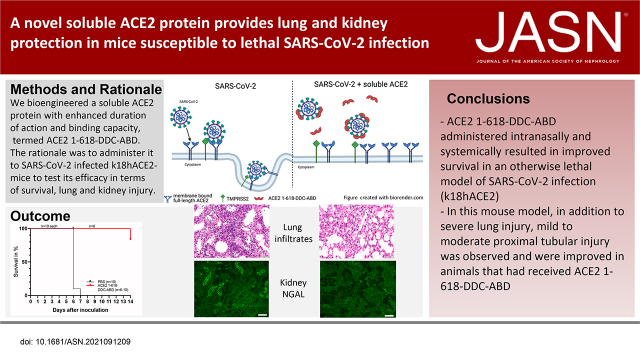
Graphical abstract
Figure 1.
Figure 1.
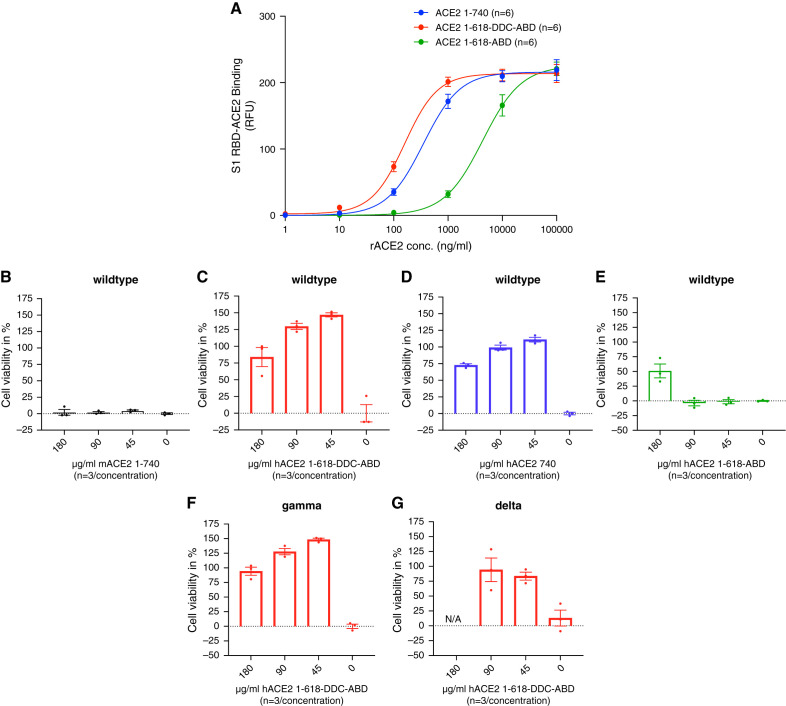
Binding affinity of soluble ACE2 proteins to the RBD of the viral S1 glycoprotein and neutralization of live SARS-CoV-2 in Vero E6 cells. (A) The binding of ACE2 variants 1-618-DDC-ABD (red), 1-618-ABD (green), and the native ACE2–1-740 protein (blue) to the S1-RBD of SARS-CoV-2 was studied using a recently published assay. The binding affinity of ACE2–1-618-DDC-ABD is markedly higher compared with that of ACE2–1-618-ABD, and also slightly higher than that of native ACE2–1-740 soluble protein. The EC50 values are given in the Results section. (B–E) The efficacy of these three proteins (0–180 µg/ml, n=3/concentration) to neutralize live wild-type SARS-CoV-2 infection of Vero E6 cells was measured by a cell death assay. (B) Mouse ACE2–1-740 used as negative control, as expected, had no protective effect on cell viability at any concentration tested (black). (C) ACE2–1-618-DDC-ABD (red) resulted in slightly higher percentages of cell viability, although (D) native ACE2–1-740 (blue) also prevented cell death almost completely at all of the high concentrations tested (but not at 0 µg/ml). By contrast, (E) ACE2–1-618-ABD (green) provided only partial protection at its highest concentration (180 µg/ml) and had no neutralizing effect at lower concentrations (90 and 45 µg/ml). (F) and (G) ACE2–1-618-DDC-ABD also neutralizes infection by the SARS-CoV-2 (F) Gamma and (G) Delta variants at the concentrations tested (45, 90, and 180 µg/ml, but not at 0 µg/ml). Please note that there are no data at 180 µg/ml for the Delta variant for technical reasons (overgrown cells did not attach well to the plate).
Figure 2.
Figure 2.
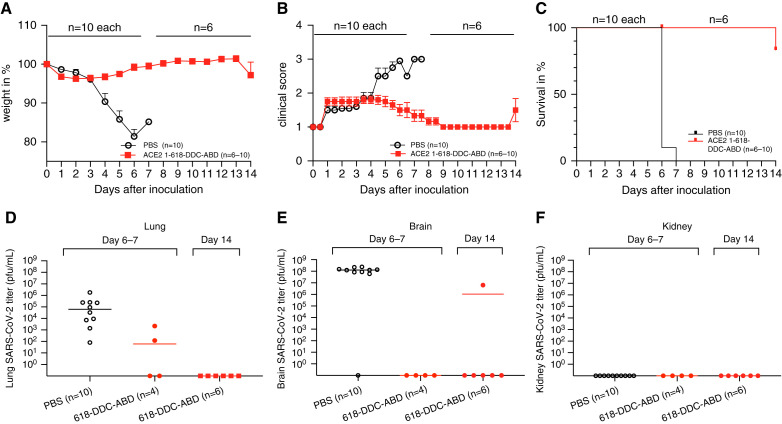
Prevention of mortality and improvement of clinical score, weight loss, and SARS-CoV-2 titers (by plaque assay) after ACE2–1-618-DDC-ABD administration to female and male k18-hACE2 mice (n=10, five male and five female) compared with animals that received PBS (n=10, five male and five female). All 20 animals were infected with SARS-CoV-2. (A–C) The administration of ACE2–1-618-DDC-ABD (red) largely (A) prevented body weight loss, (B) improved clinical scores, and (C) prevented mortality in ten k18-hACE2 transgenic mice compared with 10 vehicle-treated mice (PBS, black), all inoculated with SARS-CoV-2. (D) and (E) At 6 or 7 days post infection, titers were high in all untreated animals (PBS, black) that had to be humanely euthanized by study design. (D) In contrast, at the same time point (day 6) in two male and two female ACE2 618-DDC-ABD-treated mice (red) that were healthy but were euthanized, lung viral titers were lower or undetectable. No lung viral titers were detectable in ACE2 618-DDC-ABD-treated animals on day 6. (E) No SARS-CoV-2 virus was detectable in the lungs of remaining k18-hACE2 mice that received ACE2 618-DDC-ABD and were euthanized 14 days after viral inoculation. Except for the brain viral titer in one male (case 20) that was treated with ACE2–1-618-DDC-ABD and was high on day 14, titers were undetectable in all other mice from this group lung. This was the only animal that lost 20% of its body weight on day 14 (see A) and therefore had to be euthanized as a treatment failure. (F) Kidney viral titers were not detectable in any animals from the treated and untreated group whether they were examined on day 6 or 7 or on day 14 post infection.
Figure 3.
Figure 3.
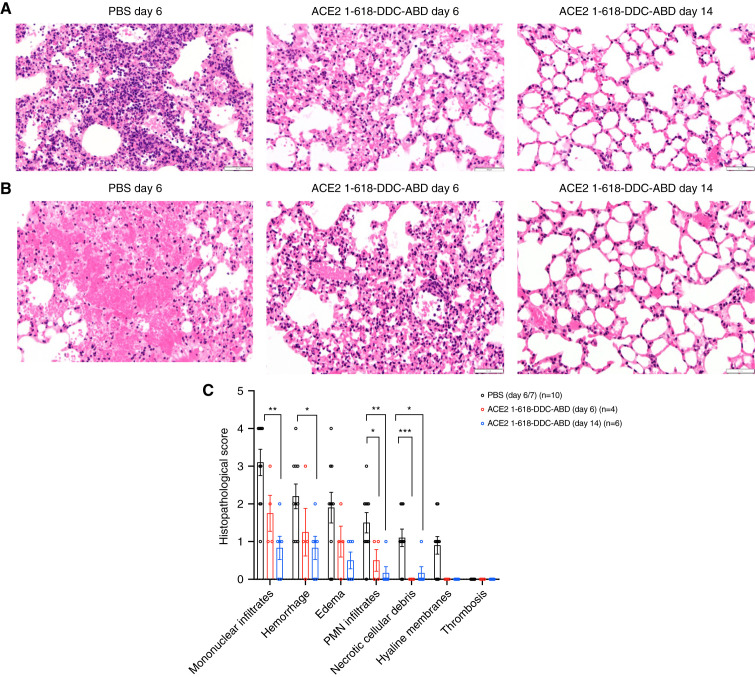
Representative examples of lung histopathology and lung injury scores. (A) Representative lung histopathology in k18-hACE2 mice infected with SARS-CoV-2 on day 6 (left and middle) and day 14 (right) post infection. Untreated animals (PBS vehicle) show dense perivascular mononuclear infiltrates and scattered neutrophils (left). (B) Untreated animals (PBS vehicle) show more extensive alveolar hemorrhage (left) in contrast to animals treated with ACE2–1-618-DDC-ABD on days 6 and 14. Hematoxylin-eosin, original magnification ×400. (C) The histopathologic lung injury scores are lower in animals treated with ACE2–1-618-DDC-ABD on both day 6 (red) and day 14 (blue) than vehicle-treated controls on day 6 or 7 (black). Significance is indicated in the figure (***P<0.001; **P<0.01; *P<0.05) and was calculated using ANOVA followed by post hoc Dunnett’s multiple comparisons test.
Figure 4.
Figure 4.
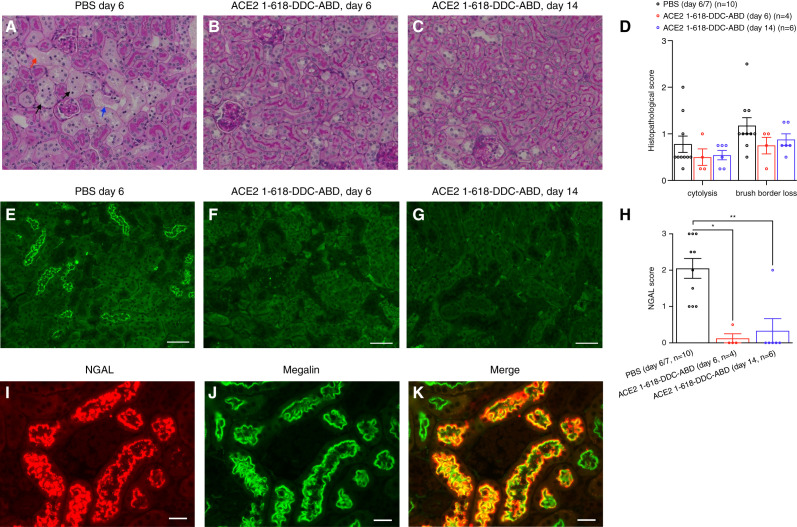
Kidney histopathology examined by PAS-staining and NGAL staining. (A–C) PAS staining in k18hACE2 mice studied on day 6 or 14 (magnification, ×200). Kidneys displayed variable degrees of proximal tubular injury. (A) An example of an untreated animal with the more severe alterations: proximal tubule brush border loss (black arrows) and cytolysis (red arrow) and tubular basement membrane disruption (blue arrow). (B) and (C) Examples of attenuated tubular injury in mice that had received ACE2–1-618-DDC-ABD and were euthanized on days 6 or 14, respectively. (D) The histopathologic injury score, on the basis of the criteria cytolysis and brush border loss, was slightly higher in the PBS group compared with the ACE2–1-618-DDC-ABD group, but this did not reach statistical significance (calculated using ANOVA followed by post hoc Dunnett’s multiple comparisons test). (E–G) NGAL staining on day 6 or 14. (E) Kidney from the untreated animal at day 6 (PBS vehicle) shows NGAL expression in the proximal tubules, whereas it is markedly reduced or non-detectable in animals that received ACE2–1-618-DDC-ABD euthanized on (F) the same day or (G) day 14 (magnification, ×200, scale bar=100 μm. (H) NGAL staining intensity is significantly higher in the PBS group (n=10, 2.05±0.273) compared with the ACE2–1-618-DDC-ABD group at day 6 (0.125±0.125, P=0.01) or day 14 (0.333±0.333, P=0.005, calculated using Kruskal–Wallis test followed by post hoc Dunn’s multiple comparisons test). (I–K) Example of the kidney of an infected k18hACE2 mouse that was untreated. NGAL immunofluorescence is strong, and there is co-localization with megalin (yellow; scale bar=20 μm, magnification, ×400).
Figure 5.
Figure 5.
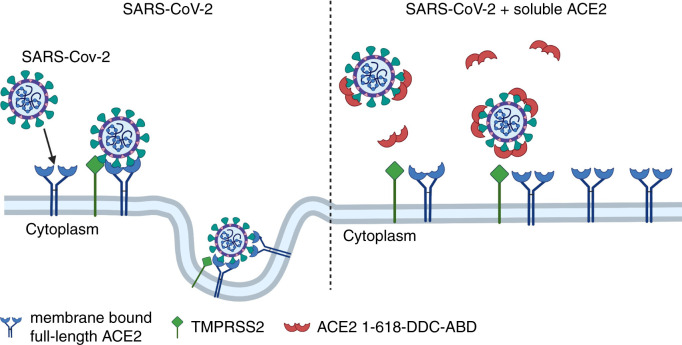
Postulated mechanism of action of ACE2–1-618-DDC-ABD. Administered ACE2–1-618-DDC-ABD (red semi-circles) binds to SARS-CoV-2, acting as a decoy to prevent the binding of SARS-CoV-2 to membrane-bound full-length ACE2 receptors (blue). This prevents the internalization of the ACE2-SARS-CoV-2 complex activated by TMPRSS2 (green). It has been also postulated that there is significant loss of full-length membrane-bound ACE2 (left panel), which is prevented by the use of soluble ACE2 proteins (right panel). Created with biorender.com.

References

    1. Batlle D, Soler MJ, Sparks MA, Hiremath S, South AM, Welling PA, et al. ; COVID-19 and ACE2 in Cardiovascular, Lung, and Kidney Working Group : Acute kidney injury in COVID-19: Emerging evidence of a distinct pathophysiology. J Am Soc Nephrol 31: 1380–1383, 2020 - PMC - PubMed
    1. Hirsch JS, Ng JH, Ross DW, Sharma P, Shah HH, Barnett RL, et al. ; Northwell COVID-19 Research Consortium; Northwell Nephrology COVID-19 Research Consortium : Acute kidney injury in patients hospitalized with COVID-19. Kidney Int 98: 209–218, 2020 - PMC - PubMed
    1. Richardson S, Hirsch JS, Narasimhan M, Crawford JM, McGinn T, Davidson KW, et al. ; Northwell COVID-19 Research Consortium : Presenting characteristics, comorbidities, and outcomes among 5700 patients hospitalized with COVID-19 in the New York City area. JAMA 323: 2052–2059, 2020 - PMC - PubMed
    1. Pei G, Zhang Z, Peng J, Liu L, Zhang C, Yu C, et al. : Renal involvement and early prognosis in patients with COVID-19 pneumonia. J Am Soc Nephrol 31: 1157–1165, 2020 - PMC - PubMed
    1. Fisher M, Neugarten J, Bellin E, Yunes M, Stahl L, Johns TS, et al. : AKI in hospitalized patients with and without COVID-19: A comparison study. J Am Soc Nephrol 31: 2145–2157, 2020 - PMC - PubMed

Publication types

Substances