. 2022 Mar 2;13(1):1125.
doi: 10.1038/s41467-022-28719-5.

Crosstalk between CRISPR-Cas9 and the human transcriptome

Affiliations

Crosstalk between CRISPR-Cas9 and the human transcriptome

Aaron A Smargon et al. Nat Commun. .

Abstract

CRISPR-Cas9 expression independent of its cognate synthetic guide RNA (gRNA) causes widespread genomic DNA damage in human cells. To investigate whether Cas9 can interact with endogenous human RNA transcripts independent of its guide, we perform eCLIP (enhanced CLIP) of Cas9 in human cells and find that Cas9 reproducibly interacts with hundreds of endogenous human RNA transcripts. This association can be partially explained by a model built on gRNA secondary structure and sequence. Critically, transcriptome-wide Cas9 binding sites do not appear to correlate with published genome-wide Cas9 DNA binding or cut-site loci under gRNA co-expression. However, even under gRNA co-expression low-affinity Cas9-human RNA interactions (which we term CRISPR crosstalk) do correlate with published elevated transcriptome-wide RNA editing. Our findings do not support the hypothesis that human RNAs can broadly guide Cas9 to bind and cleave human genomic DNA, but they illustrate a cellular and RNA impact likely inherent to CRISPR-Cas systems.


Conflict of interest statement

The authors declare the following competing interests. G.W.Y. is an SAB member of Jumpcode Genomics and a co-founder, member of the Board of Directors, on the SAB, equity holder, and paid consultant for Locanabio and Eclipse BioInnovations. G.W.Y. is a visiting professor at the National University of Singapore. G.W.Y.’s interest(s) have been reviewed and approved by the University of California, San Diego in accordance with its conflict-of-interest policies. The authors declare no other competing interests.

Figures
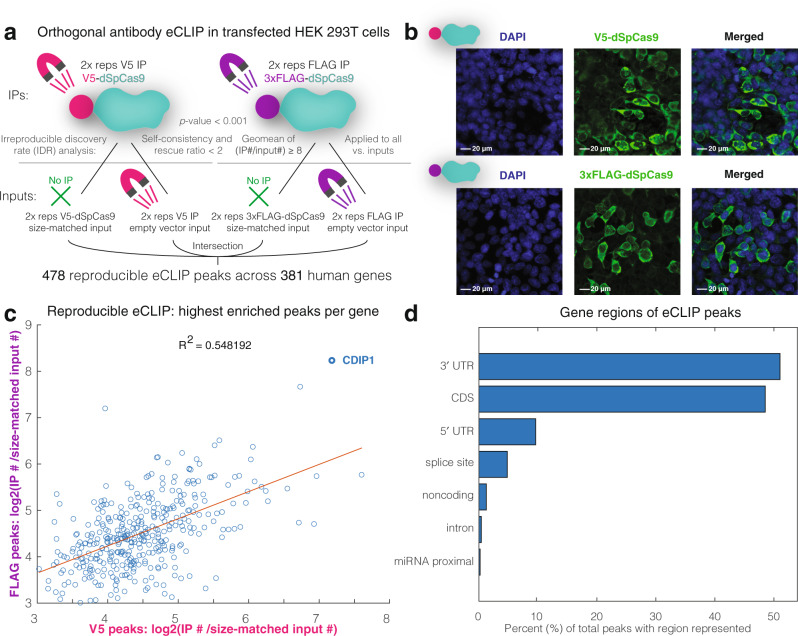
Fig. 1
Fig. 1. An orthogonal antibody eCLIP reveals transcriptome-wide Cas9-human RNA interactions.
a Orthogonal V5/FLAG dSpCas9 eCLIP (enhanced eCLIP) experimental design. The experiment in transfected HEK 293T cells found 478 reproducible peaks across 381 human genes. All eCLIPs were performed in two bioreplicates per condition and were designed with two controls: size-matched inputs from dSpCas9 transfections; and antibody immunoprecipitations of empty vector transfections. b Immunofluorescent imaging of expressed V5/3xFLAG-dSpCas9 displays predominantly cytoplasmic cellular localization of dSpCas9 in HEK 293T cells. Experiments were performed independently in triplicate with similar results, with a representative image shown. c Highest enriched peak per gene log2(IP read count/size-matched input read count) enrichment score for V5 vs. FLAG eCLIPs. CDIP1(Cell Death Inducing p53 Target 1) is the top hit. d Gene regions of eCLIP peaks, with 3′ UTR the most represented.
Fig. 2
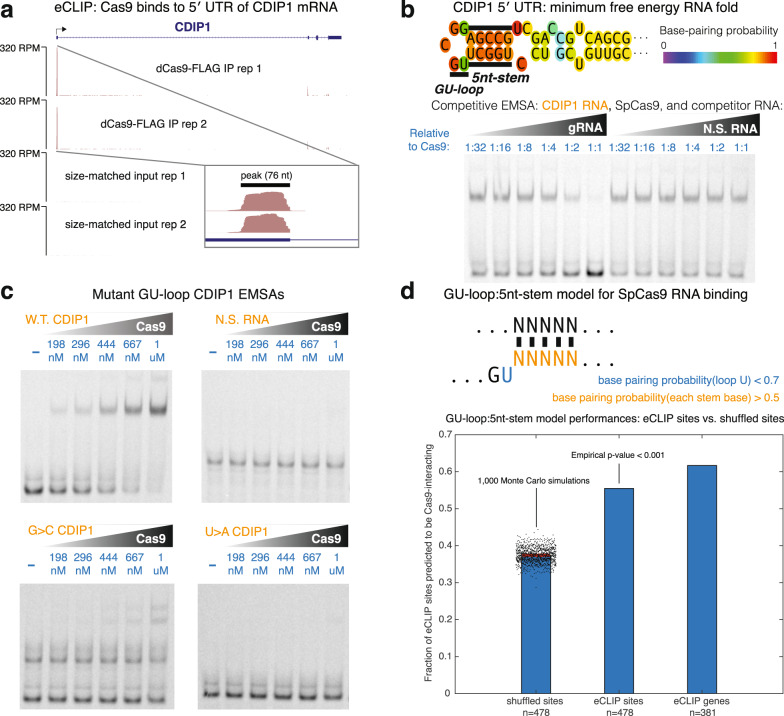
Fig. 2. The CRISPR RNA recognition domain of Cas9 binds to human RNA.
a dSpCas9 binds to the 5′ UTR of CDIP1 mRNA. b A minimum free-energy RNA fold (Vienna RNAfold) of the CDIP1 5′ UTR reveals a GU-loop:5nt-stem sequence-structure motif, identical to the SpCas9 gRNA. gRNA outcompetes 20 nM of 5′-fluorescently labeled CDIP1 RNA, whereas non-specific (N.S.) RNA does not, in a competitive EMSA (electrophoretic mobility shift assay). Experiments were performed independently in triplicate with similar results, with a representative gel shown. c SpCas9 protein binds to 20 nM of 5′-fluorescently labeled CDIP1 mRNA with an apparent dissociation constant (KD) in the high nanomolar range. Mutations to either the G or U of the GU-loop significantly reduce this binding affinity. Experiments were performed independently in triplicate with similar results, with a representative gel shown. d A GU-loop:5nt-stem model that searches an RNA sequence for a GU-loop motif (with the base-pairing probability of the U < 0.7) upstream of a 5nt-stem (five bases each with base-pairing probability > 0.5) trends with eCLIP peaks and genes predicted to interact with dSpCas9. The prediction of 1000 Monte Carlo simulations based on shuffled eCLIP peak sequences is represented by scatter, where the mean is bold horizontal red line, and 95% confidence interval is lighter red box. Empirical p-value < 0.001 (Monte Carlo simulation). (Invisible plotted confidence interval is within plotted mean).
Fig. 3
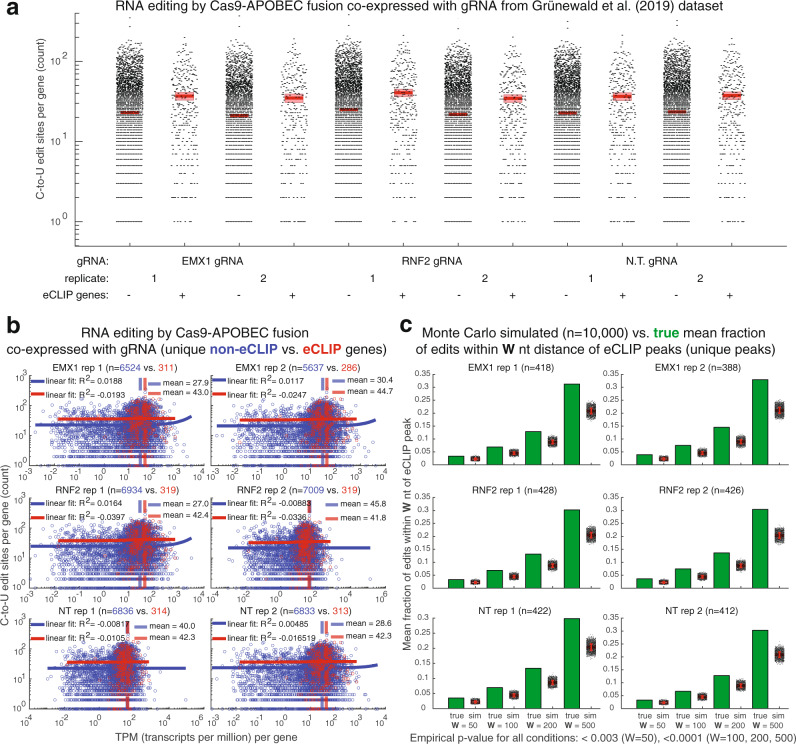
Fig. 3. Cas9-interacting human RNA transcripts reproducibly correlate with elevated transcriptome-wide RNA-editing activities at their target genes even under gRNA co-expression.
a Box plots of C-to-U edit site counts per gene, for non-eCLIP vs. eCLIP genes. Data for each experimental condition (two replicates of three different gRNAs co-expressed with Cas9-APOBEC fusion) are plotted only of genes with at least one edit site according to Grünewald et al. For each dataset mean is bold horizontal red line and 95% confidence interval is lighter red box. (Invisible plotted confidence intervals are within plotted means.) b Scatter plot based on a TPM (transcripts per million) per gene vs. C-to-U edit site counts per gene, for non-eCLIP (blue) vs. eCLIP (red) genes. Linear fits with R2 values of each dataset by gene type are plotted in solid lines, whereas TPM means of each dataset by gene type are plotted in dashed lines. c Plots of the predictions of Monte Carlo simulated (10,000 simulations) vs. true mean fraction of edits within W (50, 100, 200, 500) nt distance of each eCLIP peak represented in a whose center is on a spliced RNA transcript to each C-to-U edit site on that transcript. Empirical p-value <0.003 for W = 50 for all conditions; <0.0001 for W = 100, 200, 500 for all conditions (Monte Carlo simulation). For Monte Carlo simulations, simulated eCLIP peaks were placed along the spliced RNA transcript according to a uniform random distribution. True mean fractions of edits are represented by green bars, while the Monte Carlo simulations are represented by scatter, where the mean is a bold horizontal red line superimposed with red standard deviation error bars.

References

    1. Koonin EV, Makarova KS. Origins and evolution of CRISPR-Cas systems. Philos. Trans. R. Soc. Lond. B Biol. Sci. 2019;374:20180087. doi: 10.1098/rstb.2018.0087. - DOI - PMC - PubMed
    1. Marraffini LA. CRISPR-Cas immunity in prokaryotes. Nature. 2015;526:55–61. doi: 10.1038/nature15386. - DOI - PubMed
    1. Jinek M, et al. A programmable dual-RNA-guided DNA endonuclease in adaptive bacterial immunity. Science. 2012;337:816–821. doi: 10.1126/science.1225829. - DOI - PMC - PubMed
    1. Hsu PD, Lander ES, Zhang F. Development and applications of CRISPR-Cas9 for genome engineering. Cell. 2014;157:1262–1278. doi: 10.1016/j.cell.2014.05.010. - DOI - PMC - PubMed
    1. Dugar G, et al. CRISPR RNA-dependent binding and cleavage of endogenous RNAs by the campylobacter jejuni Cas9. Mol. Cell. 2018;69:893–905 e897. doi: 10.1016/j.molcel.2018.01.032. - DOI - PMC - PubMed

Publication types

Substances