


Persistent Endothelial Dysfunction in Coronavirus Disease-2019 Survivors Late After Recovery
- PMID: 35237624
- PMCID: PMC8882598
- DOI: 10.3389/fmed.2022.809033
Persistent Endothelial Dysfunction in Coronavirus Disease-2019 Survivors Late After Recovery
Abstract
Background: Coronavirus disease 2019 (COVID-19) can result in an endothelial dysfunction in acute phase. However, information on the late vascular consequences of COVID-19 is limited.
Methods: Brachial artery flow-mediated dilation (FMD) examination were performed, and inflammatory biomarkers were assessed in 86 survivors of COVID-19 for 327 days (IQR 318-337 days) after recovery. Comparisons were made with 28 age-matched and sex-matched healthy controls and 30 risk factor-matched patients.
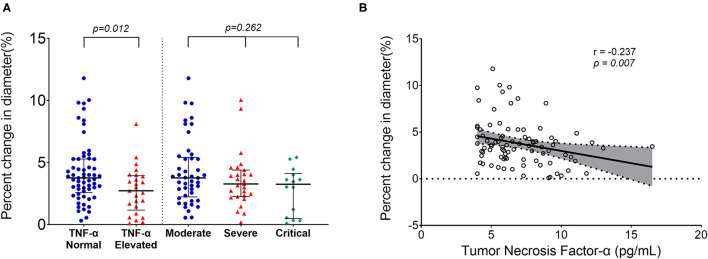
Results: Brachial artery FMD was significantly lower in the survivors of COVID-19 than in the healthy controls and risk factor-matched controls [median (IQR) 7.7 (5.1-10.7)% for healthy controls, 6.9 (5.5-9.4)% for risk factor-matched controls, and 3.5(2.2-4.6)% for COVID-19, respectively, p < 0.001]. The FMD was lower in 25 patients with elevated tumor necrosis factor (TNF)-α [2.7(1.2-3.9)] than in 61 patients without elevated TNF-α [3.8(2.6-5.3), p = 0.012]. Furthermore, FMD was inversely correlated with serum concentration of TNF-α (r = -0.237, p = 0.007).
Conclusion: Survivors of COVID-19 have a reduced brachial artery FMD, which is inversely correlated with increased serum concentration of TNF-α. Prospective studies on the association of endothelial dysfunction with long-term cardiovascular outcomes, especially the early onset of atherosclerosis, are warranted in survivors of COVID-19.
Keywords: COVID-19; TNF-α; endothelial function; flow-mediated dilation; inflammation.
Copyright © 2022 Gao, Zhou, Huang, Liu, Bi, Zhu, Sun, Tang, Li, Zhang, Zhu, Cheng, Liu and Deng.
Conflict of interest statement
The authors declare that the research was conducted in the absence of any commercial or financial relationships that could be construed as a potential conflict of interest.
Figures
References
-
- Colmenero I, Santonja C, Alonso-Riano M, Noguera-Morel L, Hernandez-Martin A, Andina D, et al. . SARS-CoV-2 endothelial infection causes COVID-19 chilblains: histopathological, immunohistochemical and ultrastructural study of seven paediatric cases. Br J Dermatol. (2020) 183:729–37. 10.1111/bjd.19327 - DOI - PMC - PubMed
LinkOut - more resources
Full Text Sources
