


Developmentally distinct CD4+ Treg lineages shape the CD8+ T cell response to acute Listeria infection
- PMID: 35239442
- PMCID: PMC8915796
- DOI: 10.1073/pnas.2113329119
Developmentally distinct CD4+ Treg lineages shape the CD8+ T cell response to acute Listeria infection
Abstract
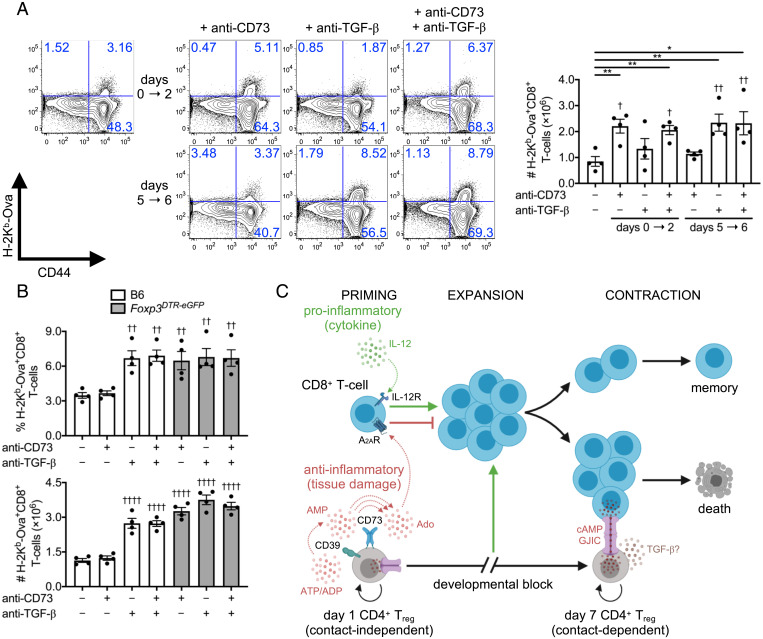
SignificanceThe CD4+ Treg response following acute Listeria infection is heterogeneous and deploys two distinct modes of suppression coinciding with initial pathogen exposure and resolution of infection. This bimodal suppression of CD8+ T cells during priming and contraction is mediated by separate Treg lineages. These findings make a significant contribution to our understanding of the functional plasticity inherent within Tregs, which allows these cells to serve as a sensitive and dynamic cellular rheostat for the immune system to prevent autoimmune pathology in the face of inflammation attendant to acute infection, enable expansion of the pathogen-specific response needed to control the infection, and reestablish immune homeostasis after the threat has been contained.
Keywords: CD73; FoxP3+ T regulatory cell; Listeria monocytogenes; cyclic AMP; gap junction.
Conflict of interest statement
The authors declare no competing interest.
Figures
Comment in
-
Tregs tango with killer cells in acute infection.Proc Natl Acad Sci U S A. 2022 Mar 29;119(13):e2202400119. doi: 10.1073/pnas.2202400119. Epub 2022 Mar 21. Proc Natl Acad Sci U S A. 2022. PMID: 35312353 Free PMC article. No abstract available.
References
-
- Sakaguchi S., Wing K., Onishi Y., Prieto-Martin P., Yamaguchi T., Regulatory T cells: How do they suppress immune responses? Int. Immunol. 21, 1105–1111 (2009). - PubMed
-
- Sakaguchi S., Vignali D. A. A., Rudensky A. Y., Niec R. E., Waldmann H., The plasticity and stability of regulatory T cells. Nat. Rev. Immunol. 13, 461–467 (2013). - PubMed
-
- Wing J. B., Sakaguchi S., TCR diversity and Treg cells, sometimes more is more. Eur. J. Immunol. 41, 3097–3100 (2011). - PubMed
-
- Sakaguchi S., Sakaguchi N., Asano M., Itoh M., Toda M., Immunologic self-tolerance maintained by activated T cells expressing IL-2 receptor alpha-chains (CD25). Breakdown of a single mechanism of self-tolerance causes various autoimmune diseases. J. Immunol. 155, 1151–1164 (1995). - PubMed
MeSH terms
Substances
Grants and funding
LinkOut - more resources
Full Text Sources
Medical
Research Materials
Miscellaneous
