. 2022 Mar 3;17(3):e0264328.
doi: 10.1371/journal.pone.0264328. eCollection 2022.

Do Hungarian multiple sclerosis care units fulfil international criteria?

Affiliations

Do Hungarian multiple sclerosis care units fulfil international criteria?

Zsófia Kokas et al. PLoS One. .

Abstract

A patients: Because of the past 3 decades' extensive research, several disease modifying therapies became available, thus a paradigm change is multiple sclerosis care was necessary. In 2018 a therapeutic guideline was created recommending that treatment of persons with multiple sclerosis should take place in specified care units where the entire spectrum of disease modifying therapies is available, patient monitoring is ensured, and therapy side effects are detected and treated promptly. In 2019 multiple sclerosis care unit criteria were developed, emphasizing personnel and instrumental requirements to provide most professional care. However, no survey was conducted assessing the real-world adaptation of these criteria.

Objective: To assess whether Hungarian care units fulfil international criteria.

Methods: A self-report questionnaire was assembled based on international guidelines and sent to Hungarian care units focusing on 3 main aspects: personnel and instrumental background, disease-modifying therapy use, number of people living with multiple sclerosis receiving care in care units. Data on number of persons with multiple sclerosis were compared to Hungarian prevalence estimates. Descriptive statistics were used to analyse data.

Results: Out of 27 respondent care units, 3 fulfilled minimum requirements and 7 fulfilled minimum and recommended requirements. The least prevalent neighbouring specialties were spasticity and pain specialist, and neuro-ophthalmologist and oto-neurologist. Only 15 centres used all available disease modifying therapies. A total number of 7213 people with multiple sclerosis received care in 27 respondent centres. Compared to prevalence estimates, 2500 persons with multiple sclerosis did not receive multiple sclerosis specific care in Hungary.

Conclusion: Less than half of Hungarian care units provided sufficient care for people living with multiple sclerosis. Care units employing fewer neighbouring specialties, might have difficulties diagnosing and providing appropriate care for persons with multiple sclerosis, especially for people with progressive disease course, contributing to the reported low number of persons living with multiple sclerosis.


Conflict of interest statement

The authors have declared that no competing interests exist.

Figures
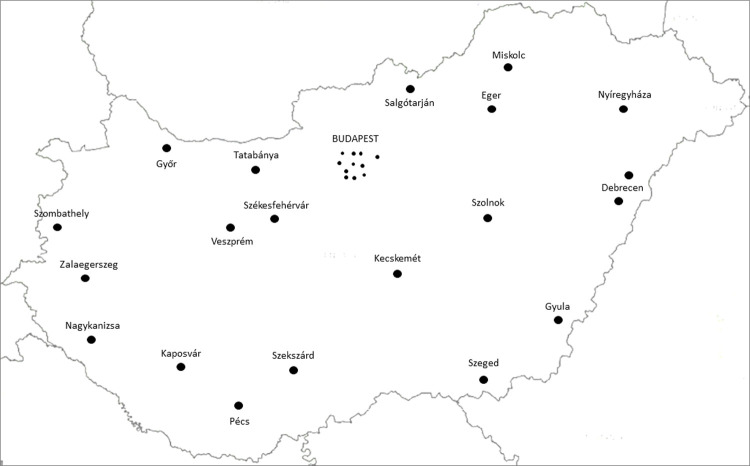
Fig 1
Fig 1. Location of Hungarian MS care units.
Black dots indicate the location of Hungarian MS care units. This map clearly represents that MS care unit density is highest in Pest County, where the capital city of Budapest with highest population density is located, whereas in other counties with less residents, usually 1 care unit/county is responsible for MS patient management. Abbreviations: MS = multiple sclerosis.
Fig 2
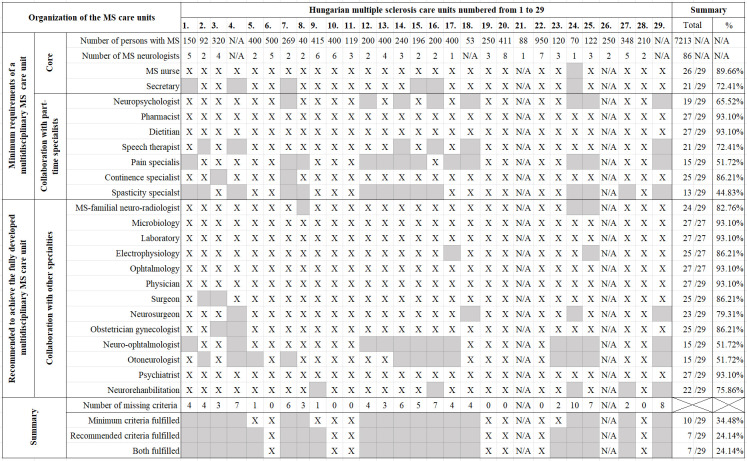
Fig 2. MS care unit criteria fulfilment among Hungarian MS care units.
Respondent Hungarian MS care units are numbered from 1 to 29. In the first column MS care unit minimum and recommended criteria are listed. In the first 2 rows patient number receiving care at the care unit and number of MS neurologists are marked. At the bottom 4 rows summary of care units fulfilling all aspects of the minimum and recommended criteria are represented as well as number of unfulfilled criteria care unit by care unit. In the last column the number of care units out of all respondent care units fulfilling a criterion is summarised. “X” indicates that criterion is fulfilled. “N/A” indicates that no data were supplied. Abbreviations: MS = multiple sclerosis.
Fig 3
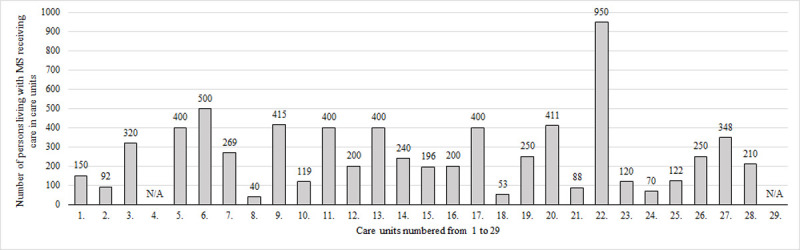
Fig 3. Distribution of people with MS among centres.
In the linear axis respondent multiple sclerosis care units numbered from 1 to 29 are listed, in the perpendicular axis number of persons with multiple sclerosis receiving care is represented. “N/A” indicates that no data were supplied. Abbreviations: MS = multiple sclerosis.

References

    1. Noseworthy JH, Lucchinetti C, Rodriguez M, Weinshenker BG. Multiple Sclerosis. N Engl J Med. 2000. Sep 28;343(13):938–52. doi: 10.1056/NEJM200009283431307 - DOI - PubMed
    1. Walton C, King R, Rechtman L, Kaye W, Leray E, Marrie RA, et al.. Rising prevalence of multiple sclerosis worldwide: Insights from the Atlas of MS, third edition. Mult Scler. 2020. Dec 1;26(14):1816–21. doi: 10.1177/1352458520970841 - DOI - PMC - PubMed
    1. Lad SP, Chapman CH, Vaninetti M, Steinman L, Green A, Boakye M. Socioeconomic trends in hospitalization for multiple sclerosis. Neuroepidemiology. 2010. Aug;35(2):93–9. doi: 10.1159/000310301 - DOI - PubMed
    1. Marrie RA, Reingold S, Cohen J, Stuve O, Trojano M, Sorensen PS, et al.. The incidence and prevalence of psychiatric disorders in multiple sclerosis: A systematic review. Mult Scler. 2015;21(3):305–17. doi: 10.1177/1352458514564487 - DOI - PMC - PubMed
    1. Knobler RL, Greenstein JI, Johnson KP, Lublin FD, Panitch HS, Conway K, et al.. Systemic Recombinant Human Interferon-β Treatment of Relapsing–Remitting Multiple Sclerosis: Pilot Study Analysis and Six-Year Follow-Up. J Interferon Res. 1993;13(5):333–40. doi: 10.1089/jir.1993.13.333 - DOI - PubMed

Publication types

MeSH terms