


Clinically adjudicated deceased donor acute kidney injury and graft outcomes
- PMID: 35239694
- PMCID: PMC8893682
- DOI: 10.1371/journal.pone.0264329
Clinically adjudicated deceased donor acute kidney injury and graft outcomes
Abstract
Background: Acute kidney injury (AKI) in deceased donors is not associated with graft failure (GF). We hypothesize that hemodynamic AKI (hAKI) comprises the majority of donor AKI and may explain this lack of association.
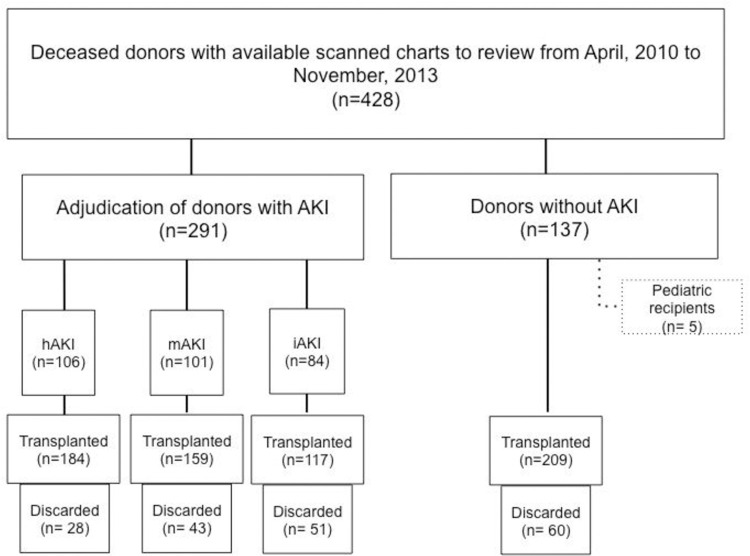
Methods: In this ancillary analysis of the Deceased Donor Study, 428 donors with available charts were selected to identify those with and without AKI. AKI cases were classified as hAKI, intrinsic (iAKI), or mixed (mAKI) based on majority adjudication by three nephrologists. We evaluated the associations between AKI phenotypes and delayed graft function (DGF), 1-year eGFR and GF. We also evaluated differences in urine biomarkers among AKI phenotypes.
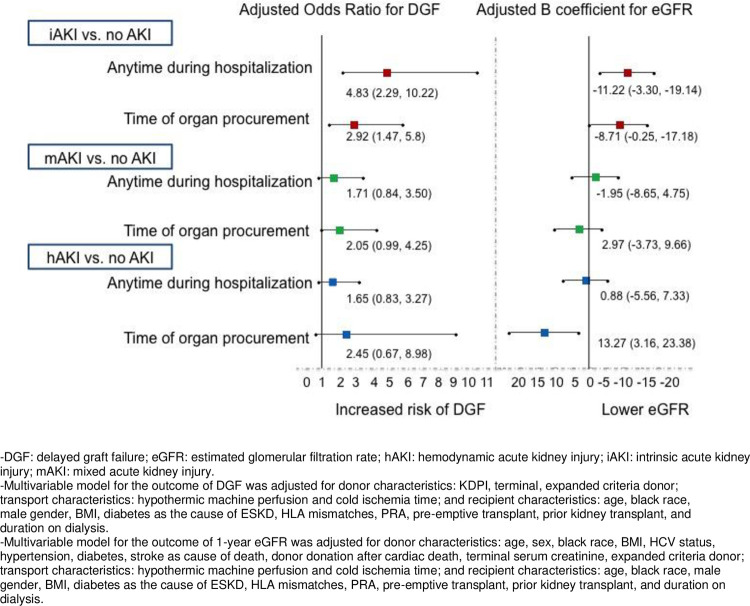
Results: Of the 291 (68%) donors with AKI, 106 (36%) were adjudicated as hAKI, 84 (29%) as iAKI and 101 (35%) as mAKI. Of the 856 potential kidneys, 669 were transplanted with 32% developing DGF and 5% experiencing GF. Median 1-year eGFR was 53 (IQR: 41-70) ml/min/1.73m2. Compared to non-AKI, donors with iAKI had higher odds DGF [aOR (95%CI); 4.83 (2.29, 10.22)] and had lower 1-year eGFR [adjusted B coefficient (95% CI): -11 (-19, -3) mL/min/1.73 m2]. hAKI and mAKI were not associated with DGF or 1-year eGFR. Rates of GF were not different among AKI phenotypes and non-AKI. Urine biomarkers such as NGAL, LFABP, MCP-1, YKL-40, cystatin-C and albumin were higher in iAKI.
Conclusion: iAKI was associated with higher DGF and lower 1-year eGFR but not with GF. Clinically phenotyped donor AKI is biologically different based on biomarkers and may help inform decisions regarding organ utilization.
Conflict of interest statement
The authors have declared that no competing interests exist.
Figures
References
-
- OPTN Transplant Trends by Center 2019 [cited 2020 Feburary 3rd]. Available from: https://optn.transplant.hrsa.gov/data/view-data-reports/center-data/.
-
- Hall IE, Schroppel B, Doshi MD, Ficek J, Weng FL, Hasz RD, et al.. Associations of deceased donor kidney injury with kidney discard and function after transplantation. American journal of transplantation: official journal of the American Society of Transplantation and the American Society of Transplant Surgeons. 2015;15(6):1623–31. Epub 2015/03/13. doi: 10.1111/ajt.13144 ; PubMed Central PMCID: PMC4563988. - DOI - PMC - PubMed
-
- Yu K, King K, Husain SA, Dube GK, Stevens JS, Ratner LE, et al.. Kidney nonprocurement in solid organ donors in the United States. American journal of transplantation: official journal of the American Society of Transplantation and the American Society of Transplant Surgeons. 2020;20(12):3413–25. Epub 2020/04/29. doi: 10.1111/ajt.15952 . - DOI - PMC - PubMed
Publication types
MeSH terms
Substances
Grants and funding
LinkOut - more resources
Full Text Sources
Medical
Research Materials
Miscellaneous
