


Application of Operating Room Nursing Intervention to Incision Infection of Patients Undergoing Gastrointestinal Surgery Can Reduce Complications and Improve Gastrointestinal Function
- PMID: 35242807
- PMCID: PMC8885529
- DOI: 10.3389/fsurg.2022.842309
Application of Operating Room Nursing Intervention to Incision Infection of Patients Undergoing Gastrointestinal Surgery Can Reduce Complications and Improve Gastrointestinal Function
Abstract
Objective: To observe the influence of nursing intervention in operation rooms on incision infection of patients undergoing gastrointestinal surgery and the improvement of gastrointestinal function.
Methods: A total of 340 patients who underwent gastrointestinal surgery in our hospital from June 2020 to August 2021 were included. According to the random number table, they were divided into the conventional nursing group (n = 170) and the operating room nursing group (n = 170). The conventional nursing group was treated with routine nursing intervention, while the operating room nursing group was treated with operating room nursing intervention. The incision infection, healing, gastrointestinal function recovery, and complications in the two groups were compared, and the patient care satisfaction was recorded.
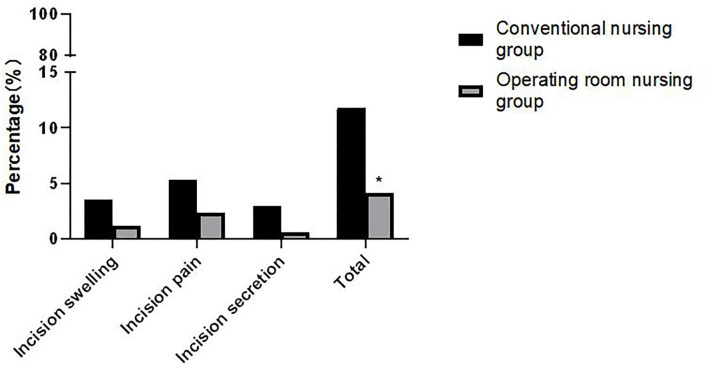
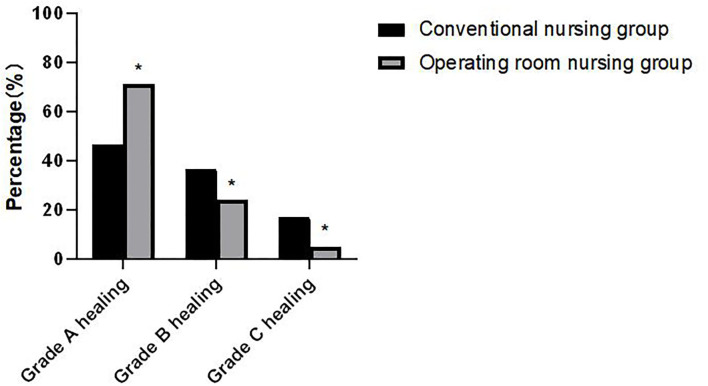
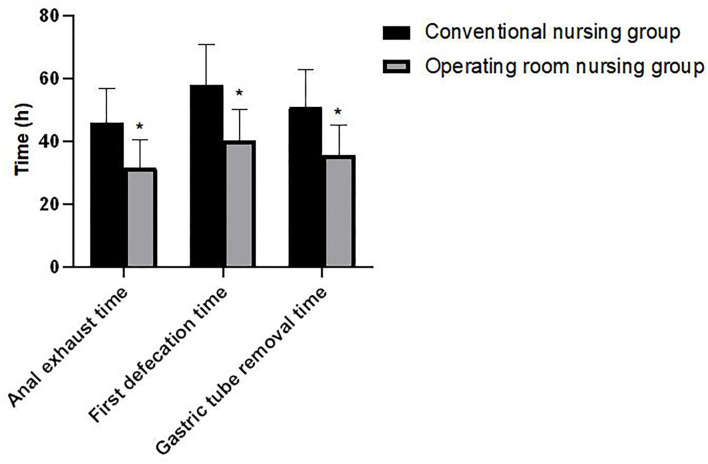
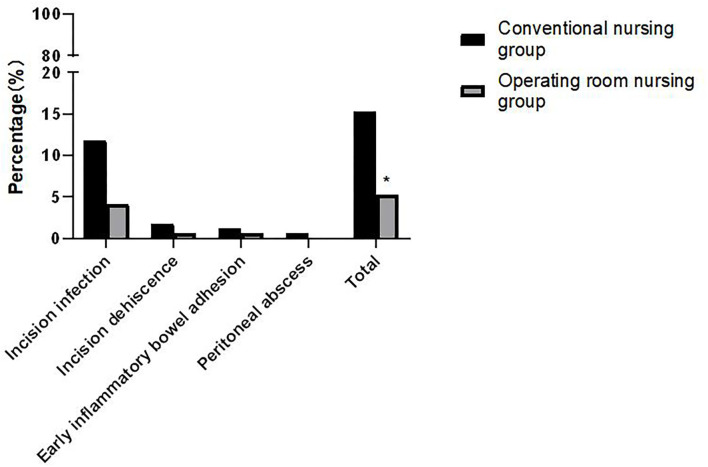
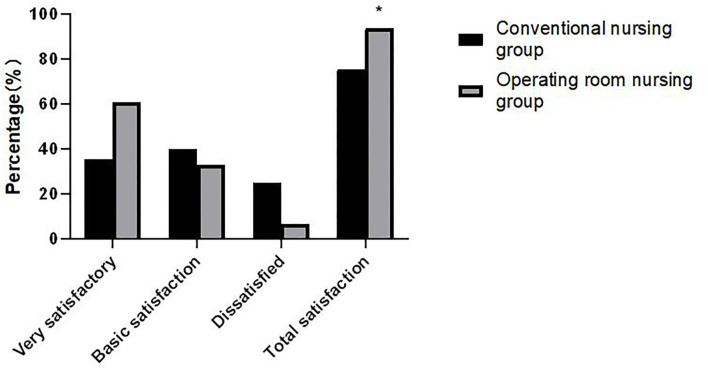
Results: The incidence of incision swelling, pain, and incision secretion in the operating room nursing group was significantly lower than that in the conventional nursing group (p < 0.05). The patients in the operating room nursing group had higher grade A healing than in the conventional nursing group, and lower grade B and grade C healing than in the conventional nursing group (p < 0.05). The time of anal exhaust, first defecation, and the time of gastric tube removal in the operating room nursing group were lower than those in the conventional nursing group (p < 0.05). The incidence of postoperative complications, such as incision infection, incision dehiscence, early inflammatory bowel adhesion, and abdominal abscess, in the operating room nursing group was lower than that in the conventional nursing group (p < 0.05). The total satisfaction degree in the operating room nursing group was significantly higher than that in the conventional nursing group (p < 0.05).
Conclusion: Nursing intervention in operation room can reduce complications and improve gastrointestinal function when applied to patients undergoing gastrointestinal surgery due to incision infection.
Keywords: complication; gastrointestinal function; gastrointestinal surgery; incision infection; operating room nursing.
Copyright © 2022 Wang, Chen and Ji.
Conflict of interest statement
The authors declare that the research was conducted in the absence of any commercial or financial relationships that could be construed as a potential conflict of interest.
Figures
References
-
- Herbert G, Perry R, Andersen HK, Atkinson C, Penfold C, Lewis SJ, et al. Early enteral nutrition within 24 h of lower gastrointestinal surgery versus later commencement for length of hospital stay and postoperative complications. Cochrane Database Syst Rev. (2019) 7:4080. 10.1002/14651858.CD004080.pub4 - DOI - PMC - PubMed
-
- Shen P, Blackham AU, Lewis S, Clark CJ, Howerton R, Mogal HD, et al. Phase II randomized trial of negative-pressure wound therapy to decrease surgical site infection in patients undergoing laparotomy for gastrointestinal, pancreatic, and peritoneal surface malignancies. J Am Coll Surg. (2017) 224:726–37. 10.1016/j.jamcollsurg.2016.12.028 - DOI - PMC - PubMed
-
- Maehara Y, Shirabe K, Kohnoe S, Emi Y, Oki E, Kakeji Y, et al. Impact of intra-abdominal absorbable sutures on surgical site infection in gastrointestinal and hepato-biliary-pancreatic surgery: results of a multicenter, randomized, prospective, phase II clinical trial. Surg Today. (2017) 47:1060–71. 10.1007/s00595-017-1480-3 - DOI - PubMed
LinkOut - more resources
Full Text Sources
