


Analyzing the Role of Research in the Radiation Oncology Match
- PMID: 35243182
- PMCID: PMC8866675
- DOI: 10.1016/j.adro.2021.100891
Analyzing the Role of Research in the Radiation Oncology Match
Abstract
Purpose: Program directors consider scholarly output to be integral in matching applicants with radiation oncology residencies. However, applicants' research productivity can be quantified in several ways, and the results can be misleading for both applicants and program directors. We conducted a bibliometric analysis to quantify the research productivity of applicants who had successfully matched to radiation oncology residencies and to test for associations between research productivity and residency program rankings.
Methods and materials: We identified U.S. radiation oncology residency programs from the Accreditation Council for Graduate Medical Education website and sorted the findings into 4 tiers based on the programs' reputation and research output per Doximity's Residency Navigator. First-year (post-graduate year-2) radiation oncology residents starting in 2020 were identified on residency program websites. Residents' research productivity was estimated by identifying peer-reviewed research articles (published before the residency applications began) via PubMed, Scopus, and Google Scholar for each resident. Bibliometric variables were analyzed for potential association with matching to higher-tier residencies.
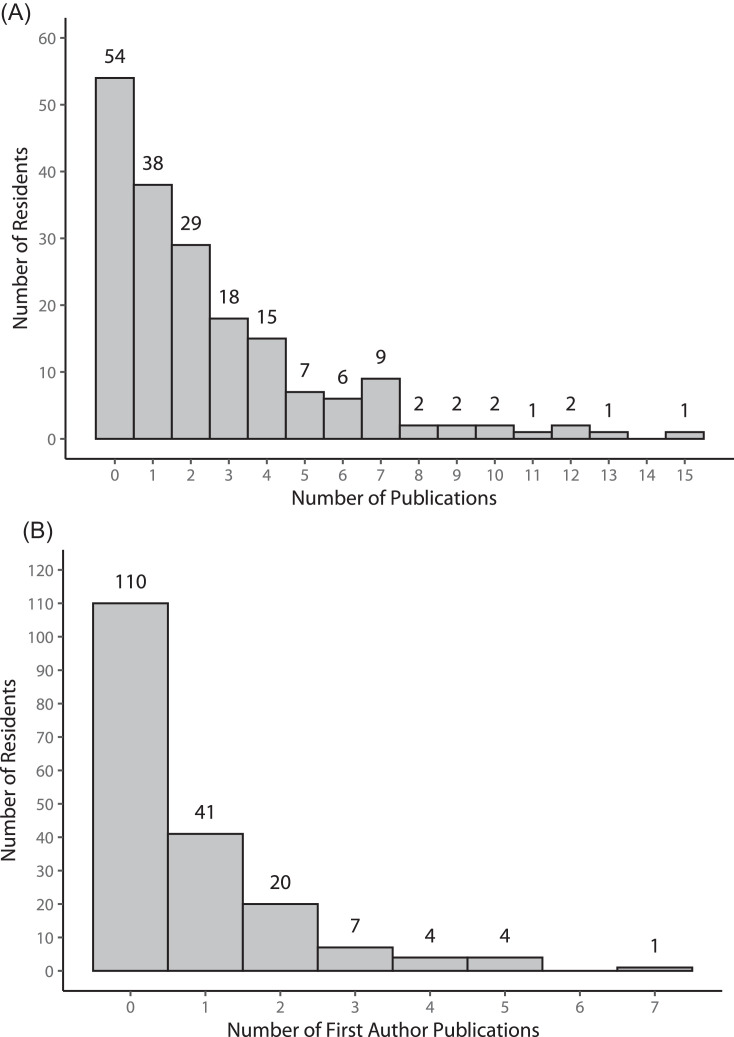
Results: We identified 187 first-year residents in 83 U.S. residency programs. The mean number of National Resident Matching Program publications (which was self-reported and included presentations and abstracts) was 18.3 per applicant; the mean (± standard deviation) peer-reviewed publications was 2.47 (±2.88) per resident. Multivariate analysis showed that number of first-author publications was associated with matching to a higher-tier program, based on the program's reputation (P = .019) and research output (P = .010); numbers of radiation oncology-specific publications (P = .039) and h-index (P = .024) correlated with matching to a higher-tier residency based on the program's research output.
Conclusions: The number of first-author publications was significantly associated with matriculating into a higher-tier residency ranked by both reputation and research output. Significant correlations were also found for number of radiation oncology-specific publications and h-index. Applicants may find publishing meaningful radiation oncology articles, especially as first author, to be more valuable than meeting National Resident Matching Program numbers.
© 2022 The Author(s).
Figures

References
-
- Wilson LD, Haffty BG. Evaluation of the National Resident Matching Program (NRMP) radiation oncology data (1993–2003) Int J Radiat Oncol Biol Phys. 2003;57:1033–1037. - PubMed
-
- Bates JE, Amdur RJ, Lee WR. Unfilled positions in the 2021 Radiation Oncology Match. Pract Radiat Oncol. 2021;11:323–324. - PubMed
-
- Chowdhary M, Parikh SD, Lee A, Tendulkar RD, Royce TJ. Radiation oncology resident quality by national resident matching program metrics from 2007 to 2018. Int J Radiat Oncol Biol Phys. 2021;109:324–328. - PubMed
LinkOut - more resources
Full Text Sources
