


A framework for integrating microbial dispersal modes into soil ecosystem ecology
- PMID: 35243247
- PMCID: PMC8866892
- DOI: 10.1016/j.isci.2022.103887
A framework for integrating microbial dispersal modes into soil ecosystem ecology
Abstract
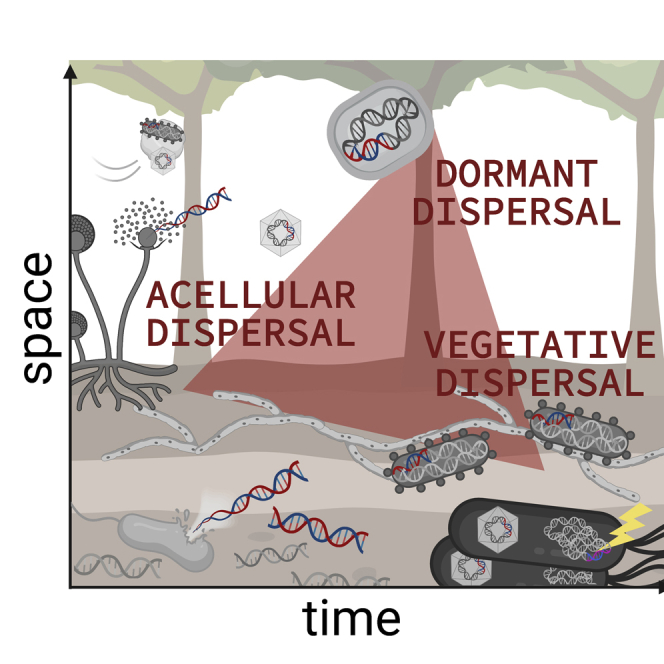
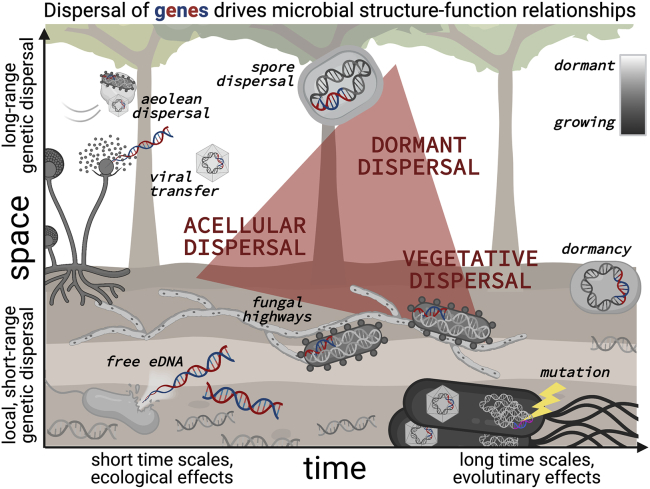
Dispersal is a fundamental community assembly process that maintains soil microbial biodiversity across spatial and temporal scales, yet the impact of dispersal on ecosystem function is largely unpredictable. Dispersal is unique in that it contributes to both ecological and evolutionary processes and is shaped by both deterministic and stochastic forces. The ecosystem-level ramifications of dispersal outcomes are further compounded by microbial dormancy dynamics and environmental selection. Here we review the knowledge gaps and challenges that remain in defining how dispersal, environmental filtering, and microbial dormancy interact to influence the relationship between microbial community structure and function in soils. We propose the classification of microbial dispersal into three categories, through vegetative or active cells, through dormant cells, and through acellular dispersal, each with unique spatiotemporal dynamics and microbial trait associations. This conceptual framework should improve the integration of dispersal in defining soil microbial community structure-function relationships.
Keywords: Microbiology; Soil ecology; Soil science.
© 2022 The Authors.
Conflict of interest statement
The authors declare no competing interests.
Figures
References
-
- Achtman M., Wagner M. Microbial diversity and the genetic nature of microbial species. Nat. Rev. Microbiol. 2008;6:431–440. - PubMed
-
- Albright M.B.N., Martiny J.B.H. Dispersal alters bacterial diversity and composition in a natural community. ISME J. 2018;12:296–299. https://europepmc.org/articles/PMC5739015 - PMC - PubMed
Publication types
LinkOut - more resources
Full Text Sources
