


Changes in polysaccharides structure and bioactivity during Mesona chinensis Benth storage
- PMID: 35243352
- PMCID: PMC8857269
- DOI: 10.1016/j.crfs.2022.01.024
Changes in polysaccharides structure and bioactivity during Mesona chinensis Benth storage
Abstract
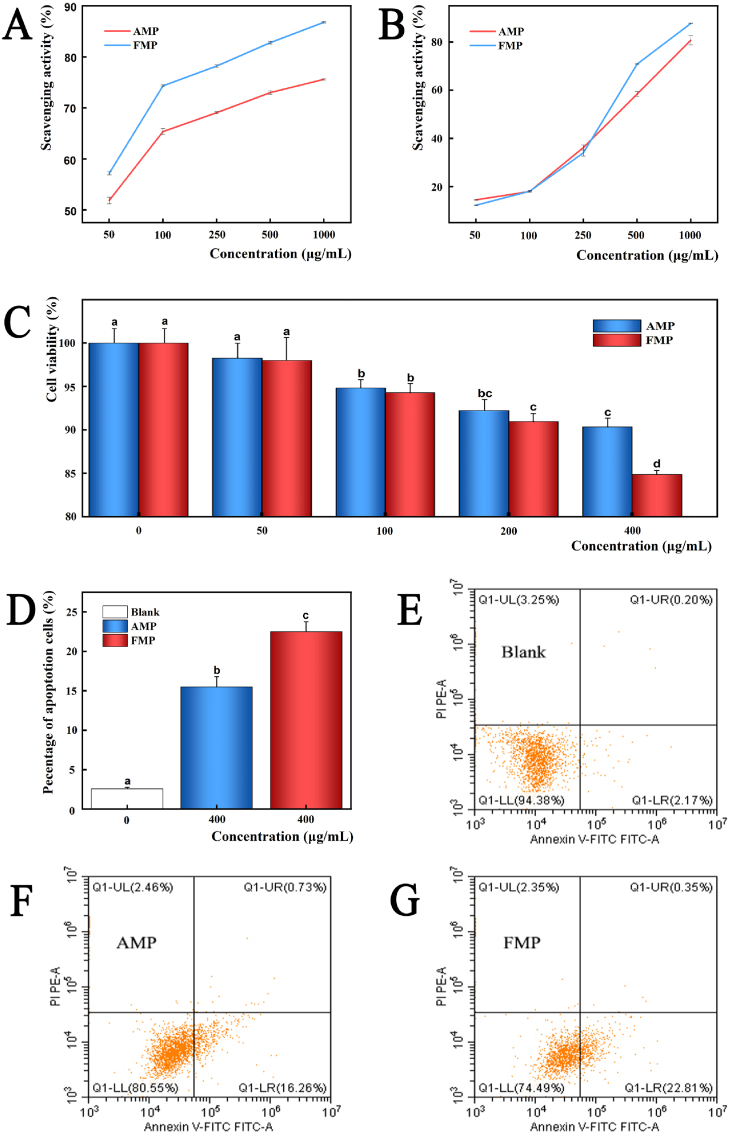
Mesona chinensis Benth has been consumed as a functional food for many years. It is widely believed that storage times affect its health benefits. In this study, Mesona chinensis Benth polysaccharides with two different storage times (fresh and storage for 1 year) were prepared, namely, FMP and AMP. The physicochemical properties and bioactivity were comparatively assessed. Results indicated that FMP was mainly composed of galacturonic acid, galactose, and glucose with a molecular weight of 44.39 kDa. AMP was composed of galacturonic acid, galactose, and fructose with a molecular weight of 64.34 kDa. However, the principal structural characteristics of polysaccharides remained stable. Furthermore, assays of antioxidant activity showed that Mesona chinensis Benth polysaccharide had an antioxidant effect against DPPH radical, ABTS radical cation, among which FMP was stronger. Additionally, flow cytometry indicated that the apoptosis rate of FMP and AMP on HepG2 tumor cells was 22.50 ± 1.25% and 15.49 ± 1.30%, respectively. In general, antioxidant and antitumor activities of Mesona chinensis Benth polysaccharides were decreased as the storage for 1 year. The change of physicochemical properties was responsible for the enhanced bioactivities. These results explained how polysaccharides contributed to the decreased health benefits of Mesona chinensis Benth during storage.
Keywords: Antioxidant; Antitumor; Mesona chinensis Benth; Polysaccharides; Properties.
© 2022 The Authors.
Conflict of interest statement
The authors declare that they have no known competing financial interests or personal relationships that could have appeared to influence the work reported in this paper.
Figures



References
-
- Bai L., Zhu P., Wang W., Wang M. The influence of extraction pH on the chemical compositions, macromolecular characteristics, and rheological properties of polysaccharide: the case of okra polysaccharide. Food Hydrocolloids. 2020;102:105586.
-
- Blumenkrantz N., Asboe-Hansen G. New method for quantitative determination of uronic acids. Anal. Biochem. 1973;54(2):484–489. - PubMed
-
- Bradford M.M. A rapid and sensitive method for the quantitation of microgram quantities of protein utilizing the principle of protein-dye binding. Anal. Biochem. 1976;72(1–2):248–254. - PubMed
-
- Chen X., Wang Y., Shen M., Yu Q., Chen Y., Huang L., Xie J. The water-soluble non-starch polysaccharides from natural resources against excessive oxidative stress: a potential health-promoting effect and its mechanisms. Int. J. Biol. Macromol. 2021;171:320–330. - PubMed
-
- Dubois M., Gilles K.A., Hamilton J.K., Rebers P., Smith F. Colorimetric method for determination of sugars and related substances. Anal. Chem. 1956;28(3):350–356.
LinkOut - more resources
Full Text Sources
