. 2022 Feb 3;3(2):100509.
doi: 10.1016/j.xcrm.2022.100509. eCollection 2022 Feb 15.

Inactivated and live-attenuated seasonal influenza vaccines boost broadly neutralizing antibodies in children

Affiliations

Inactivated and live-attenuated seasonal influenza vaccines boost broadly neutralizing antibodies in children

Sergey Yegorov et al. Cell Rep Med. .

Abstract

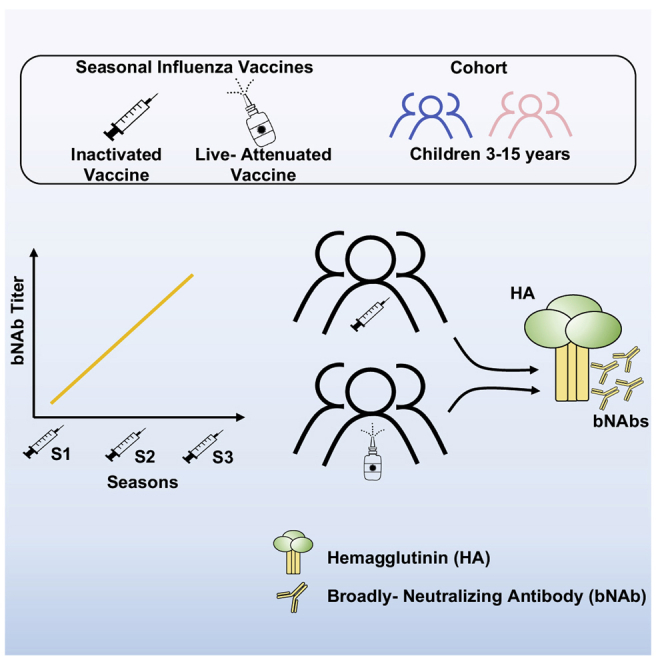
The induction of broadly neutralizing antibodies (bNAbs) that target the hemagglutinin stalk domain is a promising strategy for the development of "universal" influenza virus vaccines. bNAbs can be boosted in adults by sequential exposure to heterosubtypic viruses through natural infection or vaccination. However, little is known about if or how bNAbs are induced by vaccination in more immunologically naive children. Here, we describe the impact of repeated seasonal influenza vaccination and vaccine type on induction of bNAbs against group 1 influenza viruses in a pediatric cohort enrolled in randomized controlled trials of seasonal influenza vaccination. Repeated seasonal vaccination results in significant boosting of a durable bNAb response. Boosting of serological bNAb titers is comparable within inactivated and live attenuated (LAIV) vaccinees and declines with age. These data provide insights into vaccine-elicited bNAb induction in children, which have important implications for the design of universal influenza vaccine modalities in this critical population.

Keywords: broadly neutralizing antibodies; children; influenza virus; universal vaccine; vaccines.


Conflict of interest statement

The authors declare no competing interests.

Figures
None
Graphical abstract
Figure 1
Figure 1
Study flowchart (A) Description of participants in analysis I: effects of repeated seasonal influenza vaccination on bNAb titers in children. (B) Description of participants in analysis II: effect of vaccine type (IIV versus LAIV) on induction of bNAbs in children. cRCT, cluster randomized controlled trial; bNAb, broadly neutralizing antibody; IIV, inactivated influenza vaccine; LAIV, live attenuated influenza vaccine.
Figure 2
Figure 2
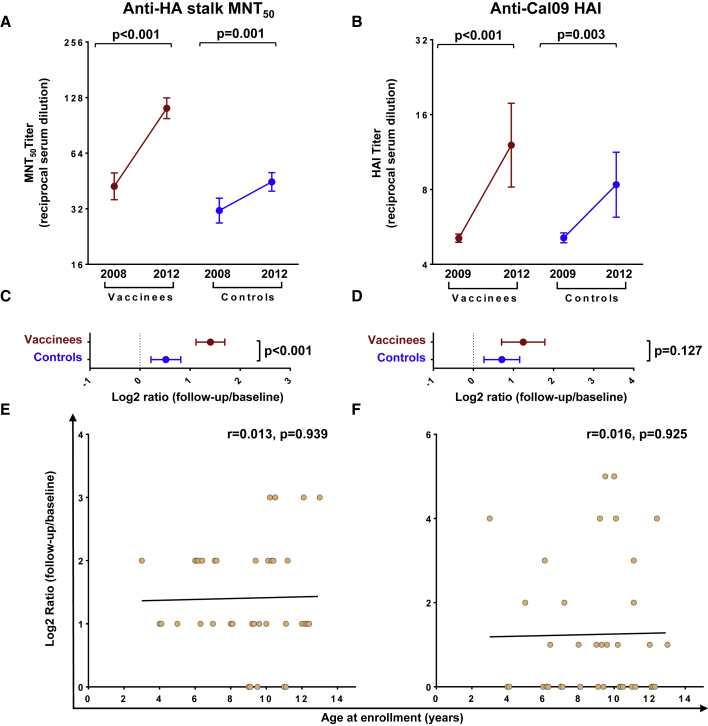
Effects of seasonal vaccination of bNAb titers in children (A) Anti-HA stalk MNT50 titers at baseline (year 2008) and after three cRCT vaccination seasons (year 2012). (B) Serum HAI activity against the Cal/09 virus assessed at baseline (year 2009) and after three cRCT vaccination seasons (year 2012). (C) Log2-transformed ratios of MNT50 titers after repeated vaccination (year 2012) versus at baseline (year 2008). (D) Log2-transformed ratios of HAI titers after repeated vaccination (year 2012) versus at baseline (year 2009). (E and F) Correlation plots of log2-transformed MNT50 (E) and HAI (F) titer ratios and participant ages at enrollment. In (A and B), dots and brackets represent geometric means and 95% CIs, respectively; p values indicate the statistical significance of the intra-individual difference between pre- and post-vaccination titers assessed by paired t test. In (C and D), dots and brackets represent means and 95% CIs, respectively; p values indicate the statistical significance of the difference between vaccinees and controls assessed by unpaired t test. In (E and F), the Pearson coefficients (r) and their statistical significance are shown along with lines of best fit for vaccinees.
Figure 3
Figure 3
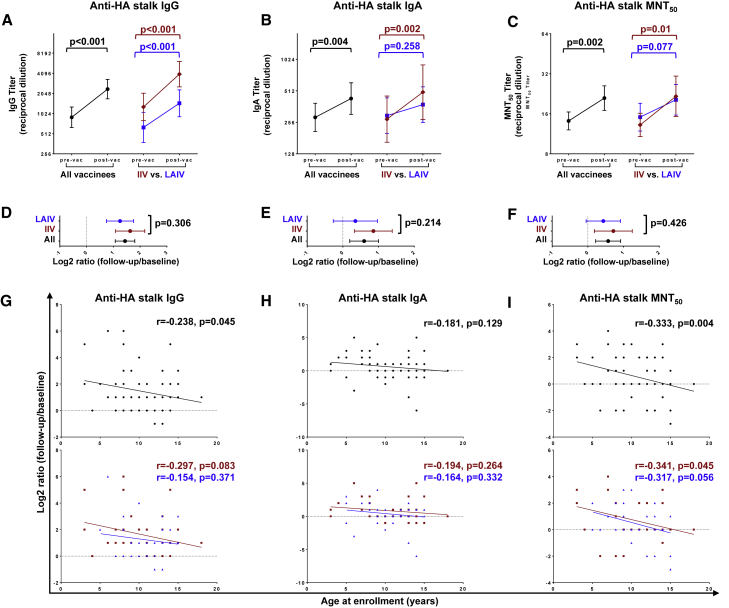
Effect of vaccine type on serological bNAb titers (A–C) Anti-HA stalk IgG (A), IgA (B), and MNT50 (C) titers pre- and post-vaccination. (D–F) Log2-transformed ratios of anti-HA stalk IgG (D), IgA (E), and MNT50 (F) titers post- versus pre-vaccination. (G–I) Correlation plots of log2-transformed anti-HA stalk IgA (G), anti-HA stalk IgG (H), and MNT50 (I) titer ratios and participant ages at enrollment. In (A–C), dots and brackets represent geometric means and 95% CIs, respectively; p values indicate the statistical significance of the intra-individual difference between pre- and post-vaccination titers assessed by paired t test. In (D–F), dots and brackets represent means and 95% CIs, respectively; p values indicate the statistical significance of the difference in the magnitude of immune response between IIV and LAIV vaccinees assessed by unpaired t test. In (G–I), the Pearson coefficients (r) and their statistical significance are shown along with lines of best fit for all participants (black) and IIV (red) versus LAIV (blue) vaccinees.
Figure 4
Figure 4
Effect of vaccine type on serological titers of strain-specific antibodies (A–C) Anti-Cal/09 IgG (A), IgA (B), and HAI (C) titers pre- and post-vaccination. (D–F) Log2-transformed ratios of anti-Cal09 IgG (D), IgA (E), and HAI (F) titers post- versus pre-vaccination. (G–I) Correlation plots of log2-transformed anti-Cal09 IgA (G), anti-Cal09 IgG (H), and HAI (I) titer ratios and participant ages. In (A–C), dots and brackets represent geometric means and 95% CIs, respectively; p values indicate the statistical significance of the intra-individual difference between pre- and post-vaccination titers assessed by paired t test. In (D–F), dots and brackets represent means and 95% CIs, respectively; p values indicate the statistical significance of the difference in the magnitude of immune response between IIV and LAIV vaccinees assessed by unpaired t test. In (G–I), the Pearson coefficients (r) and their statistical significance are shown along with lines of best fit for all participants (black) and IIV (red) versus LAIV (blue) vaccinees.
Figure 5
Figure 5
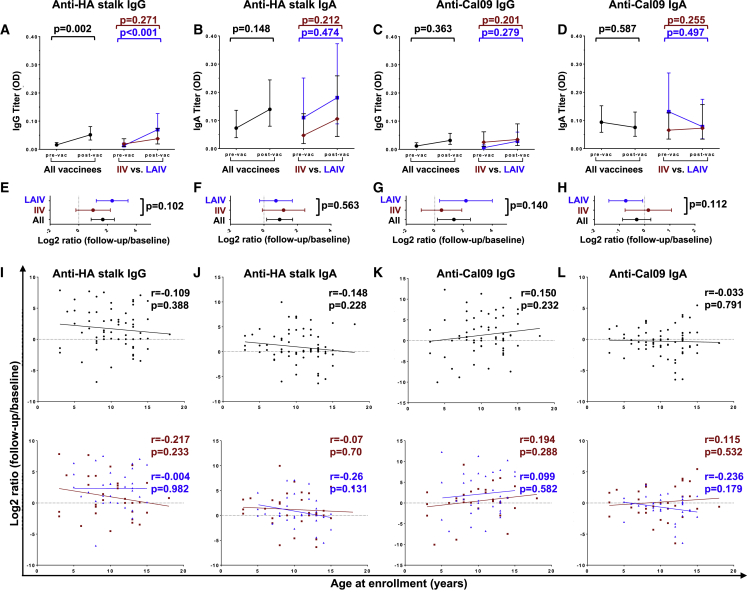
Effect of vaccine type on mucosal bNAb titers (A–D) Anti-HA stalk IgG (A), IgA (B), and anti-Cal/09 IgG (C) and IgA (D) titers. (E–H) Log2-transformed ratios of anti-HA stalk IgG (E) and IgA (F), and anti-Cal09 IgG (G) and IgA (H) titers post- versus pre-vaccination. (I–L) Correlation plots of anti H6/1 IgG (I) and IgA (J) and anti-Cal09 IgG (K) and IgA (L) titer ratios and participant ages at enrollment. In (A–D), dots and brackets represent geometric means and 95% CIs, respectively; p values indicate the statistical significance of the intra-individual difference between pre- and post-vaccination titers assessed by paired t test. In (E–H), dots and brackets represent means and 95% CIs, respectively; p values indicate the statistical significance of the difference in the magnitude of immune response between IIV and LAIV vaccinees assessed by unpaired t test. In (I–L), the Pearson coefficients (r) and their statistical significance are shown along with lines of best fit for all participants (black) and IIV (red) versus LAIV (blue) vaccinees.
Figure 6
Figure 6
Relationship between mucosal and serological antibody titers (A–D) Correlation plots of anti- HA stalk IgG (A) and IgA (B) and anti-Cal09 IgG (C) and IgA (D) log2-transformed post-/pre-vaccination titer ratios. The Pearson coefficients (r) and their statistical significance are shown along with lines of best fit for all participants (black) and IIV (red) versus LAIV (blue) vaccinees.

Comment in

References

    1. Krammer F. The human antibody response to influenza A virus infection and vaccination. Nat. Rev. Immunol. 2019;19:383–397. - PubMed
    1. Zhang A., Stacey H.D., Mullarkey C.E., Miller M.S. Original antigenic sin: how first exposure shapes lifelong anti-influenza virus immune responses. J. Immunol. 2019;202:335–340. - PubMed
    1. Miller M.S., Palese P. Peering into the crystal ball: influenza pandemics and vaccine efficacy. Cell. 2014;157:294–299. - PubMed
    1. Wang X., Li Y., O'Brien K.L., Madhi S.A., Widdowson M.A., Byass P., Omer S.B., Abbas Q., Ali A., Amu A., Azziz-Baumgartner E., Bassat Q., Abdullah Brooks W., Chaves S.S., Chung A., Cohen C., Echavarria M., Fasce R.A., Gentile A., Gordon A., Groome M., Heikkinen T., Hirve S., Jara J.H., Katz M.A., Khuri-Bulos N., Krishnan A., de Leon O., Lucero M.G., McCracken J.P., Mira-Iglesias A., Moïsi J.C., Munywoki P.K., Ourohiré M., Polack F.P., Rahi M., Rasmussen Z.A., Rath B.A., Saha S.K., Simões E.A., Sotomayor V., Thamthitiwat S., Treurnicht F.K., Wamukoya M., Yoshida L.M., Zar H.J., Campbell H., Nair H. Global burden of respiratory infections associated with seasonal influenza in children under 5 years in 2018: a systematic review and modelling study. Lancet Glob. Health. 2020;8 e497–510. - PMC - PubMed
    1. Iuliano A.D., Roguski K.M., Chang H.H., Muscatello D.J., Palekar R., Tempia S., Cohen C., Gran J.M., Schanzer D., Cowling B.J., Wu P., Kyncl J., Ang L.W., Park M., Redlberger-Fritz M., Yu H., Espenhain L., Krishnan A., Emukule G., van Asten L., Pereira da Silva S., Aungkulanon S., Buchholz U., Widdowson M.A., Bresee J.S. Estimates of global seasonal influenza-associated respiratory mortality: a modelling study. Lancet. 2018;391:1285–1300. - PMC - PubMed

Publication types

Substances