Review
. 2022 Mar 4;3(1):8.
doi: 10.1186/s43556-022-00071-6.

Therapeutic progress and challenges for triple negative breast cancer: targeted therapy and immunotherapy

Affiliations
Review

Therapeutic progress and challenges for triple negative breast cancer: targeted therapy and immunotherapy

Ruoning Yang et al. Mol Biomed. .

Abstract

Triple negative breast cancer (TNBC) is a subtype of breast cancer, with estrogen receptor, human epidermal growth factor receptor 2 and progesterone receptor negative. TNBC is characterized by high heterogeneity, high rates of metastasis, poor prognosis, and lack of therapeutic targets. Now the treatment of TNBC is still based on surgery and chemotherapy, which is effective only in initial stage but almost useless in advanced stage. And due to the lack of hormone target, hormonal therapies have little beneficial effects. In recent years, signaling pathways and receptor-specific targets have been reported to be effective in TNBC patients under specific clinical conditions. Now targeted therapies have been approved for many other cancers and even other subtypes of breast cancer, but treatment options for TNBC are still limited. Most of TNBC patients showed no response, which may be related to the heterogeneity of TNBC, therefore more effective treatments and predictive biomarkers are needed. In the present review, we summarize potential treatment opinions for TNBC based on the dysregulated receptors and signaling pathways, which play a significant role in multiple stages of TNBC development. We also focus on the application of immunotherapy in TNBC, and summarize the preclinical and clinical trials of therapy for patients with TNBC. We hope to accelerate the research and development of new drugs for TNBC by understanding the relevant mechanisms, and to improve survival.

Keywords: Immune checkpoint inhibitors; Signaling pathways; TNBC; Targeted therapy; Triple negative breast cancer.


Conflict of interest statement

All authors have declared that no competing interest exists.

Figures
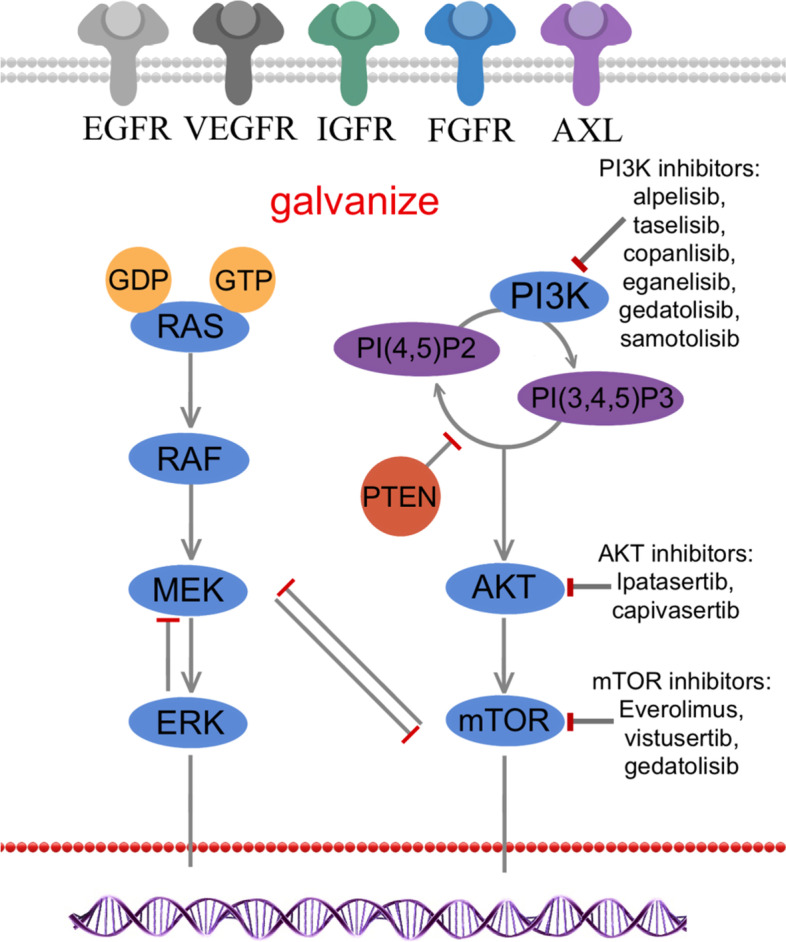
Fig. 1
Fig. 1
Receptor tyrosine kinases and associated pathways in TNBC. RTKs bind to extracellular ligands, then activated RTKs then activates downstream PI3K/AKT/ mTOR and Ras/MAPK pathway signaling pathways. After Ras family (N-Ras, M-Ras, H-Ras and K-Ras) is activated, downstream Raf, MEK and ERK in turn transfers the signals released from Ras to the nucleus, and finally drives tumor cell proliferation and survival. PI3K is firstly activated by RTKs, and then phosphorylates PIP2 into PIP3, which binds to AKT, and followed by phosphorylation of threonine. And AKT and mTOR are completely activated in turn. PTEN is a negative regulatory phosphatase of PI3K signaling, which can suppress tumor by converting PIP3 to PIP2
Fig. 2
Fig. 2
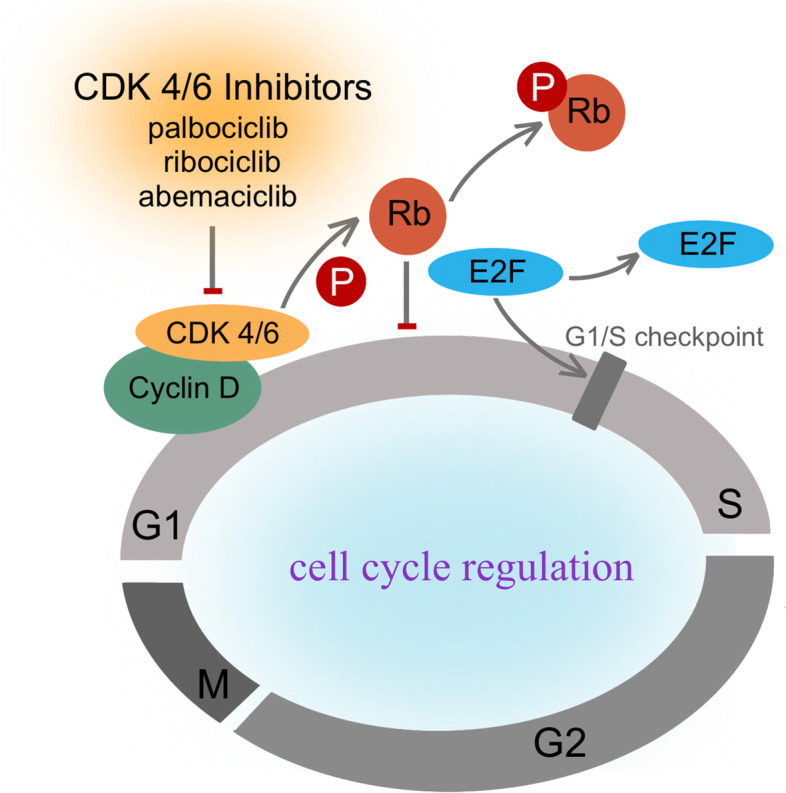
Cyclin-Dependent Kinases 4/6 signaling pathways mediated cell cycle progression in TNBC. CDK 4/6—cyclin D complex gets into the nucleus, and then phosphorylates Rb. Phosphorylated Rb inhibits E2F, and initiates the cell into S phase and drives DNA replication. CDK4/6 inhibitors can inhibit Rb phosphorylation to prevent the proliferation of tumor cells
Fig. 3
Fig. 3
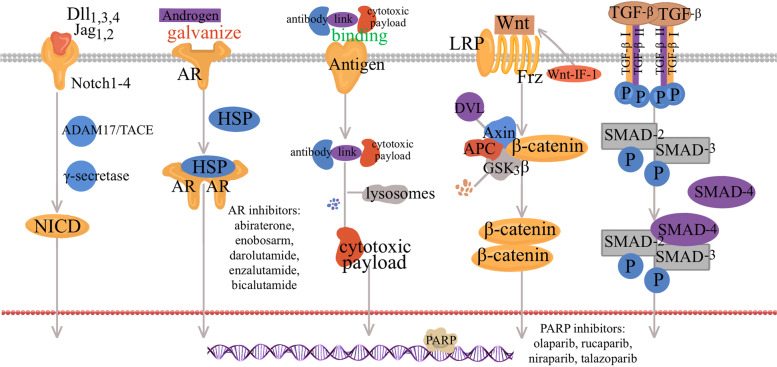
Partial Signaling pathways and potential targets for the treatment of TNBC. PARP is a DNA repair enzyme, which can promote the repair of single strand DNA breaks. PARP inhibitors can suppress DNA repair resulting in cytotoxicity. Notch receptors (Notch 1–4) on the surface of one cell bind to ligands ( Dll 1, 3, 4, and JAG 1, 2), thus activate Notching pathways. The Notch ligand–receptor complex is hydrolyzed by the ADAM17/TACE metalloprotease and γ-secretase in turn, releasing the intracellular domain of Notch into the nucleus. AR bind to endogenous androgens, and then form a homodimer. Before homodimer, AR is bound to HSP. Subsequently, the homodimer moves into to the nucleus and activates target gene transcription, regulating cell proliferation. ADCs consist of a highly efficient cytotoxic payload, an antibody and a linker connecting the former two components. ADC binds to target antigens on tumor cell surface and then enter the target cell via receptor-mediated endocytosis. After entering the cell, ADCs are degraded by lysosomes, in which the linker cleaves, leading to the release of payloads into cytoplasm. When the Wnt signaling is on, Wnt/β-catenin signaling pathway is activated from the combination of lipid-modified Wnts and the receptor complex which is composed of Fzds and LRP5/6. Dvl inhibit the destruction complex, inhibiting the β-catenin proteasomal degradation. therefore, the β-catenin enter into the nucleus. After entering into the nucleus, β-catenin binds to T cell factor and LEF families and regulates Wnt target gene expression. When Wnt ligands are absent in the cytoplasm, β-catenin is sequestered by the destruction complex (APC, GSK-3β and CK1α), and then phosphorylated by CK1α and GSK-3β in turn. TGF-β is excreted by cells and then successively binds to TβRII and TβRI on the surface of cell. During this process, two TβRI and two TβRII molecules form a heterotetrametric complex, further causing the phosphorylation and activation of TβRI. After that, the activated complex phosphorylates Smad2 and Smad3 in sequence, which bind to SMAD4 to form SMAD trimer complex. Finally, the complex translocates into nuclei and promotes target gene transcription
Fig. 4
Fig. 4
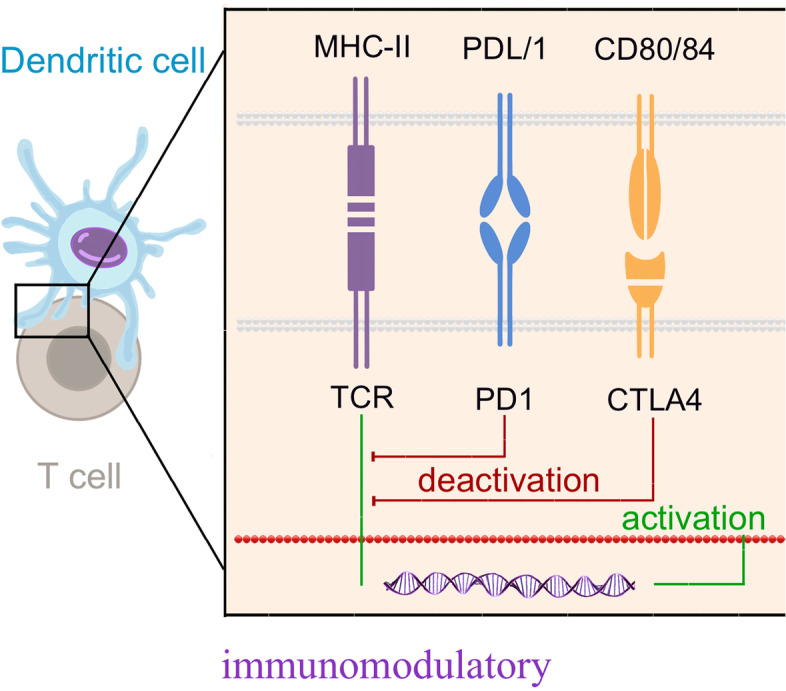
Immune checkpoint inhibitors for the treatment of TNBC. Immune checkpoints limit the anti-tumor autoimmune response by inhibiting effector T lymphocytes. PD-L1 expressing in the tumor cells binds to PD-1 which is on the surface of T cell and prevents T cell activation. The tumor-infiltrating lymphocytes also can express highly PD-1, and both of them are increased in TNBC. ICIs can enhance the anti-tumor immune responses to kill tumor cell

References

    1. Sung H, Ferlay J, Siegel RL, Laversanne M, Soerjomataram I, Jemal A, et al. Global Cancer Statistics 2020: GLOBOCAN Estimates of Incidence and Mortality Worldwide for 36 Cancers in 185 Countries. CA Cancer J Clin. 2021;71(3):209–249. doi: 10.3322/caac.21660. - DOI - PubMed
    1. Borri F, Granaglia A. Pathology of triple negative breast cancer. Semin Cancer Biol. 2021;72:136–145. doi: 10.1016/j.semcancer.2020.06.005. - DOI - PubMed
    1. Perou CM, Sørlie T, Eisen MB, van de Rijn M, Jeffrey SS, Rees CA, et al. Molecular portraits of human breast tumours. Nature. 2000;406(6797):747–752. doi: 10.1038/35021093. - DOI - PubMed
    1. Brenton JD, Carey LA, Ahmed AA, Caldas C. Molecular classification and molecular forecasting of breast cancer: ready for clinical application? J Clin Oncol. 2005;23(29):7350–7360. doi: 10.1200/jco.2005.03.3845. - DOI - PubMed
    1. Lehmann BD, Bauer JA, Chen X, Sanders ME, Chakravarthy AB, Shyr Y, et al. Identification of human triple-negative breast cancer subtypes and preclinical models for selection of targeted therapies. J Clin Invest. 2011;121(7):2750–2767. doi: 10.1172/jci45014. - DOI - PMC - PubMed

LinkOut - more resources