


Reliability of AMH and AFC measurements and their correlation: a large multicenter study
- PMID: 35243569
- PMCID: PMC9107554
- DOI: 10.1007/s10815-022-02449-5
Reliability of AMH and AFC measurements and their correlation: a large multicenter study
Abstract
Purpose: Anti-Müllerian hormone (AMH) and antral follicle count (AFC) are correlated with the ovarian response, but their reliability and reproducibility are questionable. This large multicenter study describes their distribution, inter-cycle and inter-center variability, and their correlation.
Methods: A total of 25,854 IVF cycles among 15,219 patients were selected in 12 ART centers. Statistical distribution of AMH and AFC was studied by using the Kolmogorov-Smirnov test and Shapiro goodness of fit test. The reproducibility of AFC and AMH was measured using a mixed model regressing the logarithmic transformation of AFC with age.
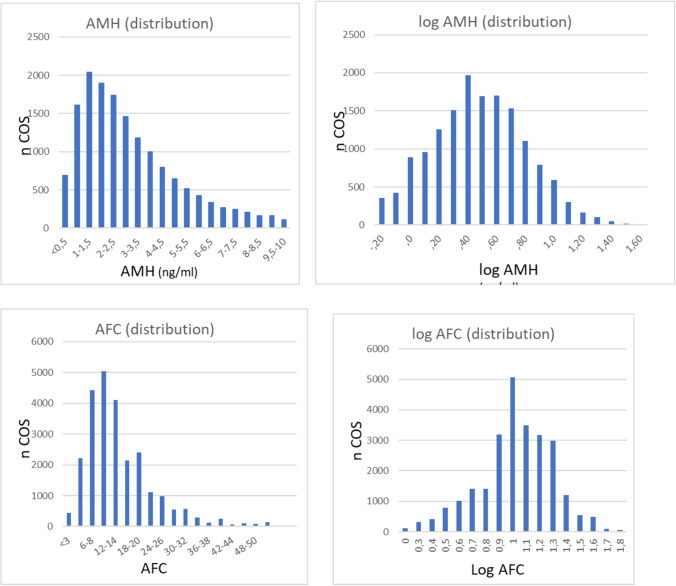
Results: The distribution of AMH and AFC was characterized by a wide dispersion of values, twice more important for AFC, and a logarithmic distribution. The faster decline in AMH than in AFC with age suggests that their correlation changes with age. AMH and AFC showed a very low proportion of concordance in the range of expected poor responders according to Bologna cutoffs. The heterogeneity for AMH and AFC across centers was small, but much larger across patients within each center. Concerning the patients with several successive cycles, the reproducibility for AMH seemed much better than for AFC. Comparing respective performances of AMH and AFC for the prediction of ovarian response depended on the local conditions for measuring these indicators and on the reproducibility of results improved over time.
Conclusion: Distribution of AMH and AFC was characterized by the wide dispersion of values, and a logarithmic distribution. Establishing cutoffs or a direct relationship AMH/AFC without considering age seems hazardous. Correlation between AMH and AFC was very poor in the range of poor responders.
Keywords: AFC; AMH; Bologna criteria; IVF; Ovarian reserve; Poor ovarian responders.
© 2022. The Author(s), under exclusive licence to Springer Science+Business Media, LLC, part of Springer Nature.
Conflict of interest statement
The authors declare no competing interests.
Figures
References
-
- La Marca A, Sunkara SK. Individualization of controlled ovarian stimulation in IVF using ovarian reserve markers: from theory to practice. Hum Reprod Update. 2014;20(1):124–40. - PubMed
-
- Polyzos NP, Drakopoulos P, Parra J, Pellicer A, Santos-Ribeiro S, Tournaye H, Bosch E, Garcia-Velasco J. Cumulative live birth rates according to the number of oocytes retrieved after the first ovarian stimulation for in vitro fertilization/intracytoplasmic sperm injection: a multicentre multinational analysis including ∼15,000 women. Fertil Steril. 2018;110(4):661–670. doi: 10.1016/j.fertnstert.2018.04.039. - DOI - PubMed
-
- Dewailly D, Lujan ME, Carmina E, Cedars MI, Laven J, Norman RJ, Escobar Morreale HF. Definition and significance of polycystic ovarian morphology: a task force report from the Androgen Excess and Polycystic Ovary Syndrome Society. Hum Reprod Update. 2014;20:334–352. doi: 10.1093/humupd/dmt061. - DOI - PubMed
-
- Broer SL, van Disseldorp J, Broeze KA, Dolleman M, Opmeer BC, Bossuyt P, Eijkemans MJ, Mol BW, Broekmans FJ. IMPORT study group Added value of ovarian reserve testing on patient characteristics in the prediction of ovarian response and ongoing pregnancy an individual patient data approach. Hum Reprod Update. 2013;19(1):26–36. doi: 10.1093/humupd/dms041. - DOI - PubMed
Publication types
MeSH terms
Substances
LinkOut - more resources
Full Text Sources
