. 2022 Jun 24;50(11):e65.
doi: 10.1093/nar/gkac159.

CRISPR/Cas13 effectors have differing extents of off-target effects that limit their utility in eukaryotic cells

Affiliations

CRISPR/Cas13 effectors have differing extents of off-target effects that limit their utility in eukaryotic cells

Yuxi Ai et al. Nucleic Acids Res. .

Abstract

CRISPR/Cas13 effectors have garnered increasing attention as easily customizable tools for detecting and depleting RNAs of interest. Near perfect complementarity between a target RNA and the Cas13-associated guide RNA is required for activation of Cas13 ribonuclease activity. Nonetheless, the specificity of Cas13 effectors in eukaryotic cells has been debated as the Cas13 nuclease domains can be exposed on the enzyme surface, providing the potential for promiscuous cleavage of nearby RNAs (so-called collateral damage). Here, using co-transfection assays in Drosophila and human cells, we found that the off-target effects of RxCas13d, a commonly used Cas13 effector, can be as strong as the level of on-target RNA knockdown. The extent of off-target effects is positively correlated with target RNA expression levels, and collateral damage can be observed even after reducing RxCas13d/guide RNA levels. The PspCas13b effector showed improved specificity and, unlike RxCas13d, can be used to deplete a Drosophila circular RNA without affecting the expression of the associated linear RNA. PspCas13b nonetheless still can have off-target effects and we notably found that the extent of off-target effects for Cas13 effectors differs depending on the cell type and target RNA examined. In total, these results highlight the need for caution when designing and interpreting Cas13-based knockdown experiments.


Figures

Figure 1.
Figure 1.
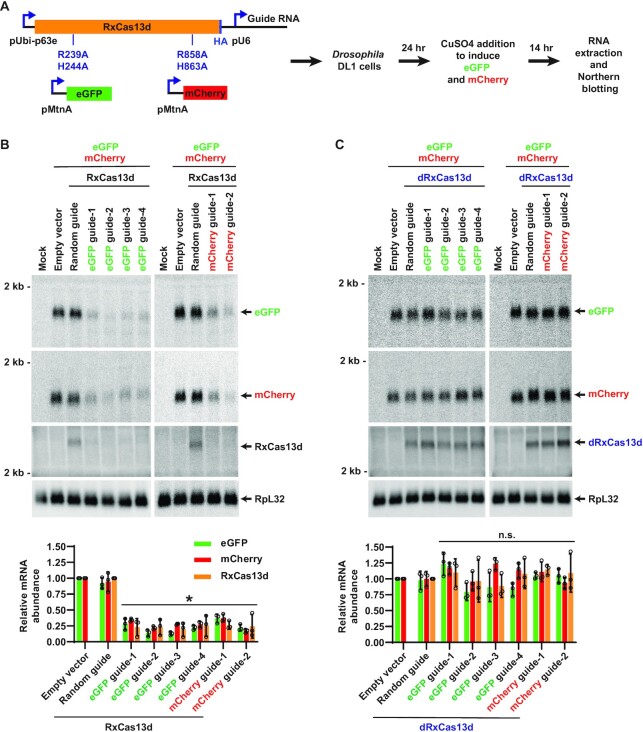
Co-transfection assays revealed that RxCas13d has significant off-target effects in Drosophila cells. (A) Drosophila DL1 cells were co-transfected with (i) 50 ng of plasmid that constitutively expresses a guide RNA from the U6 promoter as well as HA-tagged catalytically active or dead (R239A, H244A, R858A, and H863A mutations) RxCas13d from the Ubi-p63e promoter, (ii) 225 ng of plasmid that expresses eGFP from the copper-inducible MtnA promoter, and (iii) 225 ng of plasmid that expresses mCherry from the MtnA promoter. 24 h after transfection, CuSO4 was added and total RNA was isolated after an additional 14 h. Northern blots were then performed. (B) Plasmids expressing active RxCas13d and a guide RNA complementary to eGFP (left) or mCherry (right) were employed in the co-transfection assay. Representative Northern blots (20 μg of total RNA/lane) are shown. ImageQuant was used to quantify the relative expression levels of eGFP, mCherry, and RxCas13d mRNAs from three independent experiments. eGFP and mCherry mRNA expression was normalized to the empty vector samples, while RxCas13d mRNA expression was normalized to the random guide RNA samples. RpL32 mRNA served as an endogenous loading control. Data are shown as mean ± SD. For statistical comparisons, data were compared to the random guide RNA samples. (∗) P < 0.05. (C) Same as (B) except that plasmids expressing catalytic dead RxCas13d (dRxCas13d) were used. n.s., not significant.
Figure 2.
Figure 2.
Reducing the expression level of RxCas13d does not diminish the off-target effects. (A) Proposed model of Cas13 effector activation. Base pairing between the guide RNA and its target mRNA (green) leads to a conformational change in Cas13 (orange) that activates the endonuclease activity on the surface of the protein. This can result in cis-cleavage/degradation of the target RNA (left) but also trans-cleavage of bystander RNAs (red), resulting in off-target effects (right). This model predicts that increased levels of target mRNA should result in increased off-target effects due to increased numbers of active Cas13 protein in cells. (B) Drosophila DL1 cells were transfected with decreasing amounts of RxCas13d/guide RNA expression plasmid, while the amounts of the eGFP (225 ng) and mCherry (225 ng) plasmids transfected were kept constant. Empty vector (pUb-3xFLAG MCS (No BsmBI) plasmid) was added as needed so that 500 ng DNA was transfected in all samples. 24 h after transfection, CuSO4 was added and total RNA was isolated after an additional 14 h. (C) Northern blots (20 μg of total RNA/lane) were used to quantify the relative expression levels of eGFP and mCherry mRNA. Data are shown as mean ± SD, N = 3. For statistical comparisons, data were compared to the random guide RNA samples. (∗) P < 0.05. n.s., not significant.
Figure 3.
Figure 3.
A positive correlation was observed between target mRNA level and RxCas13d off-target effects. (A) Drosophila DL1 cells were co-transfected with a constant amount of RxCas13d/guide RNA (50 ng) and mCherry (225 ng) expression plasmids, but variable amounts of eGFP expression plasmid (2, 5, 10, 25 or 50 ng). Empty vector (pUb-3xFLAG MCS (No BsmBI) plasmid) was added as needed so that 500 ng DNA was transfected in all samples. 24 h after transfection, CuSO4 was added and total RNA was isolated after an additional 14 h. RNA expression levels were then analyzed by RT-qPCR (B) or northern blotting (C). (B) RT-qPCR was used to quantify the expression of eGFP mRNA in cells transfected with the RxCas13d plasmid expressing a random guide RNA or a guide RNA complementary to eGFP. For each amount of eGFP plasmid transfected, the relative abundance of eGFP mRNA was normalized to the respective random guide RNA samples. Data are shown as mean ± SD, N = 3. (∗) P < 0.05. (C) Northern blots (20 μg of total RNA/lane) were used to quantify the relative expression levels of mCherry and RxCas13d mRNAs. Data are shown as mean ± SD, N = 3. For statistical comparisons, data were compared to the random guide RNA samples. (∗) P < 0.05. n.s., not significant. A complete table of P-values for all comparisons is provided in Supplementary Table S5.
Figure 4.
Figure 4.
Co-transfection assays revealed PspCas13b has better specificity in Drosophila cells. (A) Drosophila DL1 cells were co-transfected with (i) 50 ng of plasmid that constitutively expresses a guide RNA from the U6 promoter as well as HA-tagged catalytically active or dead (H133A and H1058A mutations) PspCas13b from the Ubi-p63e promoter, (ii) 225 ng of plasmid that expresses eGFP from the copper-inducible MtnA promoter, and (iii) 225 ng of plasmid that expresses mCherry from the MtnA promoter. 24 h after transfection, CuSO4 was added and total RNA was isolated after an additional 14 h. Northern blots were then performed. (B) Plasmids expressing active PspCas13b and a guide RNA complementary to eGFP (left) or mCherry (right) were employed in the co-transfection assay. Representative Northern blots (20 μg of total RNA/lane) are shown. ImageQuant was used to quantify the relative expression levels of eGFP, mCherry and PspCas13b mRNAs from three independent experiments. eGFP and mCherry mRNA expression was normalized to the empty vector samples, while PspCas13b mRNA expression was normalized to the random guide RNA samples. RpL32 mRNA served as an endogenous loading control. Data are shown as mean ± SD. For statistical comparisons, data were compared to the random guide RNA samples. (∗) P < 0.05. No significant changes in expression of the mRNAs encoding PspCas13b or the off-target fluorescent protein were found. (C) Same as (B) except that plasmids expressing catalytic dead PspCas13b (dPspCas13b) were used. n.s., not significant.
Figure 5.
Figure 5.
PspCas13b, but not RxCas13d, can be used to specifically deplete a circular RNA in Drosophila cells. (A) A three-exon Laccase2 minigene driven by the copper-inducible MtnA promoter can be alternatively spliced to yield a linear mRNA or a circular RNA derived from exon 2. To test the ability of Cas13 effectors to catalyze isoform-specific depletion, guide RNAs were designed that should deplete only the linear RNA (Exon 3 guide), only the circular RNA (BSJ guide), or both the linear and circular RNAs (Exon 2 guide). Drosophila DL1 cells were co-transfected with (i) 50 ng of plasmid that constitutively expresses a guide RNA as well as RxCas13d or PspCas13b effector and (ii) 450 ng of the Laccase2 Exon 1–3 minigene expression plasmid. 24 h after transfection, CuSO4 was added and total RNA was isolated after an additional 14 h. (B) Representative Northern blots (20 μg of total RNA/lane) using an oligonucleotide probe complementary to exon 2 of the Laccase2 minigene. (C) ImageQuant was used to quantify the expression levels of linear and circular RNA normalized to the empty vector samples. RpL32 mRNA served as an endogenous loading control. Data are shown as mean ± SD, N = 3. For statistical comparisons, data were compared to the random guide RNA samples. (∗) P < 0.05.
Figure 6.
Figure 6.
Quantification of on- and off-target effects of RxCas13d and PspCas13b in human HeLa cells. (A) HeLa cells were co-transfected with (i) 300 ng of plasmid that constitutively expresses HA-tagged Cas13 protein followed by a 2A peptide and eGFP, (ii) 200 ng of plasmid that expresses a guide RNA, (iii) 250 ng of plasmid that expresses nanoLuciferase (nLuc) and (iv) 250 ng of plasmid that expresses firefly luciferase (FFLuc). 48 h after transfection, total RNA was isolated and Northern blots performed. (B, C) Guide RNAs complementary to FFLuc were employed in the co-transfection assay. (B) Representative Northern blots (20 μg of total RNA/lane) are shown. ImageQuant was used to quantify the relative expression levels of FFLuc, nLuc, and Cas13-2A-eGFP mRNAs. nLuc and FFLuc mRNA expression was normalized to the empty vector (pBEVY-L) samples, while Cas13-2A-eGFP mRNA expression was normalized to the random guide RNA samples. GAPDH mRNA served as an endogenous loading control. Data are shown as mean ± SD, N = 3. For statistical comparisons, data were compared to the random guide RNA samples. (∗) P < 0.05. (C) Relative RNA concentrations obtained from the co-transfection assays when the RxCas13d or PspCas13b expression plasmids were used. Data are normalized to the empty vector samples and shown as mean ± SD, N = 5. (∗) P < 0.05. (D, E) HeLa cells were co-transfected with constant amounts of RxCas13d, guide RNA, and nLuc expression plasmids, but variable amounts of FFLuc expression plasmid (20, 50 or 150 ng). (D) RT-qPCR was used to quantify depletion of FFLuc mRNA. For each amount of FFLuc plasmid transfected, the relative abundance of FFLuc mRNA was normalized to the respective random guide RNA samples. Data are shown as mean ± SD, N = 3. (∗) P < 0.05. (E) Northern blots (20 μg of total RNA/lane) were used to quantify the relative expression levels of nLuc and RxCas13d-2A-eGFP mRNAs. Data are shown as mean ± SD, N = 3. For statistical comparisons, data were compared to the random guide RNA samples. (∗) P < 0.05. A complete table of P-values for all comparisons in (D) and (E) is provided in Supplementary Table S5.
Figure 7.
Figure 7.
The extent of RxCas13d off-target effects varies across human cell lines. (A) HeLa or HEK293T cells were co-transfected with (i) 300 ng of plasmid that constitutively expresses HA-tagged RxCas13d protein followed by a 2A peptide and eGFP, (ii) 200 ng of plasmid that expresses a guide RNA, (iii) 250 ng of plasmid that expresses Renilla luciferase (RLuc) and (iv) 250 ng of plasmid that expresses nanoLuciferase (nLuc). 48 h after transfection, total RNA was isolated and Northern blots performed. (B–E) Guide RNAs complementary to nLuc or RLuc were employed in the co-transfection assay in HeLa cells (BC) or HEK293T cells (D, E). (B, D) Representative Northern blots (20 μg of total RNA/lane) are shown. ImageQuant was used to quantify the relative expression level of nLuc, RLuc, and Cas13-2A-eGFP mRNAs. nLuc and RLuc mRNA expression was normalized to the empty vector (pBEVY-L) samples, while Cas13-2A-eGFP mRNA expression was normalized to the random guide RNA samples. GAPDH mRNA served as an endogenous loading control. Data are shown as mean ± SD, N = 3. For statistical comparisons, data were compared to the random guide RNA samples. (∗) P < 0.05. (C, E) Relative RNA concentrations obtained from the co-transfection assays. Data are normalized to the empty vector samples and shown as mean ± SD, N = 3. (∗) P < 0.05. n.s., not significant.

References

    1. Barrangou R., Fremaux C., Deveau H., Richards M., Boyaval P., Moineau S., Romero D.A., Horvath P.. CRISPR provides acquired resistance against viruses in prokaryotes. Science. 2007; 315:1709–1712. - PubMed
    1. Brouns S.J., Jore M.M., Lundgren M., Westra E.R., Slijkhuis R.J., Snijders A.P., Dickman M.J., Makarova K.S., Koonin E.V., van der Oost J.. Small CRISPR RNAs guide antiviral defense in prokaryotes. Science. 2008; 321:960–964. - PMC - PubMed
    1. Jinek M., Chylinski K., Fonfara I., Hauer M., Doudna J.A., Charpentier E.. A programmable dual-RNA-guided DNA endonuclease in adaptive bacterial immunity. Science. 2012; 337:816–821. - PMC - PubMed
    1. Cong L., Ran F.A., Cox D., Lin S., Barretto R., Habib N., Hsu P.D., Wu X., Jiang W., Marraffini L.A.et al. .. Multiplex genome engineering using CRISPR/Cas systems. Science. 2013; 339:819–823. - PMC - PubMed
    1. Mali P., Yang L., Esvelt K.M., Aach J., Guell M., DiCarlo J.E., Norville J.E., Church G.M.. RNA-guided human genome engineering via cas9. Science. 2013; 339:823–826. - PMC - PubMed

Publication types

LinkOut - more resources