. 2022 Mar 4;12(1):3802.
doi: 10.1038/s41598-022-07023-8.

Scientific mobilization of keystone actors for biosphere stewardship

Affiliations

Scientific mobilization of keystone actors for biosphere stewardship

Henrik Österblom et al. Sci Rep. .

Abstract

The biosphere crisis requires changes to existing business practices. We ask how corporations can become sustainability leaders, when constrained by multiple barriers to collaboration for biosphere stewardship. We describe how scientists motivated, inspired and engaged with ten of the world's largest seafood companies, in a collaborative process aimed to enable science-based and systemic transformations (2015-2021). CEOs faced multiple industry crises in 2015 that incentivized novel approaches. New scientific insights, an invitation to collaborate, and a bold vision of transformative change towards ocean stewardship, created new opportunities and direction. Co-creation of solutions resulted in new knowledge and trust, a joint agenda for action, new capacities, international recognition, formalization of an organization, increased policy influence, time-bound goals, and convergence of corporate change. Independently funded scientists helped remove barriers to cooperation, provided means for reflection, and guided corporate strategies and actions toward ocean stewardship. By 2021, multiple individuals exercised leadership and the initiative had transitioned from preliminary and uncomfortable conversations, to a dynamic, operational organization, with capacity to perform global leadership in the seafood industry. Mobilizing transformational agency through learning, collaboration, and innovation represents a cultural evolution with potential to redirect and accelerate corporate action, to the benefit of business, people and the planet.


Conflict of interest statement

H.Ö., C.F., J.B., R.B., J.-B.J., E.R.S., C.C.C.W., F.B., B.C., R.G., P.J.G.H., K.A.J., A.M., S.N., G.O.C., J.R., L.S., M.S., J.S., M.T., P.V.G. and J.L. provide (or have provided) unpaid scientific support to companies in the seafood sector through the Seafood Business for Ocean Stewardship (SeaBOS) initiative (https://seabos.org/). H.Ö. is chairman and C.F. is board member of the SeaBOS Fundraising Foundation (part of the governance of SeaBOS). This engagement is also voluntary and is, along with our scientific support to SeaBOS companies, funded by the organisations listed above (Funding). The authors declare no other competing interests.

Figures

Figure 1
Figure 1
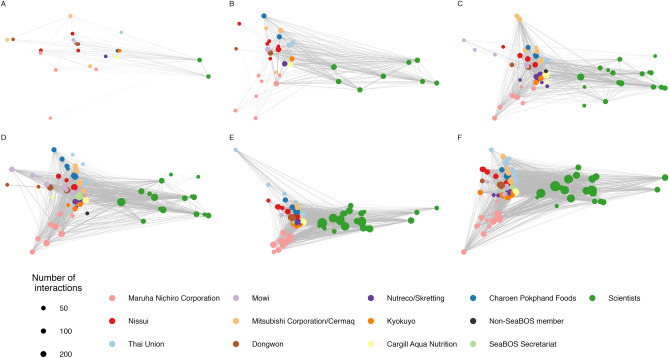
Evolution of connectivity between scientists and SeaBOS companies. (A) Initial regional connectivity, took place during Phase I, when scientists engaged multiple industry actors in individual or regional dialogues in either Japan, Norway or South Korea. (B) Phase II included two keystone dialogues, and resulted in the establishment of a global science-business network. (C) The formation of task forces during Phase III involved strengthened and diversified interactions between multiple scientists and company representatives. (D) Phase IV included a new coordinating function (a formal SeaBOS secretariat), and a set of time bound goals were defined during Phase V (E). SeaBOS produced tangible results and can be described as having become fully functional during Phase VI (F). Each node represents one individual and the size of the node corresponds to the sum of all interactions for each time period. The color of the node corresponds to the type of actor engaged in the networks.
Figure 2
Figure 2
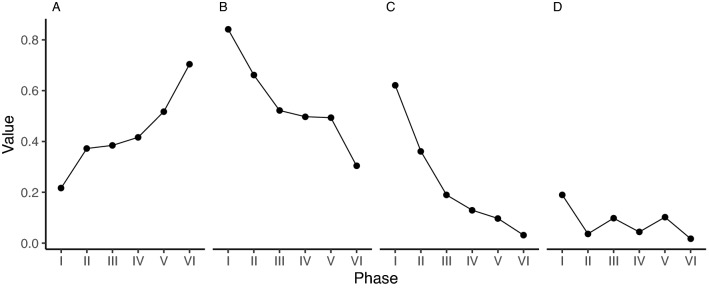
Properties of the network during the six phases of emergence. Density (A) shows the proportion of connections realized over the maximum number of connections possible. Local and global centrality metrics of all science-business interactions were calculated as normalized mean degree (B) and betweenness (C) centrality, respectively. The Bonacich power centralization (see “Methods”) measures how power is distributed across the network (D).
Figure 3
Figure 3
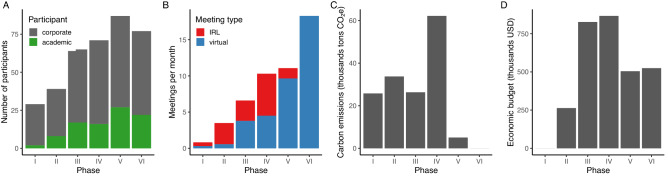
Science-business engagement, meeting frequency and costs. (A) The number of participants from companies and from science. (B) The frequency of virtual and in person (IRL) meetings. (C) The science-team travel-related carbon emissions (CO2e). (D) Dedicated science budget (USD).
Figure 4
Figure 4
Evolutionary components of science-business cooperation. Colour coding of different components and actors engaged in collaboration, representing a qualitative assessment of the evolution of cooperation from an early and unstable phase, to operational, stabilised and functional cooperation. Colours refer to: insufficient, short term and vulnerable (orange); positive developments and long-term commitments, but not stable (blue); Adequate and resilient (green). MD managing director.

References

    1. Dietz T, Ostrom E, Stern PC. The struggle to govern the commons. Science. 2003;302:1907–1912. doi: 10.1126/science.1091015. - DOI - PubMed
    1. Bodin Ö. Collaborative environmental governance: Achieving collective action in social-ecological systems. Science. 2017;357:eaan114. doi: 10.1126/science.aan1114. - DOI - PubMed
    1. Biermann, F. & Kim, R. Architectures of Earth System Governance: Institutional Complexity and Structural Transformation. (Cambridge University Press, 2020).
    1. Young OR. Research strategies to assess the effectiveness of international environmental regimes. Nature Sustain. 2018;1:461–465. doi: 10.1038/s41893-018-0132-y. - DOI
    1. Chrun E, Dolšak N, Prakash A. Corporate environmentalism: Motivations and mechanisms. Annu. Rev. Environ. Resour. 2016;41:341–362. doi: 10.1146/annurev-environ-110615-090105. - DOI

Publication types