. 2022 Mar 4;12(1):3602.
doi: 10.1038/s41598-022-07696-1.

Clinical evaluation of ocular biometry of dual Scheimpflug analyzer, GALILEI G6 and swept source optical coherence tomography, ANTERION

Affiliations

Clinical evaluation of ocular biometry of dual Scheimpflug analyzer, GALILEI G6 and swept source optical coherence tomography, ANTERION

Boonsong Wanichwecharungruang et al. Sci Rep. .

Abstract

To evaluate the performance of a new swept source optical coherence tomography optical biometer, ANTERION, in ocular biometry and intraocular lens (IOL) calculation compared with the reference standard of Dual Scheimpflug Analyzer (GALILEI, G6). A prospective comparative study was conducted in a tertiary eye center. Cataract patients were scanned with both devices in a random fashion, and parameters from the devices were analyzed in terms of mean difference and intraclass correlation coefficient (ICC). Bland-Altman plots were performed to compare agreement between the devices. Ninety-six eyes from 96 patients were enrolled for evaluation. With the exception of ACD, all parameters were significantly different, but excellent agreement was revealed for all of them. The mean difference in axial length was 0.03 mm, and ICC was 0.999. Calculated IOL power with Barrett formula revealed that 93.75% were within 1 diopter and the prediction error was 0.03 diopter. Biometry of the devices were arithmetically different. However, the mean difference of the key factors in IOL calculation were small and appeared to be negligible for the purposes of clinical application. The performance of ANTERION was comparable to that of G6 in biometric measurement and IOL calculation; however, the devices cannot be used interchangeably.


Conflict of interest statement

The authors declare no competing interests.

Figures
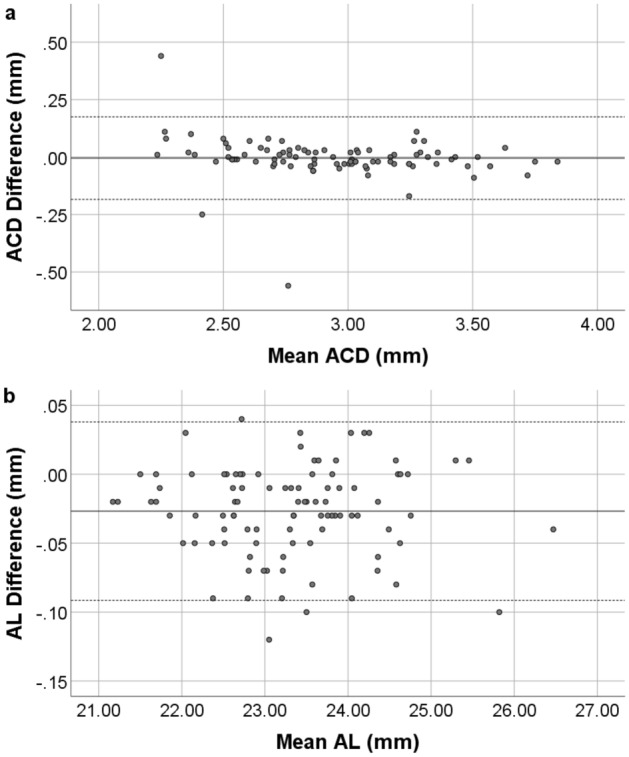
Figure 1
Figure 1
Bland–Altman plot of the ACD (a) and AL (b) from GALILEI G6 and ANTERION. The solid line represents the mean difference, whereas the dotted lines on each side show the upper and lower 95% LoA. The ACD and AL plot demonstrate that only three and four eyes respectively of the total of 96 eyes were out of the 95% LoAs, indicating excellent agreement in ACD and AL between the two devices. Created by SPSS (Version 22, SPSS Inc., IBM, Chicago, USA).
Figure 2
Figure 2
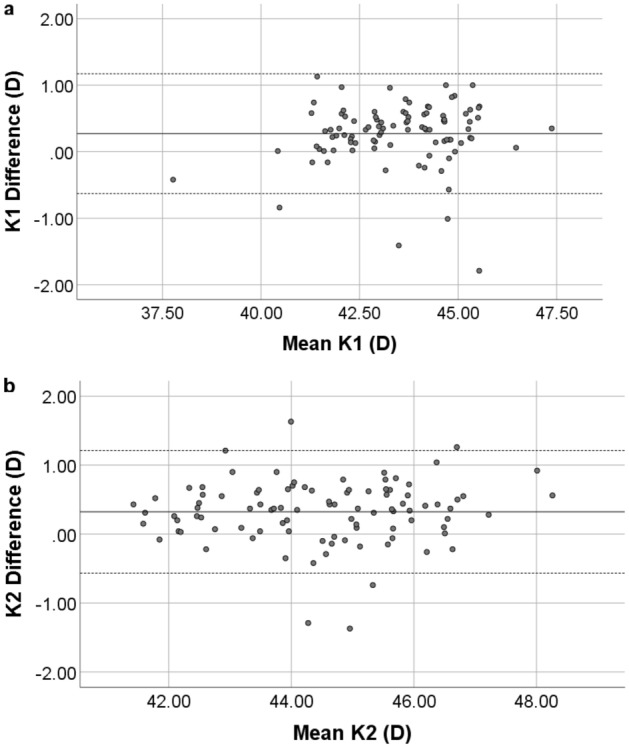
Bland–Altman plot of K1 (a) and K2 (b) from GALILEI G6 and ANTERION. The solid line represents the mean difference, while the dotted lines on each side show the upper and lower 95% LoA. The K1 and K2 plot demonstrate that only four and five eyes respectively of the total 96 eyes were out of the 95% LoAs, indicating excellent K1 and K2 measurement agreement between the two devices. Created by SPSS (Version 22, SPSS Inc., IBM, Chicago, USA).
Figure 3
Figure 3
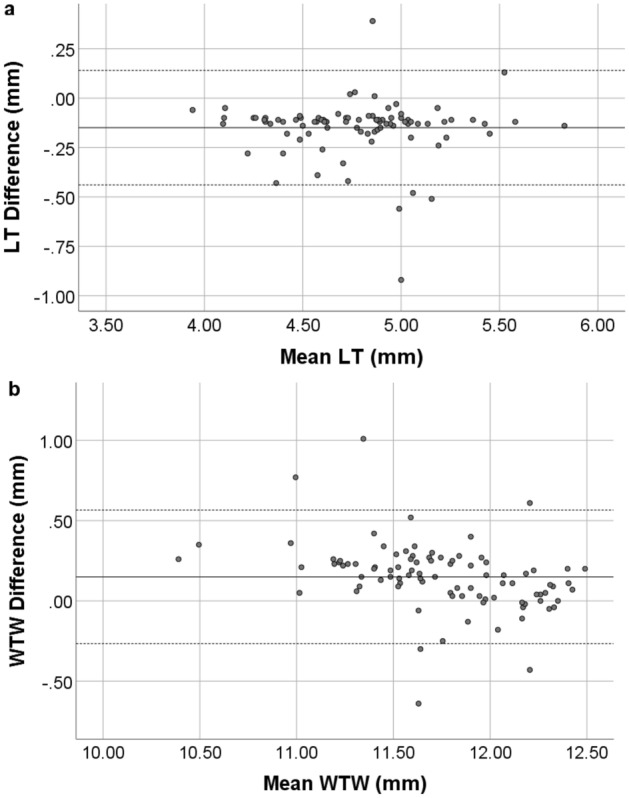
Bland–Altman plot of the LT (a) and WTW (b) from GALILEI G6 and Anterion. The solid line represents the mean difference, whereas the dotted lines on each side show the upper and lower 95% LoA. Both LT and WTW plot demonstrate that only six eyes from the total of 96 were out of the 95% LoAs, indicating excellent concordance in LT and WTW calculation between the two devices. Created by SPSS (Version 22, SPSS Inc., IBM, Chicago, USA).
Figure 4
Figure 4
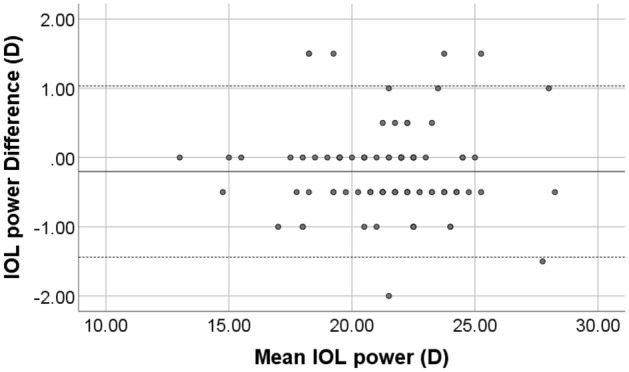
Bland–Altman plot of the IOL power using parameters from GALILEI G6 and ANTERION. The solid line represents the mean difference, whereas the dots on each side show the upper and lower 95% LoA. The plot demonstrates that six eyes at IOL power difference of ± 1.5 D (5 eyes) and 2 D (1 eye) from the total of 96 eyes were out of the 95% LoAs, indicating excellent agreement between the two devices’ measurement of IOL power. Created by SPSS (Version 22, SPSS Inc., IBM, Chicago, USA).
Figure 5
Figure 5
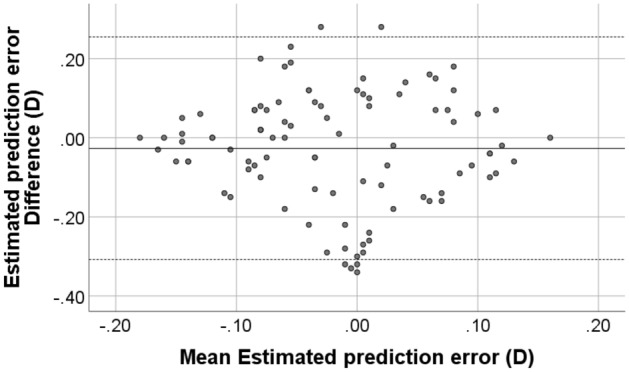
Bland–Altman plot of the prediction error using parameters from GALILEI G6 and ANTERION. The solid line represents the mean difference, while the dotted lines on each side show the upper and lower 95% LoA. The plot reveals that six eyes were out of the 95% LoAs. Created by SPSS (Version 22, SPSS Inc., IBM, Chicago, USA).

References

    1. Hoffer KJ, Shammas HJ, Savini G, Huang J. Multicenter study of optical low-coherence interferometry and partial-coherence interferometry optical biometers with patients from the United States and China. J. Cataract. Refract. Surg. 2016;42:62–67. doi: 10.1016/j.jcrs.2015.07.041. - DOI - PubMed
    1. Jung S, Chin HS, Kim NR, Lee KW, Jung JW. Comparison of repeatability and agreement between swept-source optical biometry and dual-scheimpflug topography. J. Ophthalmol. 2017;2017:1516395. - PMC - PubMed
    1. Grulkowski I, Liu JJ, Zhang JY, et al. Reproducibility of a long-range swept-source optical coherence tomography ocular biometry system and comparison with clinical biometers. Ophthalmology. 2013;120:2184–2190. doi: 10.1016/j.ophtha.2013.04.007. - DOI - PMC - PubMed
    1. Srivannaboon S, Chirapapaisan C, Chonpimai P, Loket S. Clinical comparison of a new swept-source optical coherence tomography-based optical biometer and a time-domain optical coherence tomography-based optical biometer. J. Cataract. Refract. Surg. 2015;41:2224–2232. doi: 10.1016/j.jcrs.2015.03.019. - DOI - PubMed
    1. Demir S, Sonmez B, Yeter V, Ortak H. Comparison of normal and keratoconic corneas by GALILEI Dual-Scheimpflug Analyzer. Cont. Lens Anterior Eye. 2013;36:219–225. doi: 10.1016/j.clae.2013.04.001. - DOI - PubMed

Publication types