


Obstructive Sleep Apnea and Hypertension: Updates to a Critical Relationship
- PMID: 35246797
- PMCID: PMC8897114
- DOI: 10.1007/s11906-022-01181-w
Obstructive Sleep Apnea and Hypertension: Updates to a Critical Relationship
Abstract
Purpose of review: Obstructive sleep apnea (OSA) is an underdiagnosed illness linked to essential hypertension (HTN), resistant hypertension (r-HTN), and cardiovascular disease (CVD). This review provides updates on the epidemiology, pathophysiology, and treatments of OSA-associated HTN.
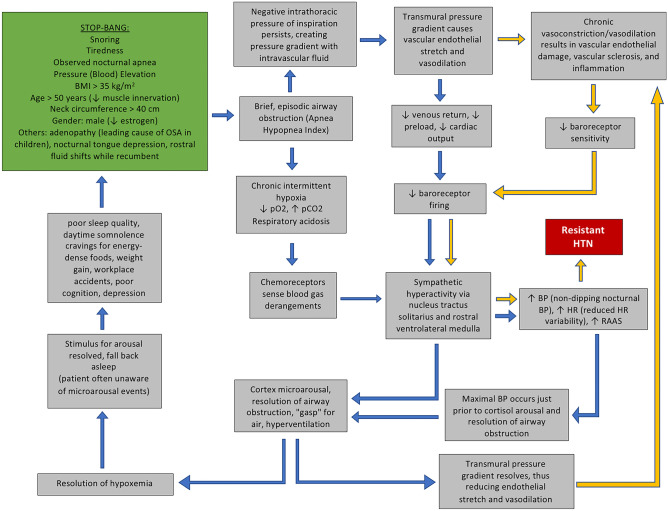
Recent findings: Mild sleep apnea increases the risk for HTN. Eighty-nine percent of young patients aged 18-35 with HTN not attributed to secondary causes have underlying OSA. Home sleep studies are noninferior to formal polysomnography for OSA diagnosis. Nocturnal oxygen desaturation rate is positively correlated with HTN severity. Gut microbiome neo-colonization in response to high-fat diet cravings in patients with OSA alters immune function and worsens HTN. Carbonic anhydrase inhibitors and probiotics show newfound potential for OSA-associated HTN treatment. OSA recognition improves hospital outcomes after a STEMI. Hypoxia-inducible factor (HIF) transcription increases in a dose-dependent manner to hypoxia, and HIFs are strongly linked to cancer growth. OSA and HTN are comorbid conditions with adversely connected pathophysiology including sympathetic hyperactivity, gut dysbiosis, proinflammation, endothelial damage, rostral fluid shifts, pharyngeal collapse, intravascular fluid retention, nocturnal energy expenditure, and metabolic derangements. The dose-response effect of OSA on HTN severity challenges blood pressure (BP) control, so those with refractory HTN should be screened for OSA.
Keywords: Apnea–hypopnea index (AHI); Gut dysbiosis; Hypertension; Obstructive sleep apnea (OSA); Resistant hypertension; Sleep-disordered breathing (SDB).
© 2022. The Author(s), under exclusive licence to Springer Science+Business Media, LLC, part of Springer Nature.
Conflict of interest statement
The authors declare no competing interests.
Figures
References
Publication types
MeSH terms
LinkOut - more resources
Full Text Sources
Medical
Research Materials
